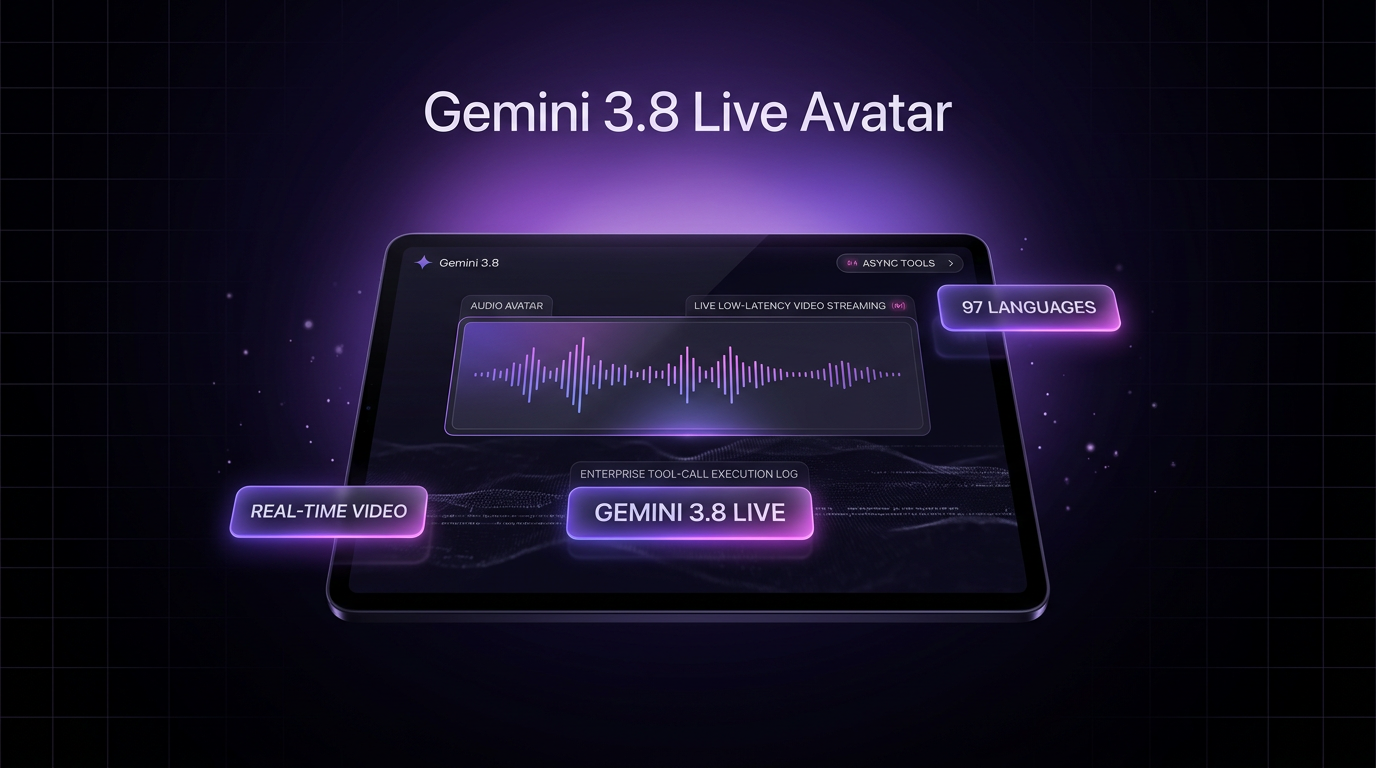
Google has announced Gemini 3.8 Live with Live Avatar, bringing real-time visual presence directly into its native conversational AI models. This release introduces the Gemini 3.8 Live Avatar capability to pair low-latency streaming video generation with live spoken dialogue, allowing enterprise systems to deploy interactive visual personas that listen, see, and respond. The update is available immediately inside Gemini Enterprise, building directly on the foundation established by Gemini 3.8 Live the previous week.
For teams building interactive digital systems, conversational interfaces have long relied on audio or text alone. While voice assistants handle routine operations, visual cues such as facial expressions and directional eye contact alter how users engage with software. The company states that the Gemini 3.8 Live Avatar release natively couples live dialogue models with video generation, targeting virtual customer assistance, interactive product walkthroughs, and enterprise concierge tasks.
Key Capabilities Introduced in Gemini 3.8 Live Avatar
The core of this release centers on multimodal interaction that operates in near real time. Rather than generating static clips or rendering pre-recorded video frames in sequence, the system processes visual and audio inputs concurrently. This architecture lets the agent observe camera feeds or shared screens while producing expressive audio and synchronized video responses simultaneously. Fluid turn-taking and natural facial expressions allow the persona to react promptly to user speech without awkward pauses.
Key technical components highlighted in the announcement include:
- Native Multilingual Synchronization: The platform supports speech-to-speech synchronization across 97 languages. The company states that the model dynamically adapts lip movements and facial expressions during live translation without visual drift or reduced video fidelity.
- Asynchronous Tool Execution: While interacting with users, the agent can call external application programming interfaces and fetch background records without pausing the conversation. This allows uninterrupted spoken dialogue while complex data queries execute.
- Preset and Custom Personas: Gemini Enterprise users receive access to a built-in library of diverse avatar personas with distinct looks and vocal qualities. Organizations can also generate custom animated personas from a single high-quality reference image through an enterprise allowlisting process.
- SynthID Provenance Watermarking: Every second of synthetic video and audio produced by the engine carries an imperceptible SynthID digital watermark, allowing downstream detection of computer-generated media.
These capabilities reflect an expansion from basic text prompts into persistent, multimodal software representatives. As teams evaluate how to deploy agentic AI systems in production environments, latency and stability during complex tasks remain central operational factors.
How Asynchronous Tool Calling Changes the Conversational Flow
A persistent challenge with conversational video agents has been operational latency. Traditional conversational agents often freeze visually while waiting for database queries, external webhooks, or API payloads to return. When an avatar pauses mid-sentence to execute a backend lookup, the interaction quickly feels broken.
The company states that the Gemini 3.8 Live Avatar architecture addresses this with asynchronous background execution. During a live interaction, such as checking a guest into a hotel or looking up an order status, the model initiates the relevant tool call behind the scenes. While waiting for the payload, the avatar continues talking naturally, acknowledging the request or explaining next steps without dead air or frozen video frames.
This continuous presence changes how business workflows can be automated. In practical terms, an enterprise using AI automation to connect customer support interfaces to scheduling engines or customer databases can now maintain visual continuity. The conversational engine does not need to pause its visual stream simply because an external server requires two seconds to verify a booking code or retrieve an account profile. The ability to reason through multi-step tasks while sustaining vocal and visual dialogue creates a more cohesive experience for end users.
Multilingual Support and Enterprise Customization
Global operations frequently struggle to deploy video avatars because regional localization requires re-recording voice actors or dealing with mismatched dubbing. The announcement states that the Gemini 3.8 Live Avatar system transitions between 97 languages during an active dialogue session. When a speaker switches from English to Spanish or Japanese, the underlying model recalculates phoneme matching on the fly, adjusting lip geometry and facial movement to match the new language output without visual distortion.
Brand presentation also receives focused attention. While off-the-shelf virtual agents can appear generic, Google has introduced custom avatar styling based on single reference photographs. A business can establish a visual character that reflects its brand guidelines, provided they participate in the enterprise allowlist program. According to the announcement on the Google blog, this custom generation preserves character identity and visual style while operating under the same low-latency execution pipeline.
Safety Controls and SynthID Watermarking
Deploying interactive synthetic personas at enterprise scale raises valid security and authenticity questions. Misuse of synthetic likenesses and unverified video generation can create severe trust issues for businesses interacting with the public. To support identity protection, custom avatar generation remains restricted behind enterprise allowlists, preventing unauthorized replication of public figures or unauthorized third parties.
To counter misattribution and misinformation, Google integrates its SynthID watermarking technology across both the audio and video output streams of the Gemini 3.8 Live Avatar service. The watermark is woven directly into the media frames and audio track without altering user perception. Because the watermark persists through compression and format conversion, security scanners and verification tools can identify the output as artificial intelligence generation, mitigating misattribution risks. The model card published alongside the release outlines the responsible deployment guidelines governing these safeguards.
What This Changes for Client Builds
When Wasif designs conversational workflows and automation pipelines for clients, the primary barrier to adopting video interfaces has been operational complexity and interface latency. Most third-party avatar generators require seconds of rendering time, making true two-way conversation impossible outside of scripted scenarios.
The arrival of native visual streaming in enterprise platforms means businesses can begin considering video-enabled agents for high-touch customer workflows. When combined with structured backend automations, an agent can check calendars, verify customer data, and present a professional visual persona without expensive custom video software. Wasif evaluates these emerging toolsets based on latency, operational cost, and reliability in real customer-facing environments.
As the Gemini 3.8 Live Avatar platform rolls out across enterprise accounts, organizations will likely test these visual agents in controlled scenarios like structured check-ins, product onboarding, and interactive technical documentation before deploying them broadly across unrestricted public channels. Testing tools in bounded environments allows engineering teams to measure latency thresholds and error rates before exposing interfaces to high-volume traffic.
Frequently Asked Questions About Gemini 3.8 Live Avatar
How do enterprises access this technology?
Access to Gemini 3.8 Live Avatar is provided directly through Gemini Enterprise. Developers can review the official API documentation to begin testing conversational flows and preset visual personas within their existing infrastructure.
Can organizations create their own custom visual personas?
Yes. Organizations can generate custom animated personas from a single high-quality reference image while maintaining brand likeness. However, Google currently restricts custom avatar creation to organizations approved through an enterprise allowlisting process.
How does the model prevent conversational delays during database lookups?
The system relies on asynchronous tool calling backed by Gemini reasoning capabilities. While a backend API query or database search executes in the background, the avatar maintains active spoken dialogue and visual presence, eliminating freezes and unnatural conversational delays.
For organizations planning production rollouts, Gemini 3.8 Live Avatar provides a path toward visual interfaces that remain anchored in reliable software engineering. If you are exploring how to integrate conversational agents or structured automation pipelines into your enterprise operations, reach out to discuss your project requirements.