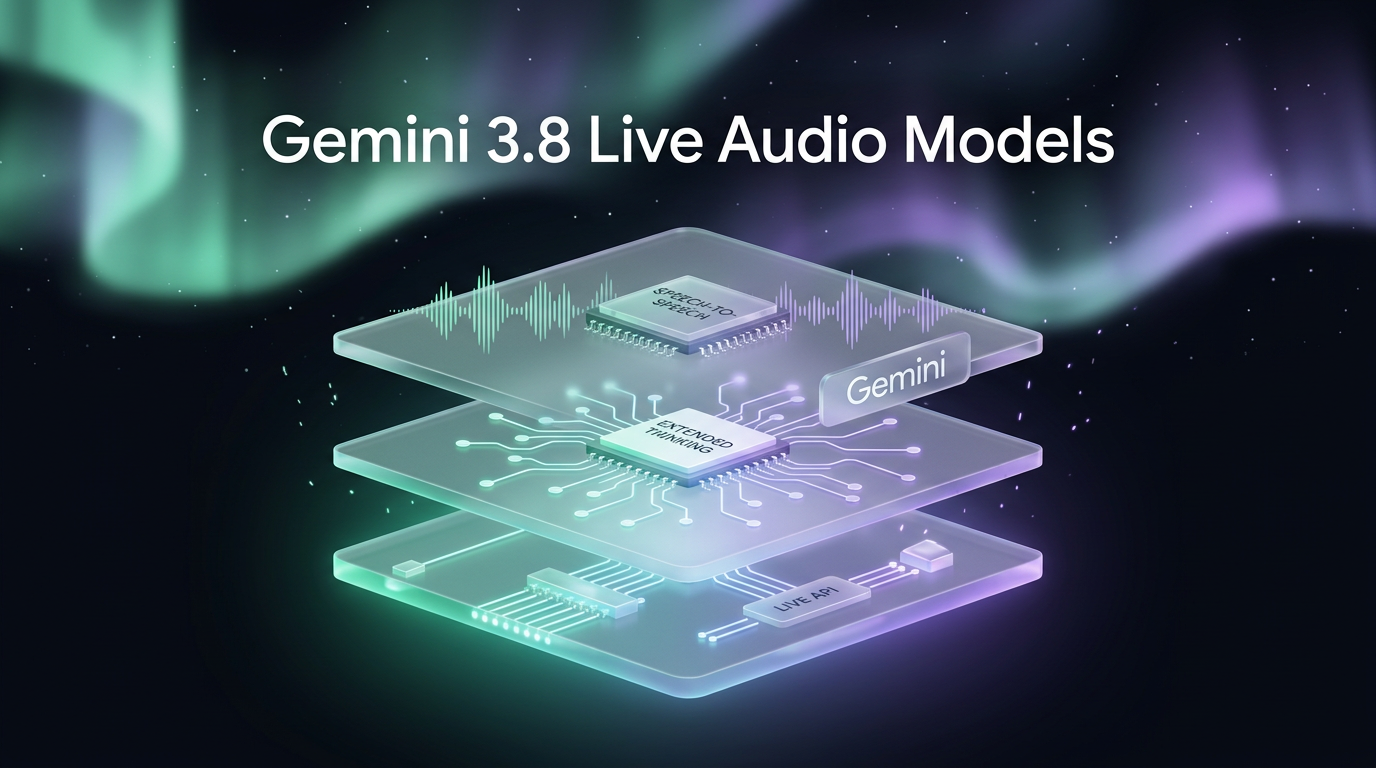
Gemini 3.8 Live is now available to developers building real-time audio systems through Google AI Studio and the Gemini API. In an update shared by Google DeepMind product manager Alisa Fortin and developer experience engineer Thor Schaeff, Google released two speech-to-speech models alongside a dedicated speech-to-text model called Gemini 3.5 Transcribe. According to the Google DeepMind announcement, the release focuses on conversational continuity, background tool execution, and direct audio-to-audio understanding.
For teams building interactive voice experiences, the release targets the primary friction points of conversational software: latency spikes, interruptions during external API calls, and misheard alphanumeric data. Developers can test the models immediately in Google AI Studio or implement them via the Live API using media streaming frameworks.
Key Features in Gemini 3.8 Live and Extended Thinking
The standard Gemini 3.8 Live model operates as a native speech-to-speech architecture. Rather than converting incoming voice to text, sending text to a language model, and converting generated text back to audio, the system processes voice tokens directly. Google states this design avoids the unnatural delays common in cascaded setups while keeping conversational flow intact when the agent takes action.
For projects requiring complex step-by-step logic, Gemini 3.8 Live Extended Thinking adds configurable reasoning. The system carries out background calculations or multi-step logic while speaking to the user or narrating its progress. Google reports that Gemini 3.8 Live Extended Thinking ranks first on the Artificial Analysis Speech-to-Speech leaderboard for conversational reasoning quality.
Both variants introduce technical capabilities designed for production deployment:
- Asynchronous function calling: The model initiates API requests and external tool actions in the background without pausing its spoken audio stream.
- Alphanumeric accuracy: The speech engine parses serial numbers, confirmation codes, dates, and technical identifiers without character dropping.
- Visual context grounding: Developers can stream live video frames or camera inputs alongside audio to let the model describe or answer questions about what the user sees.
- Multilingual consistency: The architecture covers more than 97 languages with steady accent retention across long conversational turns.
- Incremental content streaming: Real-time audio merges with incoming structured data payloads to deliver contextual responses without restarting the dialogue session.
Gemini 3.5 Transcribe and Audio Processing
Alongside the live models, Google detailed Gemini 3.5 Transcribe, which launched into general availability following its initial rollout. The model serves as a dedicated speech-to-text engine across 85 languages. In benchmark testing shared by the DeepMind team, Gemini 3.5 Transcribe recorded an average Word Error Rate (WER) of 4.0 percent in real-time streaming mode and 2.6 percent in non-streaming mode.
Gemini 3.5 Transcribe handles multi-language conversations through automatic code-switching. The model identifies when a speaker alternates languages within a single sentence and maintains accurate output without requiring manual configuration. To handle niche terminology, developers can pass a custom vocabulary list containing up to 1,000 domain-specific terms, proper nouns, and company names.
The transcription engine also includes a smart transcription mode. This setting filters verbal filler, repairs mid-sentence self-corrections, and returns formatted sentences suitable for immediate display in application user interfaces. Beyond live streaming, developers can submit audio files up to one hour long via the Interactions API to receive transcripts containing speaker identification labels and structured timestamps.
Pricing and Infrastructure for Gemini 3.8 Live
Google structured the pricing for Gemini 3.8 Live and Gemini 3.8 Live Extended Thinking around per-minute usage rather than strict text token blocks. Audio input costs $0.005 per minute, while audio output costs $0.018 per minute. This transparent cost model allows engineering teams to budget voice interfaces based on session length rather than unpredictable token inflation during rapid conversational back-and-forth.
Handling audio websockets and media streaming requires robust WebRTC infrastructure. To address this, Google confirmed direct Live API integrations with several media transport and developer platforms. Supported platforms include LiveKit, Pipecat, Agora, Fishjam, LangChain, Vercel, and Vision Agents. These integrations provide pre-built connection wrappers that manage buffer latency, microphone permissions, and packet handling.
The broader Gemini developer audio suite also includes Gemini 3.5 Live Translate for real-time speech translation across 70 languages, Gemini 3.1 Flash TTS for configurable text-to-speech generation, and Lyria 3.5 for generative background audio.
What Gemini 3.8 Live Changes for Client Builds
In client projects, voice interfaces historically presented severe architectural tradeoffs. Building a custom phone or web agent often meant stitching together an automatic speech recognition service, an external orchestration script, an LLM prompt layer, and a third-party voice synthesizer. If a user asked a database question, the pipeline stalled for several seconds while the tool executed. Gemini 3.8 Live removes much of that latency debt by running asynchronous tool calls directly through the model session.
Wasif monitors these developments to refine how voice endpoints connect with broader AI automation workflows and structured business logic. When connecting real-time callers to backend services like Go High Level or internal databases, native speech processing minimizes drop-offs caused by awkward robotic pauses. Combined with multi-agent orchestration via agentic AI systems, these audio models make phone intake and dynamic booking systems significantly more practical for small and medium businesses.
The release of Gemini 3.8 Live signals that real-time voice applications are shifting from experimental prototypes to cost-effective production systems. If you want to explore implementing voice agents or automated client communication in your operations, explore the systems Wasif builds and reach out to discuss your project.