Google has announced Gemini 3.8 Live and Gemini 3.8 Live Extended Thinking, introducing two dialogue models engineered for speech-to-speech interaction, concurrent visual reasoning, and background execution. The release targets real-time voice workflows where latency and conversational continuity have traditionally conflicted with multi-step reasoning.
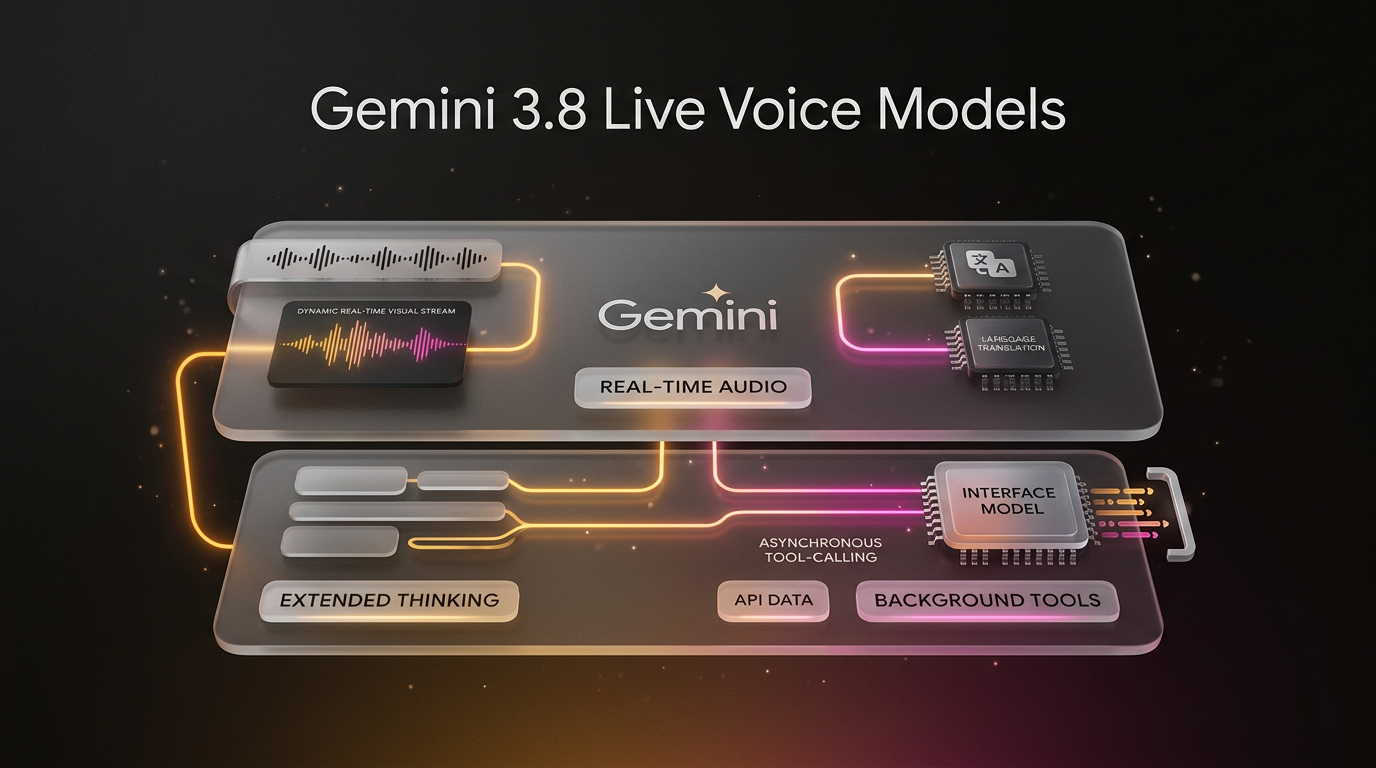
Voice interfaces often struggle with pauses when executing tools or processing images. Under the new architecture, Gemini 3.8 Live maintains a spoken dialogue while calling external application programming interfaces (APIs) and running functions asynchronously. This allows an assistant to verbally acknowledge requests with natural pacing while background tasks continue running.
The Key Changes in Gemini 3.8 Live and Extended Thinking
Google developed two distinct tiers to address different operational constraints across enterprise and developer deployments. Both models process audio streams directly without separate speech-to-text and text-to-speech intermediate layers, but they serve different performance requirements.
Gemini 3.8 Live serves as the high-throughput, cost-efficient model. It handles fluid spoken conversations, ingests visual inputs in near real-time, and automatically switches across 97 supported languages mid-dialogue without manual configuration. The model is tuned for high-volume customer interactions, visual step-by-step guidance, and real-time interactive tasks.
Gemini 3.8 Live Extended Thinking handles complex, multi-step agentic workflows. It incorporates simultaneous reasoning and speaking, enabling the model to verbalize natural progress cues—such as “Let me check that for you”—while coordinating external data lookups, multi-step bookings, or asynchronous system commands. It also provides live spoken narration as background processes advance, preventing dead air during lengthy operations.
Benchmark Results and Measured Performance
Along with the launch, Google published benchmark evaluations assessing conversational fluidity and agentic reliability. On the Artificial Analysis Speech to Speech Quality Index, Gemini 3.8 Live Extended Thinking secured the top spot with an overall score of 82.6. In standard reasoning assessments, the model registered 97.7 percent on Big Bench Audio.
For task completion within voice-driven enterprise environments, Google reported several third-party evaluations:
- Gemini 3.8 Live Extended Thinking achieved 68.6 percent on the τ-Voice benchmark for agentic completion.
- The Extended Thinking model reached 35.1 percent on Sierra’s specialized τ-Voice-banking benchmark.
- Gemini 3.8 Live secured second place in user evaluations on the Speech Agent Arena.
- On ServiceNow’s EVA-Bench, tested via the Live API on the Gemini Enterprise Agent Platform, both models demonstrated balanced conversational pacing alongside technical accuracy across complex workflows.
These benchmark figures reflect an effort to improve how autonomous voice agents handle real-time interruptions, structured data entry, and multi-tier API calls while staying grounded in conversation.
Real-Time Multimodal Capabilities and Tool Calling
A central technical update in Gemini 3.8 Live is continuous multimodal perception. Rather than treating visual data as static snapshot uploads, the model evaluates visual feeds alongside incoming audio. Google highlighted demonstrations ranging from guiding an employee through onboarding materials live on screen to generating functional React components from live hand-drawn sketches while discussing design adjustments in real time.
Parallel tool execution prevents conversational stalls. When an end user asks a Gemini 3.8 Live agent to update database records, search internal documentation, or execute reservations, the model acknowledges the command instantly. It executes function calls asynchronously and feeds the resulting output back into the conversation stream without forcing the caller to wait in complete silence.
To address concerns surrounding audio synthesis and provenance, Google embeds its SynthID watermarking technology directly into all generated audio streams. The watermark is imperceptible to human listeners but detectable by automated verification systems to track synthetic voice outputs.
Ecosystem Integrations and Availability Timeline
Google is deploying the models across consumer software, business suites, and developer infrastructure simultaneously. Availability varies across user tiers and platforms.
For developers building standalone voice interfaces, Gemini 3.8 Live and Gemini 3.8 Live Extended Thinking are available immediately through the Gemini API and Google AI Studio. Third-party real-time streaming platforms—including LiveKit, Agora, Fishjam, LangChain, Pipecat, Vercel, and Vision Agents—have integrated the Live API to manage audio transport infrastructure so developers can focus on application logic. Google also reported initial enterprise partnerships with Salesforce, Genspark, and Lumeris.
Enterprise availability is currently structured in private preview within Gemini Enterprise, with general availability planned for Gemini Enterprise for Customer Experience. For everyday users, Gemini 3.8 Live is rolling out inside Search Live. Gemini 3.8 Live Extended Thinking is accessible in the Gemini mobile app, Docs Live, Gmail Live, and Keep Live for Google AI Pro, Ultra, and Workspace business subscribers.
Practical Implications for Voice Systems
For operations teams deploying automated phone lines, customer support desks, or interactive field tools, the release of Gemini 3.8 Live reduces the infrastructure required to manage spoken interruptions and tool latency. Traditional voice stacks require chaining automatic speech recognition (ASR), large language models (LLMs), and text-to-speech (TTS) engines together, often resulting in notable latency and disjointed conversational transitions.
Native speech-to-speech architecture with integrated background execution eliminates several pipeline hops. The ability to automatically detect 97 languages within the same session also simplifies global support operations, removing the need for manual routing menus or language-specific transcription models.
What This Changes for Client Builds
In client projects that combine automated voice routing with backend operational pipelines, bridging conversational phone interactions with database updates has always presented timing challenges. When Wasif builds integrated systems connecting customer inquiries with CRM pipelines like Go High Level or custom orchestration workflows using AI automation, unexpected tool latency can cause awkward pauses on calls.
Direct speech-to-speech models like Gemini 3.8 Live offer a smoother bridge between voice inquiries and enterprise workflows. Connecting real-time audio models with structured Agentic AI Systems & AI Workforce frameworks allows customer agents to verify identities, search inventory, or trigger operational updates without losing conversational momentum.
To explore how automated voice pipelines and intelligent backend workflows can support your operations, connect via the contact page to discuss your architecture.