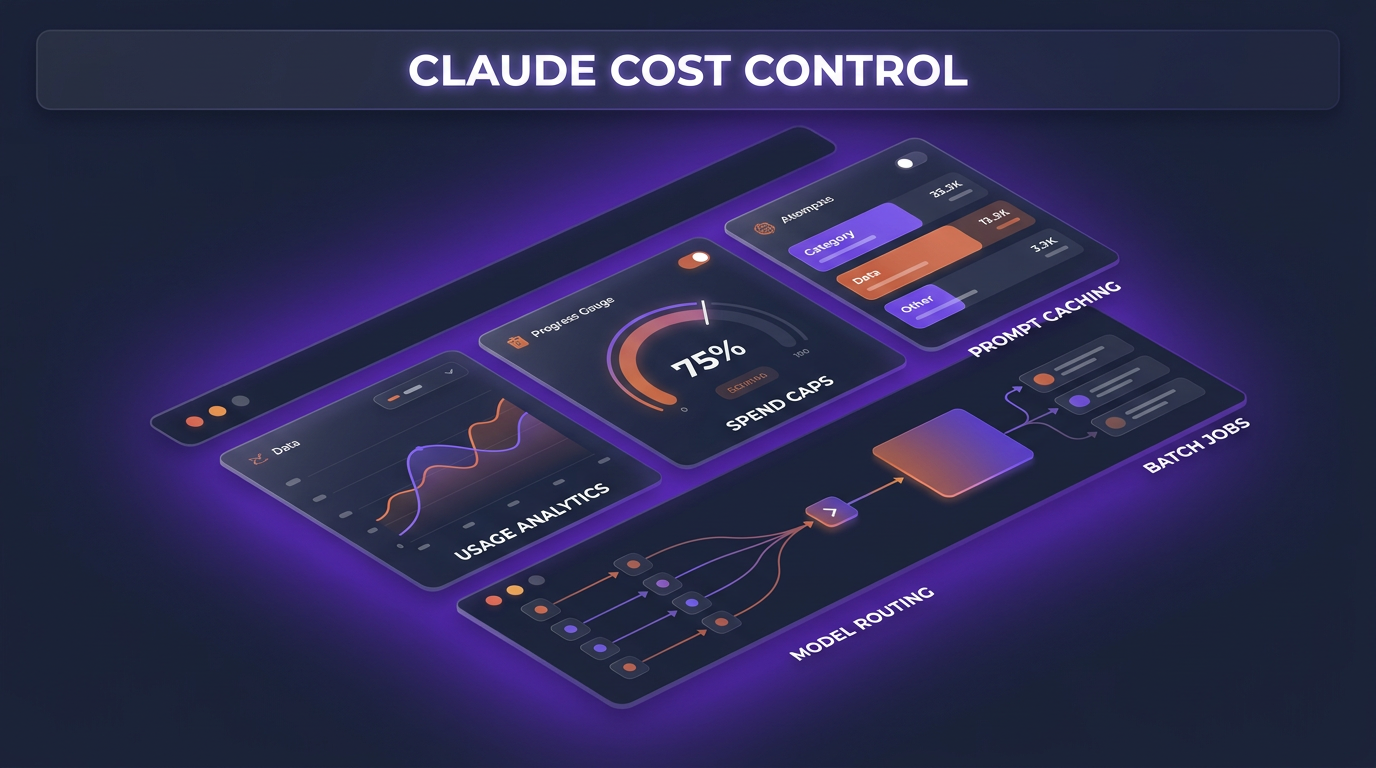
Managing AI operational spend requires looking beyond raw token consumption and focusing on the total cost per outcome. As outlined on the Claude blog, Anthropic offers administrative and platform tooling designed to help organizations monitor, analyze, and limit usage across teams and custom API builds. Implementing clear Claude cost control policies ensures that teams leverage model capabilities without incurring unpredictable monthly expenses.
Controlling expenses effectively depends on whether an organization deploys Claude as a workspace application for employees or as an API backbone for developer builds. Admins overseeing workspace deployments rely on access controls and dashboard caps, while software developers build efficiency directly into code using caching and batch workflows.
Matching Models and Parameters to Business Workloads
Assigning a less capable model to complex reasoning tasks often increases expenses due to repeated prompts and required human intervention. Conversely, sending basic document sorting tasks to a top-tier frontier model consumes expensive compute capacity without adding measurable value. Establishing clear guidelines for model selection helps organizations maintain balanced expenditure across projects.
Anthropic provides a distinct family of models engineered for specific operational demands:
- Fable: Built for the most complex problems requiring deep reasoning.
- Opus: Suited for long-horizon projects, intricate coding, and advanced analysis.
- Sonnet: Designed for everyday tasks, general analysis, and balanced operational speed.
- Haiku: Optimized for fast, high-volume tasks like document tagging and basic extraction.
Beyond selecting models, technical teams can adjust the effort parameter to dial model thinking up or down. Lowering effort on routine text parsing saves input tokens, while raising effort on final decision steps reserves deep processing for critical judgments. Organizations also deploy advisor strategies, where smaller models like Sonnet run routine steps and call a frontier model only when complex tasks demand higher reasoning.
Setting Up Claude Cost Control in Enterprise Workspaces
Administrators managing workspace deployments generally observe usage patterns for a full monthly cycle before enforcing hard spending limits. Establishing baseline data prevents setting restrictive caps that accidentally disrupt ongoing operations.
Workspace governance relies on four primary administrative mechanisms:
Access Gating: Admins restrict features like Claude Code or Claude Cowork to targeted custom roles or user groups. Rolling out capabilities department by department keeps initial usage predictable.
Entitlements and Defaults: Entitlements determine which specific models a group can access. Setting default workspace initializations to Sonnet keeps daily messaging costs manageable, while granting model entitlements for Opus or Fable exclusively to specialized teams.
Hard Spend Caps: Spending ceilings apply instantly across individual user accounts, designated groups, or entire organizations. Once configured, caps strictly prevent overage charges.
Automated Requests: Dashboard systems let admins automate request reviews for limit increases, flag members approaching spending thresholds, and detect rapid shifts in consumption speed.
Monitoring Token Usage with Dashboard Analytics and APIs
Clear visibility into usage data prevents unexpected end-of-month invoice billing. Dashboard analytics categorize costs by user, team, and model version, matching line items against overall financial billing statements.
For organizations using enterprise reporting tools, the Analytics API exports consumption metrics directly into internal business intelligence dashboards and finance forecasting platforms. Additionally, admins can use analytics chat to inquire about workspace usage using plain English prompts such as asking which team recorded the fastest consumption growth over a specific quarter.
Optimizing API Infrastructure for Developer Builds
For custom platform builds, developers manage expenses via the Claude Console. Console Workspaces divide API keys and environments by team or application, making expenditure tracking transparent across development stages.
Developers lower platform expenses significantly using native optimization parameters:
Prompt Caching: Applications that send identical reference materials, static documentation, or system instructions repeatedly can store those prompts in cache memory. Successful cache hits reduce input processing rates to 10% of standard pricing, offering up to 90% savings on static inputs.
Batch Processing: Asynchronous tasks that do not demand instantaneous outputs, such as overnight e-commerce inventory processing, can be processed via batch endpoints at a 50% discount. Batch processing discounts combine directly with prompt caching savings.
Advisor Routing: Structuring API pipelines so that lighter models handle data formatting before calling frontier models on final output steps preserves high-tier tokens for necessary logic checkpoints.
Common Mistakes in Managing Claude Expenses
A frequent mistake in AI infrastructure management is applying identical model settings to every step in a pipeline. Running data extraction, summary formatting, and final validation on a single frontier model wastes budget on simple tasks.
Another common mistake is setting hard spend caps before gathering adequate historical data. Restricting limits too quickly can cut off functional team processes mid-workflow. Teams also frequently forget to activate prompt caching when passing large context windows, forfeiting substantial input token discounts.
FAQs
How does prompt caching lower Claude API costs?
Prompt caching stores frequently repeated context, like reference documents or system prompts, in memory. When subsequent API requests hit the cached context, input tokens are charged at 10% of the standard rate, yielding up to 90% savings on repeated input text.
What is the difference between model entitlements and defaults?
Model entitlements control which specific models a designated team or custom role has permission to access. Defaults determine which model open workspace conversations automatically select when a new user starts a chat.
How can background tasks run more affordably on Claude?
Non-urgent background jobs can be submitted through batch processing endpoints. Anthropic offers a 50% discount on batch jobs that do not require immediate real-time responses, and this discount stacks with prompt caching.
Putting Cost Controls into Practice
Wasif builds custom AI automation workflows and integration architectures that incorporate structured model routing, cache parameters, and clear rate limits. Designing automated systems around sensible context windows ensures business platforms perform reliably while maintaining strict financial predictability.
To explore custom AI integrations and workflow implementations tailored to your team, feel free to reach out directly.