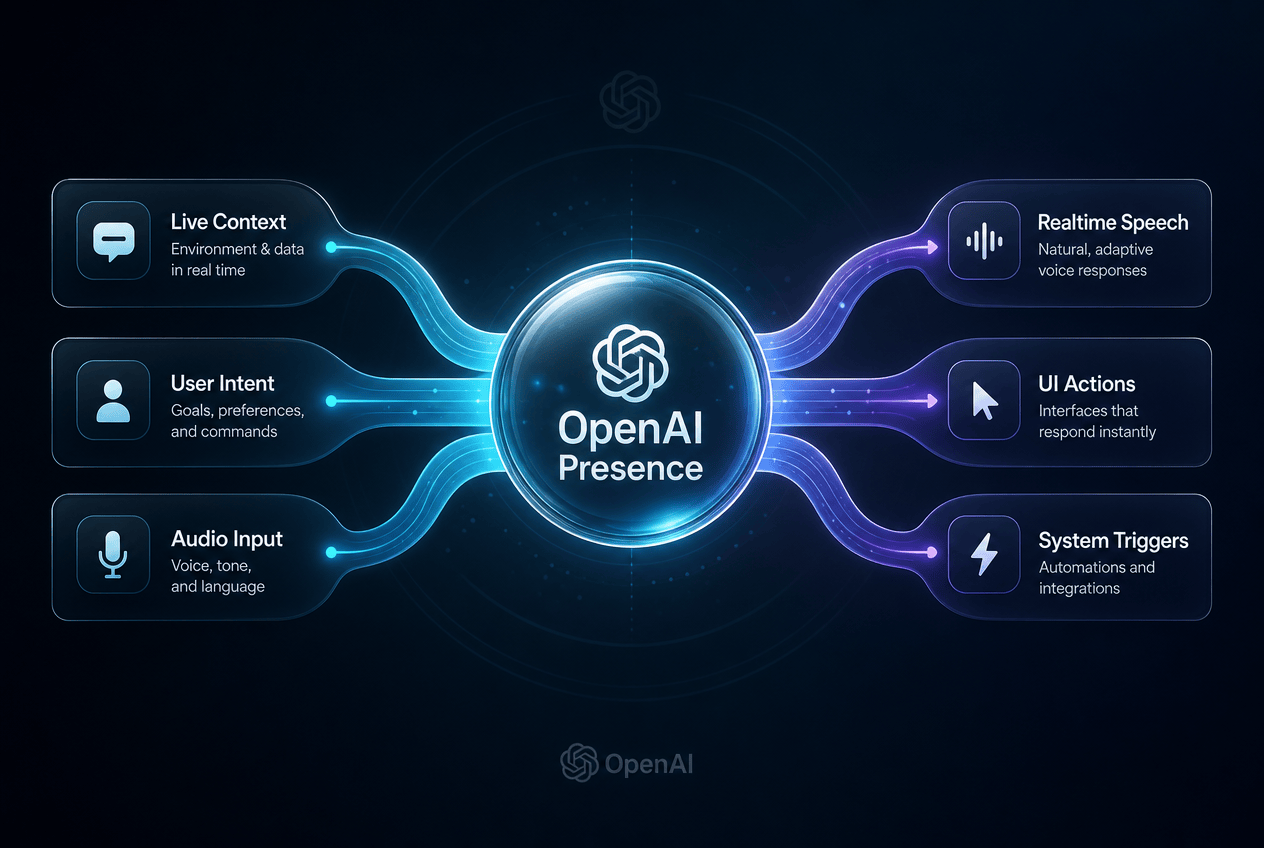
OpenAI recently introduced a set of infrastructure updates focused on continuous context and real-time state tracking, officially named OpenAI Presence. As detailed on the OpenAI blog, this update focuses on bridging the gap between static API requests and persistent background interaction. Instead of firing isolated prompt-response cycles, systems built on this architecture maintain active awareness of context, user state, and system events over longer sessions.
For business owners and system builders, this shift represents a move toward software that listens, waits, and acts based on environment changes rather than explicit user triggers. Understanding how this infrastructure operates allows teams to evaluate where live contextual awareness adds tangible value over traditional scheduled tasks or stateless webhooks.
Understanding the Architecture of OpenAI Presence
Traditional API interactions operate on a strict request-response model. A user or server sends a payload, the model processes the text or audio, and the response closes the connection. OpenAI Presence alters this dynamic by establishing long-lived session state objects managed on server infrastructure. The system retains short-term memory buffers, environmental variables, and active tool availability without forcing the developer to re-transmit the entire conversation history on every event.
This design significantly reduces payload overhead for multi-step tasks. In practice, a desktop agent or browser assistant can monitor structured event streams—such as form fills, call transcripts, or database updates—and evaluate whether an intervention is required. By moving session maintenance to the provider layer, latencies drop and context drift is minimized across extended workflows.
Key Capabilities and Feature Highlights
The roll-out includes several underlying features designed to make live agent interactions more efficient and reliable. Key technical changes include:
- Persistent State Handlers: Connections can remain idle without losing session tokens or contextual memory, reducing re-initialization costs.
- Event-Driven Triggers: Models can evaluate structured conditions in real time and execute functional calls only when specific thresholds are met.
- Low-Latency Interruption Handling: Real-time voice and streaming audio sessions handle user interruptions instantly without dropping background state.
- Granular State Controls: Developers can explicitly wipe, pause, or snapshot session state to ensure data security and compliance standards.
These capabilities shift how background tasks are constructed. Instead of building complex database polling loops or chaining dozens of stateless functions, developers can deploy persistent execution environments that respond instantly when criteria are met.
Why OpenAI Presence Matters for Business Automation
In standard business operations, delays between receiving information and taking action lead to dropped leads, missed alerts, and manual entry overhead. Integrating OpenAI Presence into operational pipelines allows organizations to build reactive monitors that process information as it arrives. A customer service module, for example, can monitor incoming support tickets alongside real-time call transcripts, suggesting immediate resolution pathways to human agents before the call ends.
This real-time layer compliments existing tools like Make.com and custom webhook receivers. Rather than replacing core business logic, the presence framework acts as an intelligent event filter. It sits between incoming communication streams and core operational tools, deciding when to run a full script, when to update a database, and when to remain quiet.
Practical Implications for Developers and Client Builds
Implementing OpenAI Presence requires rethinking standard software architecture. Developers must account for connection management, state persistence, and token consumption over extended idle periods. While stateless calls bill purely on input and output tokens, persistent sessions require careful design to avoid idle resource consumption.
A concrete example involves a service desk managing inbound phone inquiries. Using standard APIs, each speech segment requires full history re-transmission, leading to compounding latency after several minutes. With persistent presence objects, the audio stream stays active with sub-second response times, routing verified caller details into a management portal without call lag.
Building these connections effectively requires pairing low-latency model interfaces with reliable backend architecture, such as AI automation systems designed to handle database updates, user permissions, and external notifications.
Where OpenAI Presence Fits in Real Projects
Wasif builds custom automation setups, CRM structures, and web platforms for growing businesses. When new API features launch, Wasif evaluates them based on system reliability, token efficiency, and practical maintenance requirements for clients.
For enterprise setups, Wasif integrates persistent state models into lead intake, automated qualification, and live operational dashboards. Rather than applying continuous AI execution everywhere, Wasif targets high-value inflection points where instant response times generate clear business returns, such as instant lead callbacks and dynamic inventory routing.
If you want to integrate real-time voice or intelligent agent flows into your business, reach out through the contact page.