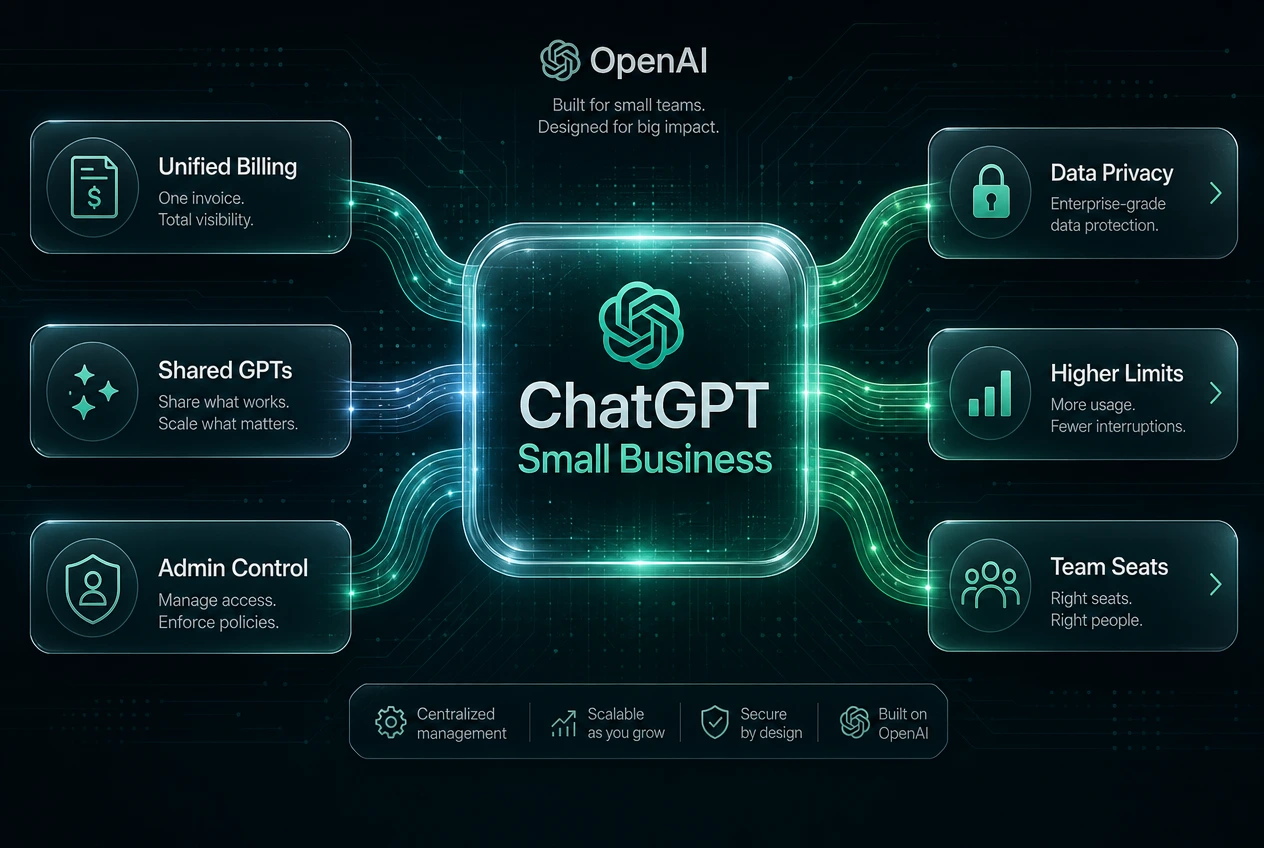
OpenAI introduced the ChatGPT Small Business Program to give growing companies a practical middle ground between individual accounts and enterprise deployments. As revealed in the OpenAI official announcement, this initiative targets teams needing shared workspace tools, unified billing, and strict privacy controls without committing to large enterprise contracts. The announcement arrives at a moment when small organizations are looking for controlled ways to deploy artificial intelligence across daily workflows.
Key Features of the ChatGPT Small Business Program
The updated program brings several structural changes tailored to teams operating with 2 to 100 seats. Centralized admin dashboards allow team managers to assign licenses, monitor workspace activity, and oversee access rights from a single interface. These tools reduce the administrative friction of managing scattered individual subscriptions.
Data privacy forms a central pillar of the new structure. Business conversations, uploaded documents, and custom inputs remain isolated from model training pipelines by default. This change provides small firms with the compliance assurance required when handling client data or proprietary operations.
- Unified workspace billing to simplify monthly software expenses
- Higher usage caps on flagship reasoning and conversational models
- Shared custom GPTs tailored for company-specific tasks
- Admin controls for user management and workspace security settings
Why the Program Matters for Growing Teams
Small teams often face operational bottlenecks when team members use fragmented personal tools. The ChatGPT Small Business Program standardizes prompt environments, allowing employees to share effective custom assistants across departments. A customer support desk, for example, can share a dedicated agent trained on standard operating procedures to maintain consistent service quality.
Cost predictability is another major factor. Managing individual expense claims for separate accounts creates finance overhead and unpredictable software spend. Unified seat management delivers a single bill while giving managers complete visibility over tool utilization.
Security guarantees also enable teams to process internal data safely. Agencies handling confidential client files can build automated research summaries without exposing sensitive trade details to public training sets. This privacy boundary aligns workspace usage with standard corporate data protection requirements.
Practical Implications for Operational Workflows
Adopting workspace-level AI changes how small businesses connect operational platforms. Teams can create specialized assistants for copywriting, financial auditing, or lead qualification, then connect those processes with broader management systems. Combining team AI workspaces with AI automation pipelines creates predictable background tasks that run without manual intervention.
Consider a sales team managing leads inside a Go High Level CRM system. Sales representatives can use standard team prompts to outline follow-up emails, verify meeting transcripts, or analyze prospect notes directly within their shared workspace. This reduces repetitive context-switching across different tools.
Technical operations also benefit from shared custom GPTs. Developers and operations leads can establish standardized code reviewers or document parsers that every team member accesses instantly, keeping quality consistent across project deliverables.
Realistic Outlook for Business Adoption
While the ChatGPT Small Business Program solves management and security challenges, rollout success depends on deliberate implementation. Businesses need clear guidelines on context sharing, prompt standards, and internal verification before handing off client tasks to automated workspaces. Organizations that treat workspace software as a structured asset rather than an informal chat tool will see the strongest returns.
Pricing flexibility makes this tier attractive, but decision-makers must still audit actual user seat activity regularly. Idle seats can accumulate quickly if team onboarding is not paired with clear task ownership. A phased rollout by department usually yields better adoption rates than company-wide launches without training.
Where This Fits in Client Builds
When Wasif designs custom automation pipelines and client systems, tool management is always a core consideration. Shared team workspaces provide a clean foundation for integrating internal team prompts with automated operational backbones. Wasif builds scalable systems that connect team AI tools directly into CRM workflows, website backends, and daily business operations.
Ready to structure your business AI tools and automation pipelines for sustainable growth? Reach out at https://wasifahmed.dev/contact/ to discuss your project.