In 2024, over 70 percent of businesses have experimented with standalone AI tools, yet few have successfully scaled these tools into daily operations. A successful AI transformation strategy requires moving beyond simple playground prompts and isolated chat interfaces. To build real value, companies must connect language models to their existing operational databases and communication channels. This transition turns isolated tools into systematic business assets that run without manual intervention.
The Core Stages of an AI Transformation Strategy
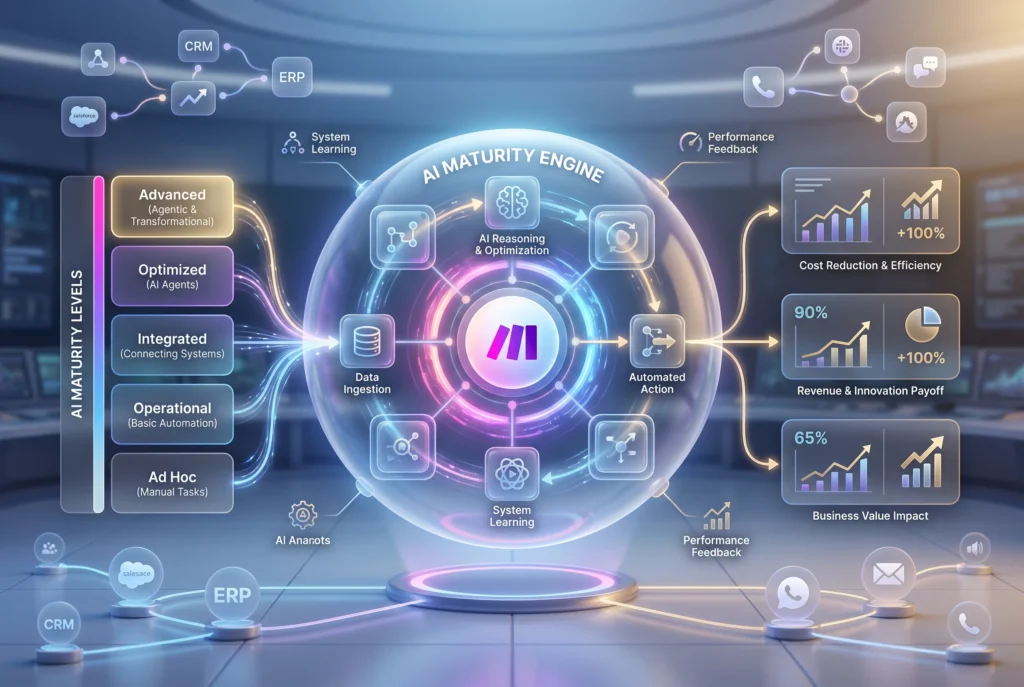
Many organizations begin their journey with ad-hoc experimentation. Employees use public chat interfaces to write emails, draft social media posts, or summarize documents. While this individual usage provides minor productivity gains, it does not constitute a cohesive corporate strategy. The data remains siloed, and the manual effort of copying and pasting information limits scalability.
In the early stage, a company might use an AI chatbot to draft a single customer response. This is a local optimization. While helpful, it still requires a human to copy the customer’s email, paste it into the chatbot, review the output, and paste it back into the email client. This manual bridge creates a bottleneck.
The next phase involves standardizing these interactions. Teams begin to share successful prompts and document best practices. However, the true shift occurs when businesses connect these models directly to their core databases. By integrating artificial intelligence into active workflows, systems can automatically trigger tasks based on incoming customer data, system alerts, or calendar events. This structured approach allows companies to scale their operations without a linear increase in headcount.
Integrating AI Automation Workflows Into Daily Operations
To move past basic prompting, companies must build reliable pipelines that handle data securely. An effective AI transformation strategy relies on middleware to pass information between applications. Instead of writing custom API integrations for every new tool, using visual orchestration platforms simplifies the connection process.
Integrating these systems requires a clear understanding of data payloads. When data moves from an application like a web form, it must be formatted so that the language model can parse it accurately. System builders use system instructions to guide the model’s behavior, ensuring it only outputs the specific information needed for the next step of the workflow.
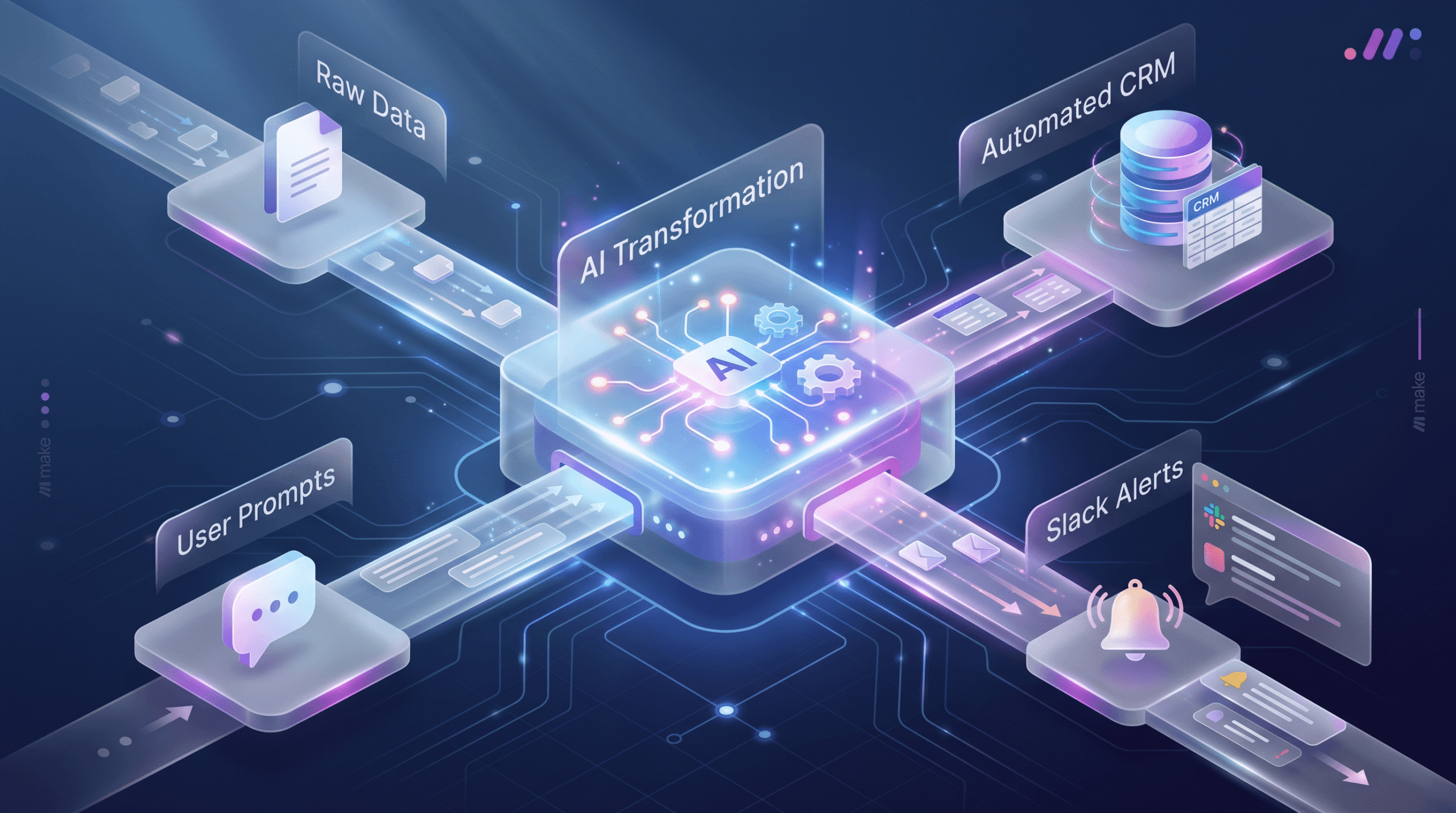
Consider a concrete example of this architecture in action. When a new lead fills out a form on a website, a webhook triggers a workflow in Make.com. The workflow routes the lead details to an OpenAI assistant module, which analyzes the lead’s company size and industry. The assistant then drafts a highly personalized introductory email tailored to that industry. Simultaneously, the system updates the lead record inside a CRM like Go High Level, assigns a follow-up task to a sales representative, and posts a formatted notification in a Slack channel. This entire sequence occurs within seconds, requiring zero manual data entry.
By utilizing structured AI automation, businesses ensure that their team members spend time on high-value strategy and relationship building rather than administrative data transfer.
For instance, if the goal is to categorize incoming support tickets, the model should be instructed to output only one of three categories: ‘Billing’, ‘Technical’, or ‘Sales’. If the model responds with a conversational sentence, the downstream applications will fail to process it. Using structured JSON schemas within the automation platform ensures that the data remains clean and predictable at every step.
Key Challenges in Modern AI Implementations
Transitioning to automated systems is not without its hurdles. According to insights published on the Make.com blog, organizations often struggle with the transition from individual productivity gains to systemic business-wide efficiency. Security, reliability, and data structure represent the three major roadblocks.
To mitigate these challenges, builders must design systems with built-in error handling and clear data schemas. Below are the primary considerations when designing these integrations:
- Data isolation: Legacy software platforms often lack accessible APIs, making it difficult to extract the clean data required for AI processing.
- Rate limits and latency: Public AI APIs can experience occasional slowdowns or strict request limits, which requires workflows to have queueing systems.
- Output unpredictability: Large language models can produce varied responses, meaning systems must use strict formatting rules like JSON schemas to ensure compatibility with other software.
- Cost management: Running thousands of automated API calls daily can become expensive if prompts are not optimized for token efficiency.
FAQs
What is the first step in an AI transformation strategy?
The first step is identifying repetitive manual tasks that involve structured or semi-structured data. Businesses should map out these processes and document the exact inputs and outputs before introducing any AI tools. This ensures the technology solves a specific operational bottleneck rather than adding unnecessary complexity.
How does Make.com help with AI integration?
Make.com acts as the visual orchestrator that connects various applications to AI models without requiring complex custom code. It allows businesses to trigger AI analysis based on events in their CRM, email, or database systems. This creates a continuous flow of data where AI processes information automatically in the background.
Can small businesses execute an AI transformation strategy?
Yes, small businesses can easily implement this strategy by focusing on high-impact, low-complexity workflows. Starting with automated lead triaging or social media content drafting provides immediate time savings. These initial successes build the foundation for more complex system integrations over time.
Putting It to Work
For businesses looking to implement a robust AI transformation strategy, building these connected systems requires technical precision. Wasif designs and implements custom automation architectures that bridge the gap between separate applications. By configuring secure pipelines within Go High Level and building custom visual workflows, Wasif helps companies replace manual administration with reliable, automated systems. Whether connecting advanced language models to customer databases or optimizing lead generation pipelines, the focus remains on building clean, stable infrastructure that scales.
If you are ready to transition your business from manual tasks to automated systems, reach out to Wasif today to discuss your project.