Meta Muse Wonder has arrived as the latest addition to Meta’s growing lineup of foundation models, targeting complex personal and professional agentic tasks. In an announcement on the official Meta announcement post, the company unveiled both Muse Wonder and Muse Wonder Full, positioning them as its most capable releases to date following fourteen months of foundational restructuring that began with Muse Spark.
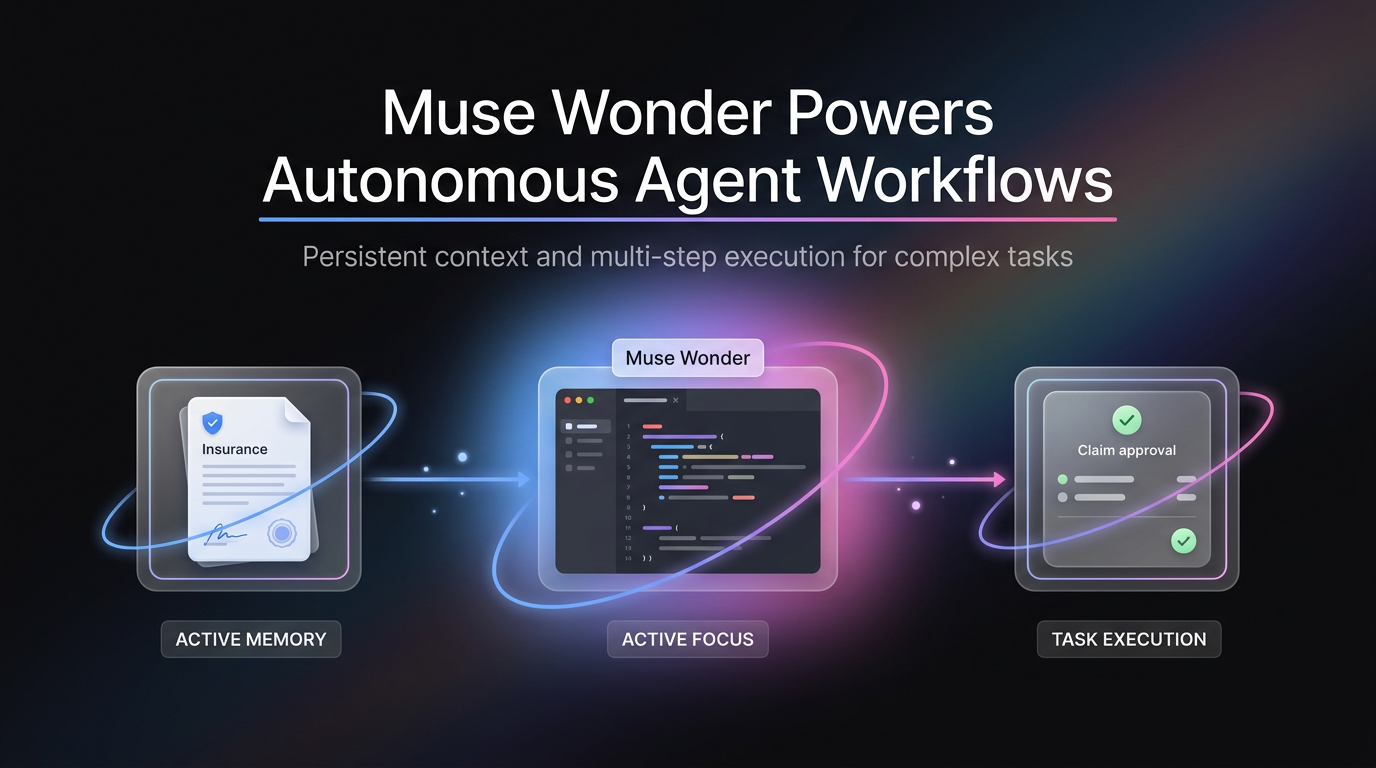
For builders and business owners exploring automated operations, Meta Muse Wonder marks an intentional shift from basic generative prompts toward multi-step problem solving. The new release introduces distinct architectural capabilities, specifically Active Memory and Active Focus, designed to let systems maintain context across multiple interactions and persist through intricate workflows without losing track of instructions.
What Changed With the Meta Muse Wonder Release
The Meta Muse Wonder series consists of two specific variants: the standard Muse Wonder model and the larger Muse Wonder Full. Both variants build upon the foundational engineering established by Muse Spark. Meta states that these releases are designed to navigate domain-specific knowledge across sectors such as law, finance, and health, in addition to supporting advanced software engineering tasks.
A recurring limitation with previous generations of language models has been context degradation over extended work sessions. Meta reports that the Meta Muse Wonder models directly target this problem through two core capabilities:
- Active Memory: The model carries relevant context across separate conversations, retrieving specific historical details pertinent to the immediate objective rather than requiring users to re-prompt from scratch.
- Active Focus: The system maintains goal orientation when tasks encounter obstacles, attempting alternate pathways, recovering from processing errors, requesting clarification when ambiguous, and verifying instructions before executing high-impact decisions.
- Specialized Domain Interpretation: Enhanced processing capabilities targeted toward professional documentation, including insurance claims, commercial leases, accounting data, and full-stack software development.
- Defensive Security Utilities: Explicit training to detect code vulnerabilities and assist development teams in patching security issues.
Meta states that these capabilities are trained to prevent the unauthorized sharing of private information and reject malicious requests, adhering to the benchmarks established in the Meta Superintelligence Scaling Framework.
Understanding Active Memory in Meta Muse Wonder
In standard conversational workflows, context windows often reset or require external retrieval-augmented generation pipelines to retain past preferences. The Meta Muse Wonder architecture integrates Active Memory to bridge ongoing engagements. By indexing meaningful details across historical exchanges, the model is designed to recall client constraints, formatting rules, or operational criteria without manual re-entry.
For teams building automated pipelines, this behavior addresses a common friction point in customer operations. When an autonomous system handles ongoing client communications, losing track of earlier negotiations or client preferences creates disjointed interactions. Meta states that Active Memory allows Meta Muse Wonder to recall relevant details specifically when the ongoing task calls for them, rather than flooding the active context window with unrelated historical records.
How Active Focus Supports Long-Running Tasks
Autonomous agency requires more than simply generating the next most likely token. When a script fails, an API endpoint returns an error, or a document contains contradictory text, standard models frequently stall or fabricate an answer. The Meta Muse Wonder family includes Active Focus to guide procedural problem resolution.
According to Meta, Active Focus allows Meta Muse Wonder to assess intermediate outcomes against the broader goal. If an initial approach fails, the model attempts alternate methods. Crucially, Meta points out that the model is instructed to pause and request clarification when an ambiguity arises, as well as confirm intentions before committing irreversible actions. This checkpointing behavior is essential for operational environments where automated actions affect databases, client records, or live code deployments.
Domain-Specific Applications for Professional Operations
Meta claims that both Muse Wonder and Muse Wonder Full deliver frontier performance when interpreting intricate domain files. Examples cited in the launch include analyzing insurance policies, interpreting commercial lease agreements, and organizing complex financial statements.
Software development represents another major application area for Meta Muse Wonder. The release notes indicate that the models support complete application authoring, from casual software experiments to commercial business systems. Furthermore, security engineers can direct Meta Muse Wonder to inspect source code for vulnerabilities, functioning as an automated code auditor that identifies system weaknesses while resisting requests to build exploits.
Availability and Deployment Timeline
Meta announced that Meta Muse Wonder is available immediately through the Meta Model API and within Muse Code. Developers can begin integrating the model into external applications, custom orchestrations, and internal development tools right away.
For end-user platforms, Meta states that the new architecture will soon power expanded capabilities across the broader Muse product line, beginning with a rollout to paid subscribers. The company also indicated that a comprehensive safety evaluation report, outlining compliance with its Superintelligence Scaling Framework, will be released in an upcoming publication.
Putting Meta Muse Wonder to Work in Real Systems
Practical implementation of models like Meta Muse Wonder depends heavily on where they sit inside a company’s data architecture. While foundation models provide the reasoning engine, real business value requires connecting those reasoning layers to existing CRMs, web hooks, and communication pipelines.
When deploying production automations, Wasif Ahmed integrates advanced reasoning models with platforms like Make.com and Go High Level. In practical client architectures, models equipped with persistent context and error recovery enable more resilient Agentic AI Systems & AI Workforce deployments. Rather than relying on rigid if-this-then-that scripts, workflows can leverage the Active Focus traits of Meta Muse Wonder to handle unformatted inputs, review incoming business paperwork, and autonomously resolve edge cases before handing clean data over to downstream systems.
To explore how models like Meta Muse Wonder can be integrated into your business operations, visit the contact page to discuss your automation infrastructure.