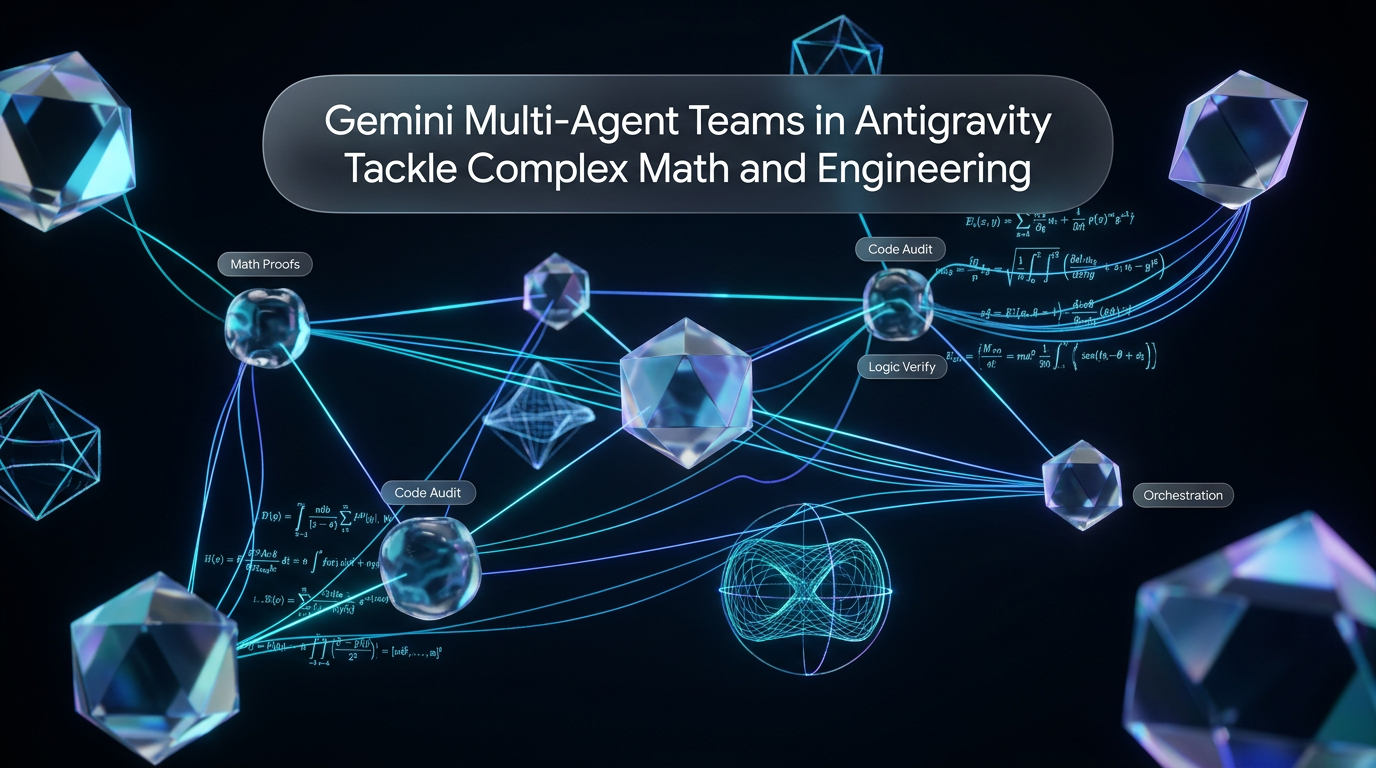
Google has updated its Teamwork framework inside Google Antigravity, enabling Gemini multi-agent teams to collaborate on complex mathematical research and systems engineering tasks over long timeframes. As detailed in the announcement on the Google blog, pairing Gemini 3.7 Flash with this multi-agent orchestration framework allows autonomous AI agents to critique code, verify logic, and iterate continuously over hours or days.
How the Antigravity Teamwork Framework Operates
The updated Teamwork framework focuses on long-horizon problem solving. Instead of relying on a single prompt-response cycle, the system structures multiple specialized agents into collaborative units. These agents divide objectives into manageable subtasks, test each other’s outputs, and run validation routines before producing final deliverables.
By running Gemini 3.7 Flash across this structured network, the system coordinates parallel execution paths. One agent can draft mathematical proofs or low-level software architecture while peer agents independently audit the logic, run test cases, and suggest targeted revisions.
Key Benchmark Results and Engineering Milestones
The collaboration between Gemini 3.7 Flash and Antigravity produced measurable results across theoretical computer science, systems programming, and existing open-source codebases:
- Theoretical Computer Science: The system solved seven open problems across academic venues including FOCS and JMLR. Notable solutions include Knuth’s Cycles Conjecture, verified in Lean with proofs exceeding 40 pages, alongside work in sparse convex optimization, provable LLM quantization, and prefix-matrix factorizations. It also reached a 71% score on TCSBench.
- Systems Engineering: The agents built a cycle-accurate, out-of-order RISC-V CPU simulator entirely from scratch. The resulting simulator booted the xv6 operating system to an interactive shell, recording a 0.71% cycle alignment error compared to real hardware baselines.
- Open-Source Contributions: Multi-agent runs generated upstream performance patches for established repositories. Contributions included SIMD fast-paths for the Eigen library and algorithmic improvements to ParlayHash that doubled insertion throughput while cutting memory consumption by 25%.
Practical Implications for AI-Driven Development
These benchmarks show a distinct shift in how autonomous AI can handle rigorous technical work. Single-agent setups often struggle with context drift and logical degradation on tasks requiring sustained execution. By distributing verification across specialized agents, the Teamwork framework reduces cumulative errors in multi-step engineering pipelines.
For teams building production systems, this setup highlights the value of self-correcting agent networks. Rather than demanding flawless code on the first attempt, the system uses automated critique loops to catch edge cases, syntax bugs, and performance bottlenecks before committing changes.
Connecting Multi-Agent Workflows to Real Builds
While theoretical proofs demonstrate raw reasoning power, the underlying patterns directly inform practical automation. Wasif structures agentic AI systems and end-to-end workflows that use similar principles of task separation, validation, and automated quality checks.
When deploying commercial systems, separating execution from verification ensures that outputs remain accurate and reliable. Organizations looking to implement resilient multi-step workflows can integrate these principles directly into their standard operating environments.
If you are planning to deploy reliable autonomous agent workflows in your business, reach out to Wasif Ahmed to discuss your architecture.