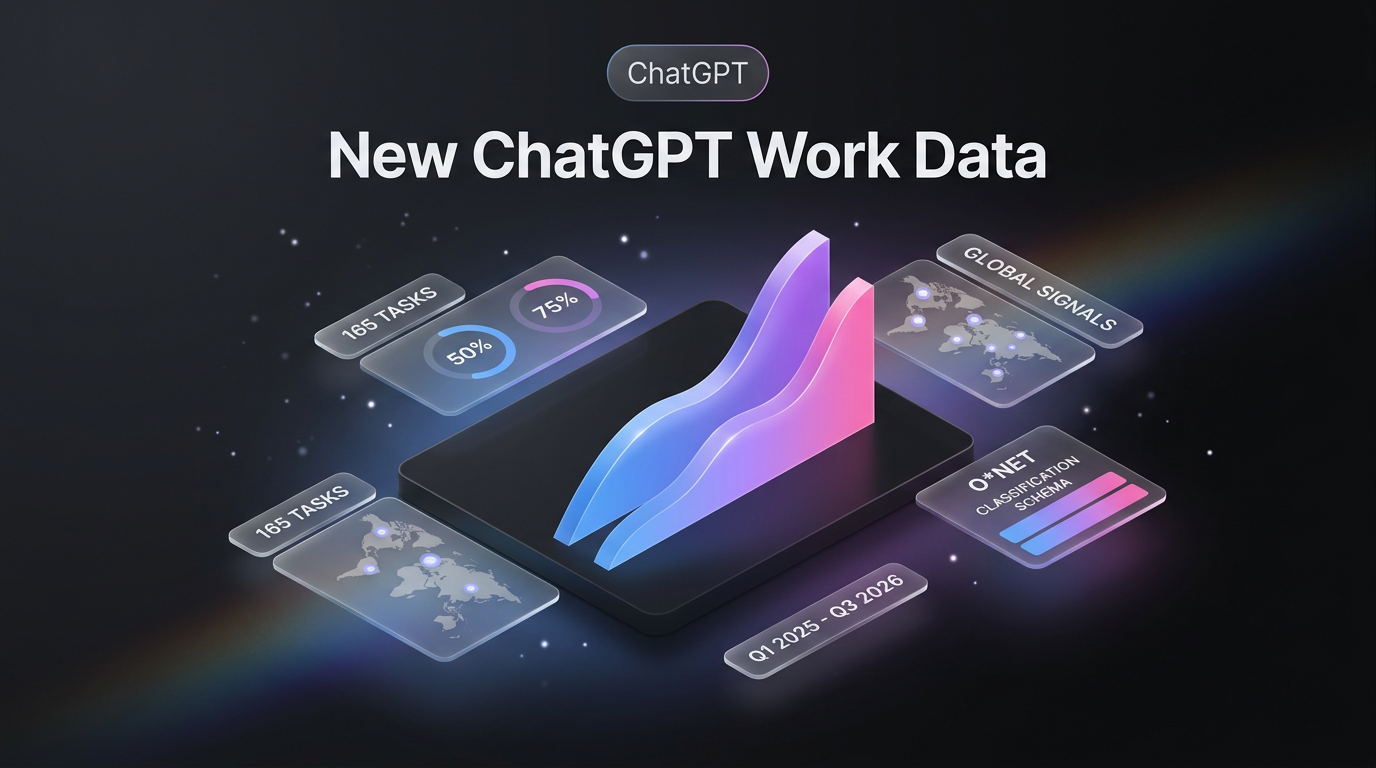
OpenAI has released fresh ChatGPT work data that details how people use consumer AI accounts to complete specific job duties across nearly 100 countries. The dataset, called OpenAI Signals v3.0, was published on October 26, 2026, by researchers Aaron Chatterji, Thomas Cunningham, David J. Deming, Zoe Hitzig, Drew Johnston, Alex Martin Richmond, Christopher Ong, Carl Yan Shan, and Kevin Wadman. It tracks user activity quarter by quarter from the first quarter of 2025 through the third quarter of 2026, mapping prompt activity against standardized workplace tasks.
As detailed in the announcement on the OpenAI website, the initiative uses the O*NET occupational framework to organize user conversations into 165 Intermediate Work Activities, known as IWAs. This taxonomy gives economists and business planners a standardized baseline to compare prompt behavior against established government labor figures.
What the New ChatGPT Work Data Reveals
The released records show a clear geographic and functional diversification in how people complete job tasks with AI. Rather than concentrating solely on early use cases such as draft writing or basic syntax checks, the mix of duties has dispersed over time.
- Task diversification: Across 74 countries tracked continuously in every quarter, the ten most common activities made up an average of 51.1 percent of work messages in Q3 2026, down from 56.0 percent in Q1 2025.
- Country specialization: Different countries developed distinct task concentrations over time, reflecting local industry mixes and differences in software access.
- Documented activities: The reported messages address tasks such as preparing instructional materials, building marketing collateral, writing computer code, and interpreting business analytics.
- Scope limits: The release documents individual consumer plans. It excludes enterprise accounts and Codex usage.
The shift away from top-heavy task concentrations indicates that workers are finding practical uses for AI in specialized segments of their daily jobs rather than relying on the tool for only a handful of repetitive prompts.
Why the Distinction in Job Tasks Matters
The published ChatGPT work data highlights a significant gap between what happens inside language model chats and the actual distribution of employment across the wider economy. In the United States, about 43 percent of the employment-weighted task mix falls into task categories outside the reportable criteria of this dataset.
These unrepresented duties include physical operations such as moving materials, operating vehicles, and maintaining health or medical records. Because those duties require physical presence or specialized compliance controls, they did not meet the sample threshold for regular representation in consumer AI prompts. For business operators, this distinction clarifies where conversational tools assist modern work and where operational workflows remain manual or require dedicated field systems.
Understanding this split allows builders to target software development where language models actually perform well, such as processing structured text, generating instructional workflows, and synthesizing internal documentation.
How Researchers Protect Privacy in the Dataset
The research team built privacy protections directly into the data processing pipeline before calculating country-level statistics. OpenAI notes that researchers do not read individual user conversations.
Instead, automated processing tools classify messages after stripping all identifying user information. The research team then generates aggregated statistics, withholds data points for small cohorts, and injects statistical noise to prevent any reverse identification of specific messages. This methodology ensures that economic researchers can study macro trends across 165 intermediate work activities without exposing sensitive workplace conversations.
Practical Implications of This ChatGPT Work Data for Businesses
For organizations looking to deploy AI automation, the broadening spread of tasks confirmed by the ChatGPT work data confirms that staff members frequently adopt AI tools individually before corporate systems are introduced. Workers identify repetitive computer tasks in their specific workflows and turn to conversational interfaces to draft outlines, structure tabular data, and prepare reference materials.
However, relying solely on ad-hoc individual accounts presents clear limits. Individual prompts lack integration with operational databases, customer management records, and validation pipelines. When businesses identify the work activities their teams bring to chat interfaces, they can formalize those steps into dependable automated workflows.
Organizations developing custom software development or workflow pipelines can use these behavioral trends to prioritize which departments receive structured assistance first. Routine knowledge-work tasks, such as content formatting and data analysis, benefit from systematized prompt chains, while physical and logistics tasks continue to rely on traditional operational tooling.
Where This Fits in Real Client Builds
When Wasif Ahmed designs automation setups for business clients, the first step involves auditing which tasks team members attempt to handle manually through standalone AI chat windows. Many teams lose hours copying information between web chat interfaces and their core operational software.
Wasif connects routine text processing, data categorization, and notification steps directly into Make.com scenarios and Go High Level CRM pipelines. Turning casual prompt habits into structured automations ensures that data remains consistent, team members follow standard operating guidelines, and client information is never exposed to unsecured consumer browser extensions.
FAQs
What is the OpenAI Signals dataset?
OpenAI Signals v3.0 is a public economic dataset released by OpenAI researchers on October 26, 2026. It tracks how individual consumer ChatGPT accounts perform 165 work activities across nearly 100 countries between Q1 2025 and Q3 2026 using the O*NET task framework.
Does the dataset include enterprise accounts?
No, the dataset focuses strictly on work-related messages from individual ChatGPT plans. It explicitly excludes enterprise tier accounts and Codex platform usage to preserve consistent consumer measurement standards.
Why does the ChatGPT work data differ from overall job market data?
The ChatGPT work data differs from the broader job market because about 43 percent of the employment-weighted tasks in economies like the United States involve physical operations, such as transportation, physical healthcare, and equipment maintenance, which cannot be executed within a text-based chat interface.
Conclusion
The latest ChatGPT work data shows that workplace AI adoption has expanded beyond general drafting into diverse, specialized daily duties across dozens of global markets. To make these productivity gains permanent, business leaders should move past disorganized individual prompting and build reliable, automated systems that protect client records and streamline routine tasks.
To discuss building automated workflows and structured systems for your organization, reach out to Wasif directly at https://wasifahmed.dev/contact/.