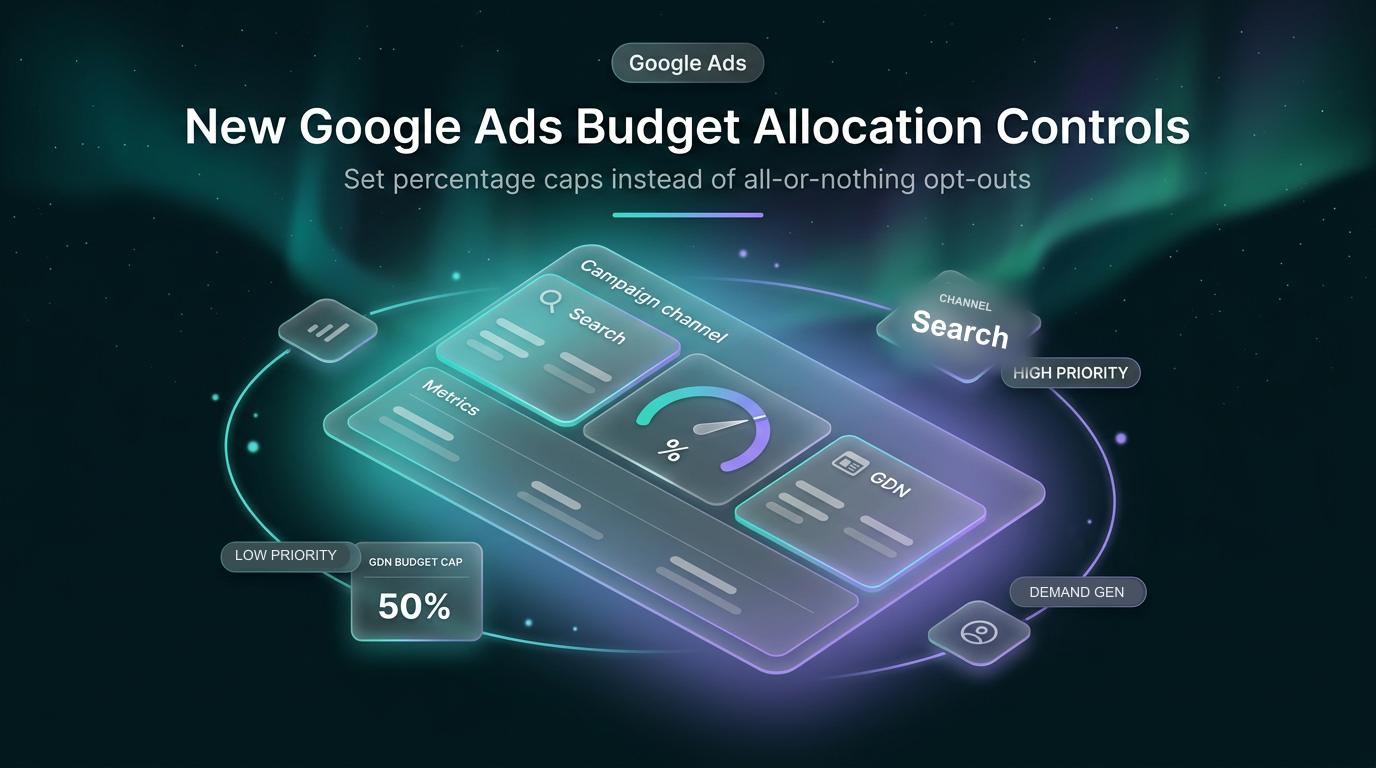
Google Ads is introducing channel prioritization and budget allocation controls to give advertisers more granular command over where campaign money flows. Instead of forcing marketers into binary, all-or-nothing inclusions for secondary ad networks, the platform now allows campaigns to categorize inventory into distinct priority tiers and cap spend on secondary placements.
The change addresses a longstanding frustration for search marketers: running Search partners or the Google Display Network often meant either accepting unpredictable spend shifts or opting out completely. The new controls aim to make network testing safer across Search, Shopping, Performance Max, and Demand Gen campaigns.
How Channel Prioritization Works
At its core, channel prioritization lets advertisers assign specific channels or channel groupings into “High priority” or “Low priority” tiers. Campaigns configured with these tiers will fully fund high-priority channels first, keeping within efficiency targets like Target CPA or Target ROAS, before directing any remaining budget to low-priority options.
For standard Search campaigns, advertisers can now split Google Search, Search partners, and the Google Display Network across separate priority tiers based on performance goals. In Performance Max and Demand Gen campaigns, core Google inventory like Search, YouTube, Maps, Gmail, and Discover is grouped together under a single “Google channels” designation.
These tier settings operate at both the account and campaign levels, and they also apply to shared budgets. Marketers managing multi-campaign portfolios can set distinct channel prioritization levels across different campaign types to protect their primary lead-generation or sales funnels.
Setting Spending Limits with Budget Allocation
Alongside priority tiers, Google Ads is adding channel-level budget allocation caps. When an advertiser labels an inventory group as “Low priority,” they can define a maximum percentage limit of their daily budget allowed to flow into that channel. The bidding algorithm will then work on a best-effort basis to keep daily delivery under that specified cap.
This cap becomes especially useful on uncapped bidding setups. Campaigns running on Target CPA or Target ROAS that are not budget-constrained historically saw minimal impact from simple priority flags alone. With budget allocation limits active alongside channel prioritization, advertisers can safely test exploratory inventory without risking unconstrained spend.
Key practical benefits of this combined approach include:
- Testing Search partners incrementally without risking entire daily budgets on unproven placements.
- Allocating a controlled slice of budget to secondary channels during seasonal demand peaks.
- Keeping core search inventory fully funded before secondary networks receive automated bids.
- Preventing display expansions from eroding bidding efficiency on Target CPA campaigns.
Key Differences Across Campaign Types
Google has clarified how these levers function depending on campaign architecture. While standard Search campaigns allow separate tiering for Search partners and the Display Network, complex multi-surface formats handle groupings differently.
Search and Shopping Setup
In standard search campaigns, Google Search stays separate from secondary placements. Advertisers can keep core Search at High priority while placing Search partners at Low priority with a small 10% to 20% budget cap. This structure lets automation capture incremental search volume without cannibalizing core search queries.
Performance Max and Demand Gen Rules
Because Performance Max and Demand Gen combine multiple visual and text formats, Google does not separate YouTube, Maps, Gmail, and Discover into standalone priority toggles. Instead, those core platforms are treated together as “Google channels.” Channel prioritization in these formats primarily helps regulate how secondary partner networks participate alongside Google-owned inventory.
The February 2027 Display Network Transition
The rollout includes a notable timeline consideration for advertisers who currently run the Google Display Network inside Search campaigns. Google announced that starting in February 2027, the legacy spend allocation structure for Display expansion inside Search will be deprecated. When that deprecation occurs, campaigns that rely on old defaults may experience unexpected shifts in channel distribution.
To preserve their existing distribution balance without interruption, advertisers must configure the Google Display Network to “Low priority” with a 50% budget allocation cap before the February 2027 deadline arrives. Setting up channel prioritization ahead of that cutoff ensures campaign behavior remains predictable.
Practical Strategy for Client Builds
When Wasif designs conversion pipelines connecting Google Ads with automated lead tracking in Go High Level, unpredictable traffic sources often lead to noisy conversion data. Poorly targeted secondary display clicks frequently dilute CRM attribution pipelines.
Using structured channel prioritization allows marketers to isolate verified high-intent search clicks from broad network traffic. By applying strict percentage caps to display and partner networks, campaigns protect core acquisition budgets while feeding cleaner data into backend lead-nurturing workflows.
If you want to align your paid advertising spend with dependable, automated tracking workflows, reach out at wasifahmed.dev/contact to discuss your campaign setup.