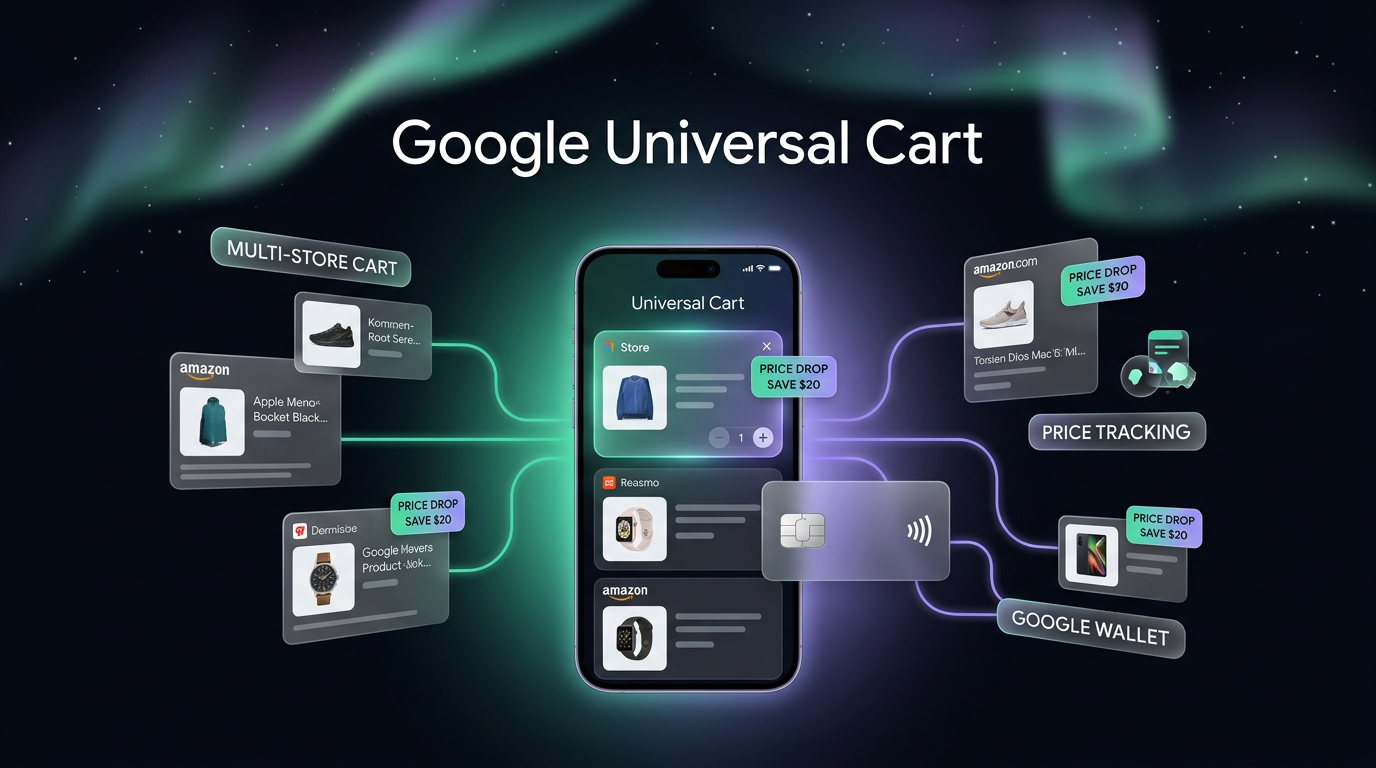
Google Universal Cart has rolled out in the United States across Google Search and the Gemini app. The update introduces a centralized system that gathers products from different online stores into a single purchasing list, replacing the habit of keeping dozens of disconnected browser tabs open.
Announced by Suresh Ganapathy, Senior Director of Product Management for Consumer Shopping, on the official Google blog, this release implements Google’s Universal Commerce Protocol (UCP). The tool aims to organize cross-store retail journeys directly inside Google’s search surfaces, giving online shoppers unified tracking and unified checkout options.
The Core Capabilities of Google Universal Cart
The roll-out of Google Universal Cart focuses on four specific functional areas designed to streamline retail research and purchasing across diverse merchants.
1. Cross-Merchant Product Saving
Online buyers frequently browse across multiple retailers before deciding on a purchase. With Google Universal Cart, users can save items from separate merchants directly into one shared cart interface. For instance, a buyer can save a handbag from Steve Madden while browsing in Search AI Mode, and later add a sweater from Quince or cosmetic items from Ulta Beauty through the Gemini application.
All saved items persist in the unified list. This cross-session retention prevents users from losing track of merchandise or having to bookmark individual product pages across disparate vendor websites.
2. Price Drop and Inventory Alerts
Google Universal Cart connects directly to Google’s Shopping Graph, a database containing more than 60 billion continually refreshed product listings. Because the cart is tied to this structured index, it actively monitors price drops and changes in product availability.
Instead of manually refreshing vendor storefronts, users receive automatic notifications when tracked merchandise goes on sale or returns to stock after being sold out. This automated monitoring operates continuously in the background without requiring extra browser extensions or third-party alert software.
3. Automated Payment Perk Reasoning and Promo Detection
The system connects to Google Wallet to evaluate payment methods. Many consumers carry multiple credit cards that offer varying cashback percentages, points, or retail benefits, but rarely remember which card maximizes rewards for a specific category.
Google Universal Cart evaluates the saved cards in a user’s wallet against the item category to recommend the most advantageous payment option. Alongside card optimization, the cart checks for available promotional discount codes and applies them during the review stage.
4. Unified Checkout Through UCP and Google Pay
Once ready to purchase, shoppers can finalize their orders directly through Google Pay for supported retailers, or transfer the aggregated items directly to the merchant’s native checkout page. The list of merchants supporting these simplified purchase pathways includes Target, Walmart, Wayfair, Nike, Sephora, Ulta Beauty, and several merchants hosted on Shopify.
Under both checkout options, the individual merchant remains the legal seller of record. Customers receive direct order confirmations, delivery tracking, and post-purchase customer support directly from the participating retailer rather than through an intermediary marketplace.
Why the Update Matters for Merchants and Builders
This deployment changes how consumers discover, compare, and pay for goods across the web. Retailers that rely heavily on proprietary checkout flows must adapt to discovery environments where buying intent is gathered within search interfaces and AI assistants.
- Centralized intent: Customers assemble their orders inside conversational and search views before ever visiting a product page.
- Shopping Graph visibility: Accurate product feeds and real-time inventory synchronization become critical, as out-of-date stock status directly hurts cart conversion.
- Direct merchant relationships: Because the retailer remains the seller of record, merchants retain customer service ownership and shipping logistics.
- Reduced abandoned carts: Real-time price tracking and automated discount retrieval reduce friction that normally leads to dropped sessions.
For builders developing modern storefronts, ensuring compatibility with structured product data and checkout protocols is becoming a baseline requirement rather than an optional enhancement. Clean catalog feeds and standards-compliant inventory systems directly dictate whether products surface properly inside generative search queries.
Where This Fits in Practical Automation Projects
Wasif builds custom workflows and AI automation pipelines that bridge external product catalogs, order management systems, and marketing platforms. The launch of consumer-facing tools like Google Universal Cart illustrates how quickly search interfaces are turning into transactional hubs.
In practical client builds, maintaining unified data between customer databases, CRM pipelines, and storefronts ensures that inventory, coupon structures, and fulfillment triggers react immediately when external discovery platforms send traffic. Businesses preparing their technical infrastructure can explore agentic AI systems to keep inventory feeds verified and synchronize customer service flows across multiple retail channels.
Frequently Asked Questions
What is Google Universal Cart?
Google Universal Cart is a shopping feature in Google Search and the Gemini app that lets shoppers save items from multiple retailers into a single cart. It tracks price drops, finds promo codes, suggests optimal payment cards, and supports streamlined checkout.
Does Google become the merchant when using Google Universal Cart?
No, Google does not become the seller. The individual retailer remains the seller of record, handles shipping, issues receipts, and provides post-purchase customer support whether you pay through Google Pay or transfer items to the merchant site.
Which stores support the new checkout experience?
The feature currently works with major retailers including Nike, Target, Walmart, Wayfair, Sephora, Ulta Beauty, and numerous Shopify merchants across the United States.
Conclusion
Google Universal Cart represents a tangible move toward aggregating multi-store commerce inside AI and search interfaces. By combining product tracking across 60 billion listings with payment intelligence and direct retailer fulfillment, the update changes how shoppers assemble orders online. Businesses should ensure their product feeds and checkout data remain structured and up to date.
To discuss implementing structured automation and modern customer systems for your business, reach out through the contact page.