Building agent ready websites has become a central discussion among developers, even though there is no official rulebook yet for how web pages should cater to autonomous programs. As highlighted in research published on the Elementor blog, today’s artificial intelligence tools do not consume internet content the same way humans do. While human visitors prioritize responsive layout, visual styling, and interactive scripts, automated agents prioritize raw tokens, clear hierarchy, and low computational overhead.
Because established technical standards from formal web bodies have not yet arrived, modern online publishers and engineering teams are taking practical steps right now. The rapid rise of autonomous software has forced a pragmatic transition. Instead of waiting for universal committee consensus, platforms are adopting straightforward conventions that prevent bots from wasting context windows on interface markup. Creating functional agent ready websites today requires examining what software agents actually fetch when they visit a domain.
Why Agent Ready Websites Rely on Markdown Instead of HTML
Traditional web pages are heavy with presentation code. A standard webpage contains nested division tags, navigation bars, tracking pixels, stylesheet references, and inline scripts. When an automated scraper or Large Language Model ingests an HTML page directly, it must spend considerable context capacity simply filtering out boilerplate code before reaching the primary text. This overhead inflates runtime costs and slows processing time for every automated task.
To solve this inefficiency, agent ready websites increasingly serve clean markdown versions of their primary content. Markdown eliminates visual noise while preserving semantic organization like headings, bullet lists, tables, and anchor links. Systems can supply this data through two primary methods: hosting explicit markdown files reachable via a dedicated file extension like .md, or supporting content negotiation via HTTP headers. When a client sends a request specifying Accept: text/markdown, the server returns plain markdown text instead of the standard visual document.
The quantitative difference between these two data representations is substantial. In one test case, Cloudflare reported that a web page requiring 16,180 tokens in standard HTML dropped to just 3,150 tokens when served as pure markdown. That represents an enormous efficiency gain for automated systems that read documents repeatedly. For organizations planning agent ready websites, offering markdown feeds directly reduces processing friction for external research agents and internal scrapers alike.
The Role of llms.txt in Site Architecture
One of the clearest practical conventions for indexing site content for software tools is llms.txt. Originally proposed by computer scientist Jeremy Howard, llms.txt is a plain markdown index hosted at the root directory of a domain. Similar in spirit to robots.txt or sitemap.xml, this document is designed specifically to guide language models to the most informative parts of a web property without forcing them to spider hundreds of low-value pages.
Although llms.txt remains an informal community proposal rather than an officially ratified web standard, major technology organizations have already embraced it. Companies such as OpenAI, Anthropic, and Google publish llms.txt files on their public web properties. These files act as curated directories, linking directly to high-priority documentation, technical guides, and core service descriptions. By placing a structured index at the domain root, agent ready websites give automated scrapers an immediate map of where useful knowledge lives.
The specification is also advancing beyond its original format. A second version, referred to as version 2, adds explicit discovery mechanisms to help crawlers locate documentation. It introduces requirements such as sending a specific Link header in the server response or including a describedby relationship tag. These additions allow visiting bots to discover the markdown index automatically, even if they begin their crawl on a deeply nested secondary page.
Core Technologies Powering Agent Ready Websites
Making a web property accessible to automated agents involves more than just reformatting text into markdown. Advanced autonomous software frequently requires real-time information retrieval and programmatic interaction. Several complementary technologies are emerging across real-world deployments to handle these requirements:
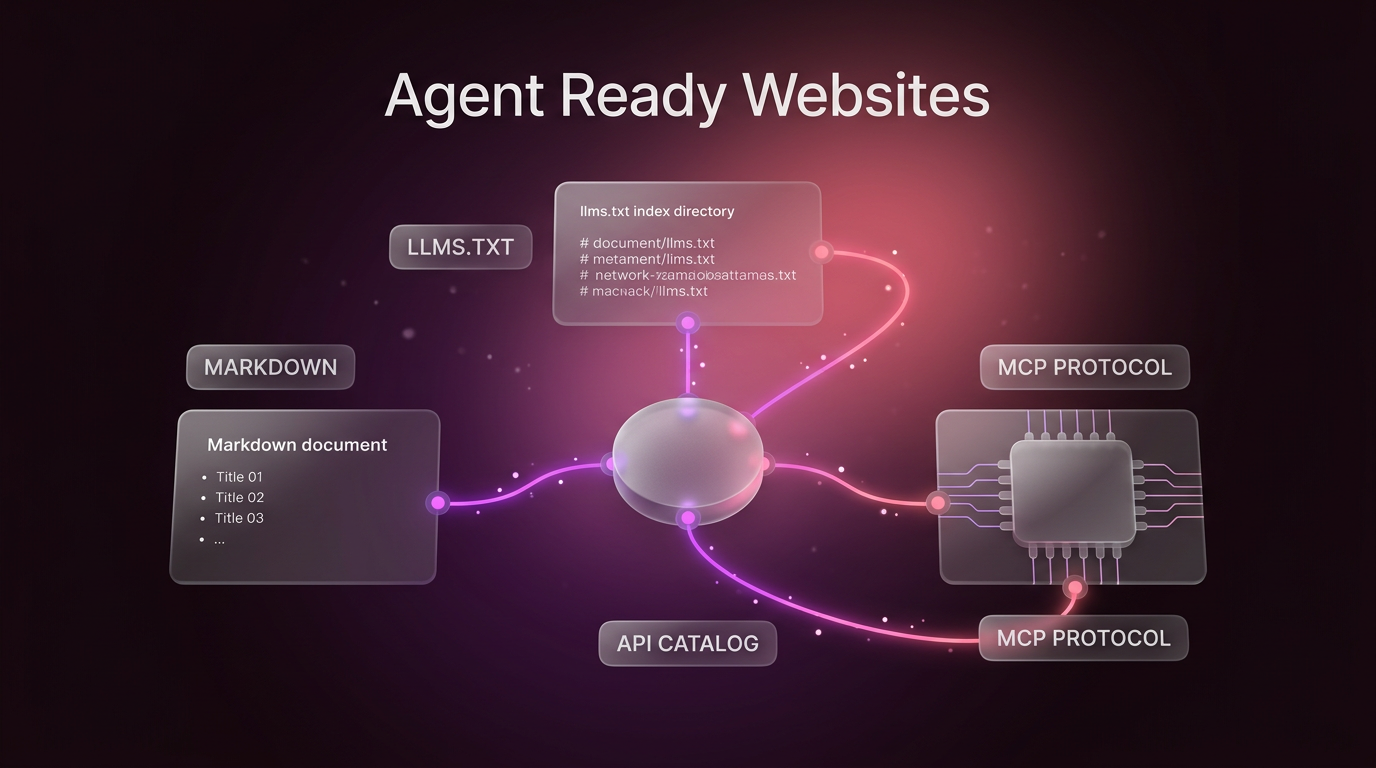
- API Catalogs: Instead of forcing an agent to guess how to retrieve structured data, sites publish machine-readable API catalogs that clearly detail endpoints, authentication requirements, and data schemas.
- Agent Discovery Endpoints: These configuration files point visiting software directly to supported tools, search interfaces, and machine-readable data repositories.
- Model Context Protocol (MCP): A communication specification that standardizes how artificial intelligence clients connect to external tools, file repositories, and data sources.
These emerging tools work together to change how autonomous programs interact with online infrastructure. An agent can discover a site map through llms.txt, retrieve readable reference pages via markdown content negotiation, and query specific transaction interfaces through Model Context Protocol servers or documented API endpoints. Together, these layers form the backbone of functional agent ready websites.
Balancing Bot Accessibility with Traditional Browsing
A common concern among business owners is whether building agent ready websites requires sacrificing the human user experience. In practice, these optimizations run parallel to existing human-facing interfaces without replacing them. Human visitors continue to receive responsive styling, modern layout components, and visual assets, while machines receive token-efficient data streams through server-side routing.
Content negotiation provides an ideal middle ground for this dual-purpose delivery. When a standard browser navigates to a URL, it requests text/html, prompting the content management system to deliver regular visual templates. When an artificial intelligence scraper or automated client requests the same URL with an Accept: text/markdown header, the server skips theme rendering and outputs the underlying markdown. Modern web designing practices increasingly incorporate these parallel delivery rules to serve both audiences effectively.
This architectural split allows site owners to maintain high design standards for human customers while minimizing compute waste for automated tools. By treating autonomous programs as a distinct audience class with unique bandwidth and token constraints, businesses avoid the trap of designing solely for one group at the expense of the other.
FAQs
What is the main benefit of agent ready websites?
The primary benefit is drastic token reduction and faster information parsing for automated programs. By delivering clean markdown or structured documentation, web hosts allow language models to extract accurate information without wasting processing capacity on decorative code.
Are llms.txt files mandatory for modern web properties?
No, llms.txt is an informal standard rather than an enforced requirement. However, prominent technology companies like Anthropic, OpenAI, and Google have adopted it to provide clear, machine-readable indexes of their documentation for automated software.
How do agent ready websites handle content negotiation?
Servers look at incoming HTTP headers sent by visiting clients. If an automated client sends Accept: text/markdown, the server delivers plain markdown, while human browsers sending standard HTML requests receive fully styled web pages.
Where This Fits in Real Builds
In modern digital operations, configuring web properties for software agents is rapidly shifting from an experimental concept to a standard deployment consideration. Wasif builds automation and web infrastructures that focus on structural efficiency, clean data pipelines, and practical integration. As organizations adopt agentic AI systems to research markets and execute cross-platform tasks, ensuring company resources are readable by third-party agents becomes essential.
Implementing these methods does not demand an entire site rebuild. Instead, technical teams can introduce lightweight files like llms.txt, configure markdown endpoints for documentation, and prepare standardized data interfaces. Wasif approaches system architecture by prioritizing clarity and maintainability, ensuring data flows smoothly between internal databases and external platforms without unnecessary operational complexity.
Conclusion
The rise of autonomous digital agents is reshaping how web architectures are planned and evaluated. Although formal governing bodies have not yet released an official technical rulebook, modern agent ready websites are already functioning across the web using markdown negotiation, llms.txt indexes, and standardized protocols. By adopting these practical formats today, site owners can ensure their digital assets remain accurate, accessible, and economical for the next generation of automated research and search engines.
To explore how structured infrastructure and automation can enhance your business operations, reach out to Wasif directly to discuss your technical setup.