Building a custom Claude Code skill allows engineering teams to codify complex telemetry analysis and operational checks directly into their development terminal. When software teams ship updates to scripts running across millions of client devices, determining whether a beta release is safe to deploy requires evaluating dozens of performance indicators across billions of telemetry rows. Rather than relying on manual query execution and ad-hoc spreadsheet reviews, teams are turning to agentic workflows to enforce consistent evaluation protocols.
Telemetry verification at scale presents steep technical hurdles. Fragile data warehouse queries frequently hit server-side timeouts, and unbalanced population sampling can easily mimic catastrophic performance drops. As detailed by the Microsoft Clarity engineering team, encoding an entire release evaluation protocol into an AI agent workflow transforms raw database access into reliable ship and no-ship decisions.
Understanding the Architecture of a Claude Code Skill
A Claude Code skill functions as an executable methodology rather than a simple automated script. Operating within the terminal via a designated markdown definition, such as a file in the project repository, the agent pairs domain guidelines with live code execution. Developers trigger the routine with a short command specifying release tags, after which the assistant fetches active metric definitions, writes targeted analytical code, runs warehouse queries, and synthesizes the findings.
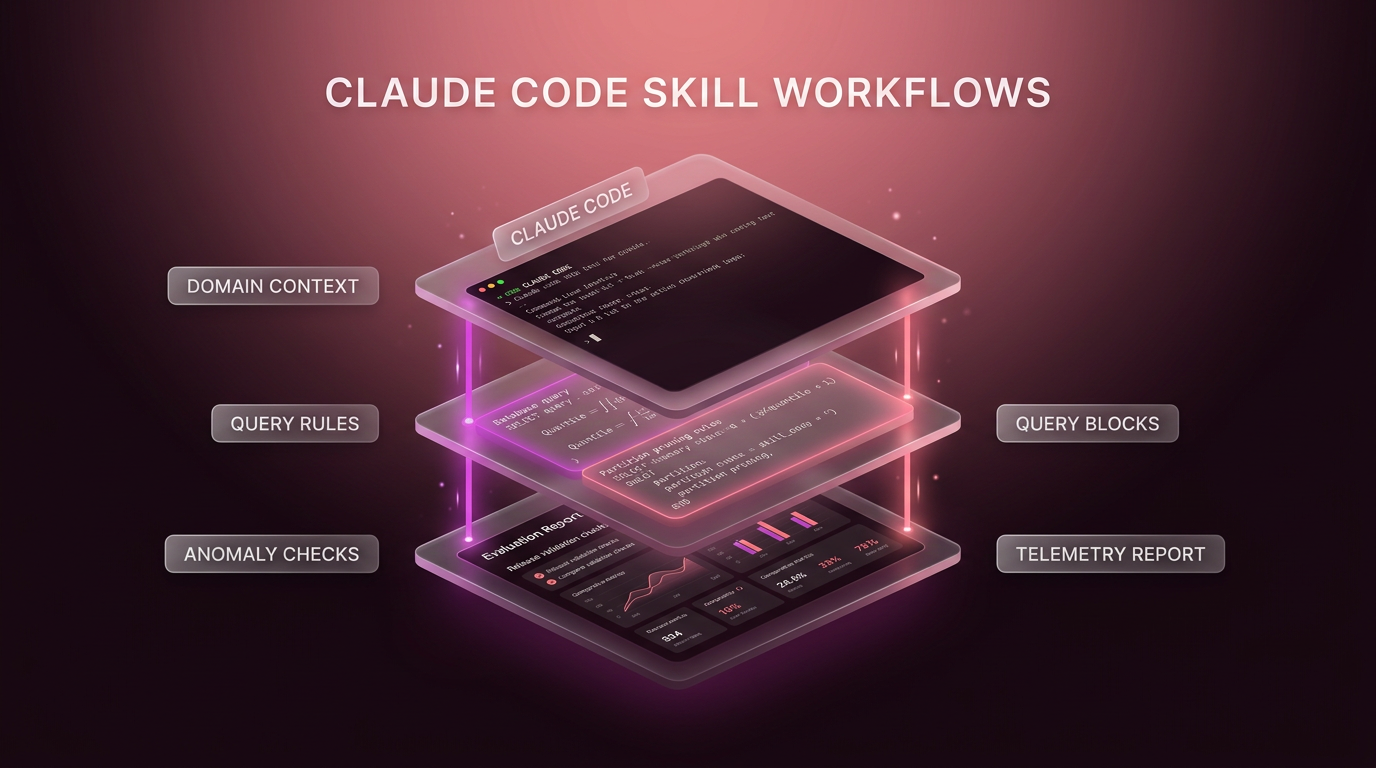
To deliver reliable output without human hand-holding, an enterprise Claude Code skill generally brings together four structural components:
- Domain context: Explicit definitions of critical performance metrics like Interaction to Next Paint (INP), Cumulative Layout Shift (CLS), and thread overhead, alongside strict threshold boundaries.
- Execution guardrails: Syntax constraints and memory limits tailored to the host data warehouse to prevent execution failures.
- Investigation phases: Step-by-step instructions that separate initial aggregate data collection from deep anomaly drill-downs.
- Statistical rules: Contextual guidelines that dictate when sample sizes, population imbalances, or tracking modes make aggregate figures unreliable.
By capturing operational know-how in a repeatable framework, teams prevent historical query mistakes from recurring during urgent production releases.
Eliminating Warehouse Timeouts at Billion-Row Scale
Aggregating client performance metrics across hundreds of thousands of websites generates enormous strain on analytical engines. Default quantile calculations often rely on reservoir sampling algorithms. Because reservoir sampling tracks individual data points in memory per aggregation state, calculating multiple percentiles across segmented groups causes memory consumption to skyrocket, triggering query termination.
Within their custom Claude Code skill, the Clarity team solved this by codifying strict algorithmic rules. Switching from default reservoir quantiles to T-Digest implementations reduced memory consumption from linear scaling down to constant memory per state. T-Digest also supports batched operations, such as computing the 50th, 90th, and 99th percentiles in a single state pass rather than through separate resource-heavy calls.
The agent was further instructed to apply partition pruning inside query pre-filters, match partition keys to version tags, and offload URL domain parsing to local application scripts instead of running heavy string manipulation in database clusters. These structural constraints turned queries with persistent timeout rates into stable executions.
Preventing the Sampling Artifact Trap in Release Telemetry
A major risk in automated evaluation is misinterpreting statistical variance as real product regression. In production telemetry, stable software versions typically run across a much larger population than beta builds. To manage computational load, engineering teams often apply asymmetric sampling, capturing data from the primary production base at a lower percentage than the experimental beta cohort.
When an analytical query returns unweighted event counts from populations sampled at disparate rates, metric volumes can look severely degraded. In one documented instance, an internal diagnostic flag appeared ten times higher in a beta release simply because the beta cohort was sampled at ten times the density of production. An automated check that solely evaluates aggregate figures would incorrectly halt the deployment.
To protect against false alarms, a rigorous Claude Code skill enforces bidirectional verification. Whenever any performance metric demonstrates a swing greater than twenty percent, the agent isolates individual websites running both versions concurrently. If metric distributions remain identical at the isolated site level, the system identifies the swing as a sampling artifact rather than code regression. Furthermore, telemetry must be stratified by operating mode, such as separating lightweight tracking from full session recording, ensuring like-for-like comparisons.
Structuring Practical AI Workflows for Modern Teams
Creating terminal-level agentic routines bridges the gap between deep analytical knowledge and day-to-day release execution. When an engineer runs a dedicated Claude Code skill, the workflow handles data gathering, isolates sample-skewed metrics, and outputs clean summary tables showing whether Core Web Vitals or processing overhead remain within acceptable boundaries.
This approach moves team practices away from informal manual checks and toward auditable, reproducible deployment gates. Similar principles apply across business operations, where connecting structured analytical agents with broader agentic AI systems allows organizations to maintain strict operational controls while saving hundreds of engineering hours.
FAQs
What is a Claude Code skill?
A Claude Code skill is an invokable workflow stored inside a repository that gives an AI coding agent specific instructions, domain guidelines, and execution boundaries. It enables the assistant to generate scripts, query databases, and analyze findings within defined operational constraints.
How does a Claude Code skill prevent query timeouts?
The skill embeds explicit query optimization rules, such as enforcing T-Digest quantiles over reservoir sampling and utilizing partition pruning. These instructions prevent the agent from writing naive database aggregations that exceed server memory limits.
Why is population stratification necessary in automated telemetry evaluation?
Stratification separates distinct operational cohorts, such as basic analytics versus full session recording, to ensure data comparisons remain fair. It prevents natural differences in tool usage or uneven population sampling rates from distorting release evaluations.
Putting Agentic Systems to Work
Deploying specialized agentic workflows ensures technical standards remain consistent regardless of which team member manages a release. Wasif Ahmed designs and deploys custom AI automation pipelines that connect analytical logic, data processing, and day-to-day business tools into reliable operational workflows.
If you want to implement dependable AI workflows for your team, explore how to get started at Wasif Ahmed’s contact page.