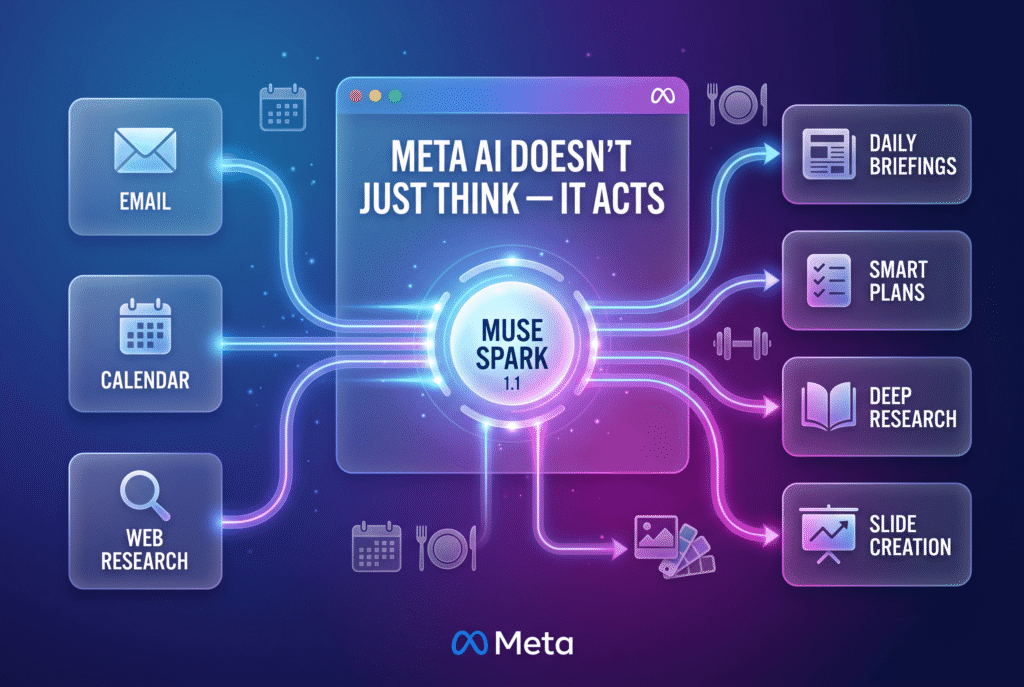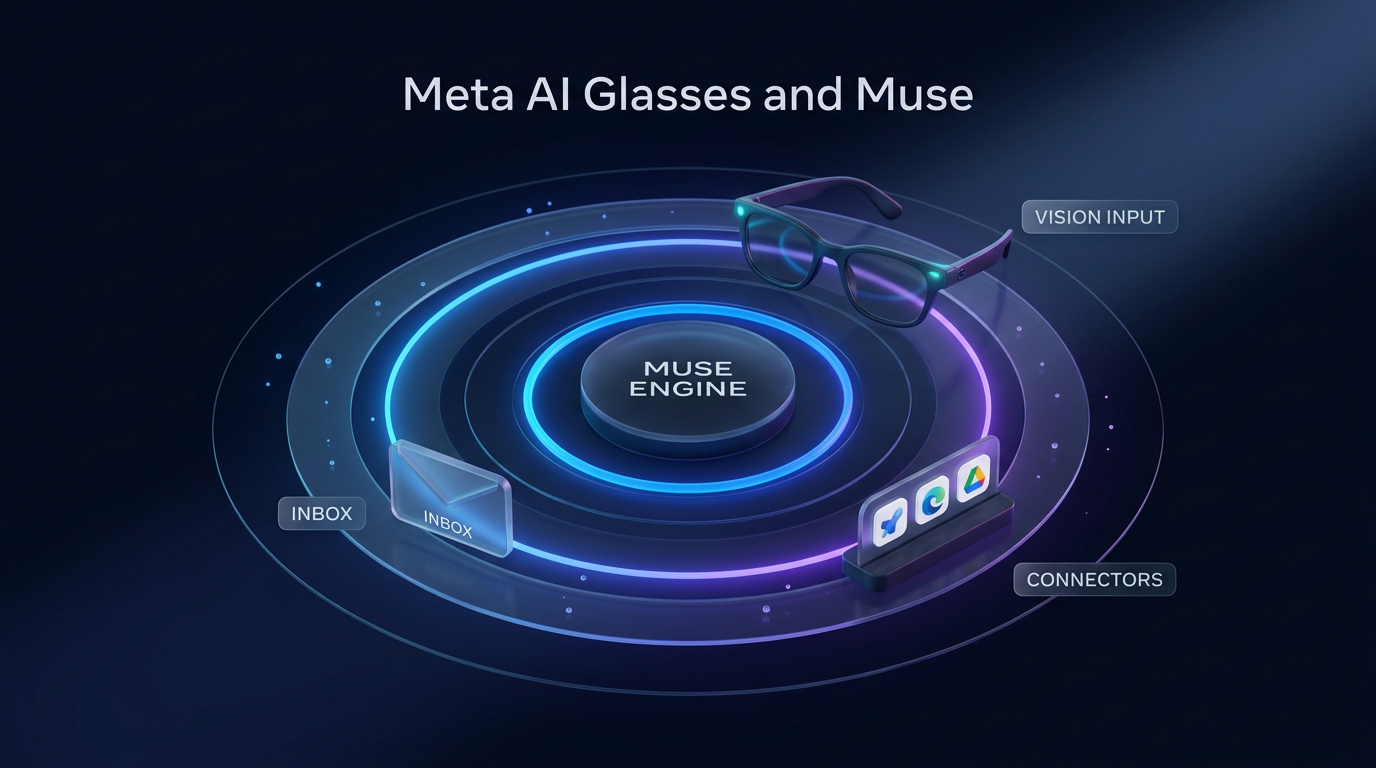
Meta AI glasses are gaining direct integration with Muse, a personal AI agent designed to execute real-world tasks proactively. The company unveiled the hardware and software roadmap at its Connect event, as announced on the Meta newsroom. The rollout combines updated consumer eyewear, enterprise connectors, dedicated email functionality, and an ultralight virtual reality headset designed for portable productivity.
The shift reflects an ongoing transition from reactive voice assistants to proactive software agents. Earlier generations of smart glasses required users to ask isolated questions and wait for rigid scripted responses. The integration of continuous models and back-end service pipelines establishes a foundation where wearables serve as persistent, ambient interfaces for daily coordination.
What Meta AI Glasses Gain with Muse Integration
The primary software development centers on Muse, a personal assistant introduced earlier this month. When paired with Meta AI glasses, Muse allows wearers to call their agent by name and prompt it based directly on what the front-facing cameras see. Rather than describing an item aloud, users can point their gaze at a product on a store shelf, a physical notice board, or written notes, prompting the system to take immediate action.
Voice interactions also receive an architectural shift. Instead of short command-and-response cycles common in conventional virtual assistants, Meta states Muse uses a conversational voice engine that performs background operations while dialogue continues uninterrupted. Wearers can maintain an ongoing conversation about a project or schedule while the assistant queries services, structures notes, and completes tasks behind the scenes.
In addition, every Muse agent will receive a dedicated email address. This enables the assistant to send messages, process incoming digital correspondence, and handle asynchronous workflows without user intervention. By providing an email address for each assistant, the software integrates directly into standard communication protocols already used across workplaces and personal scheduling tools.
Alongside the glasses integration, Meta introduced the Muse Charm, a pocket-sized companion device powered by the real-time voice model. The dedicated hardware provides another tactile access point for interacting with the assistant without requiring a phone display.
Third-Party Connectors and Shopping Ecosystem
Software agents require execution pipelines to perform meaningful work. Meta expanded its platform connectors, adding consumer retail integrations alongside existing Shopify catalog support. The partner roster now includes Walmart, Best Buy, American Eagle Outfitters, DICK’S Sporting Goods, Fanatics, Gap, Michael Kors, Sephora, Ulta, and Wayfair, backed by Shop Pay and PayPal processing.
These retail connections allow the agent to move from item identification to direct fulfillment. If a user examines an item in person or reviews a written list of school supplies, the agent can reference partner inventories, compare options, and initiate checkout through supported payment methods.
For logistical and productivity tasks, the platform is adding integrations with travel and grocery services, specifically Expedia and Instacart. Knowledge work pipelines connect directly to Notion, GitHub, Box, and Granola. These integrations allow Meta AI glasses to transition from purely informational inquiry devices to functional endpoints capable of booking, code tracking, document management, and purchasing.
- Retail and transaction support across major national merchants using Shop Pay and PayPal
- Travel planning through Expedia and automated grocery ordering via Instacart
- Workplace task management and developer tools connecting Notion, Box, Granola, and GitHub
- Dedicated email addresses assigned to individual agents for direct communication
- Real-time multimodal analysis of products, documents, and physical notices
Next-Generation Hardware: Audio Frames, Gen 3, and Meta VR Glasses
Alongside agent updates, hardware options expanded across multiple form factors. The newly announced Ray-Ban Meta Audio glasses eliminate visual cameras to focus entirely on open-ear listening, telephone calls, and hands-free voice commands. This design provides high-fidelity audio while keeping the wearer aware of surrounding sounds in offices or transit environments.
Design Variations and Audio Updates for Meta AI Glasses
For the flagship visual line, Ray-Ban Meta (Gen 3) expands the Meta AI glasses lineup with a slimmer profile, extended battery life, and a physical action button that can be configured for instant assistant access. Meta also introduced an Ivory colorway designed with Kylie Jenner, an international collaboration with LISA, and a lower-cost entry model. The company stated it will offer more than 100 frame options across the collection by the end of the year.
A specialized health feature also enters the ecosystem. An FDA-cleared hearing enhancement tool designed for perceived mild-to-moderate hearing loss will launch in the United States later this year for supported AI glasses. The software setup takes minutes at home without prescriptions or clinic visits, priced at $149.99 through HSA/FSA funds or included with a Meta One subscription. Wearers also gain an audio balance tool to shift sound bias toward the left or right ear, as well as mono audio routing options.
Updates to Meta Ray-Ban Display include hands-free navigation, a personalized hologram for video calls, and Dolby Atmos capture with spatial surround sound. The display hardware is expanding distribution through online ordering into the United Kingdom, Canada, France, Italy, and Germany.
Meta also revealed its 100-gram Meta VR Glasses, an ultralight headset matching the approximate weight of a deck of cards. Designed without bulky facial straps, the hardware functions as an IMAX Enhanced personal display supporting exclusive expanded aspect ratio films, 3D media, and immersive sports broadcasts. Content partners include Prime Video, YouTube, DIRECTV, AMC+, Crunchyroll, Plex, ESPN, Tubi, Disney+, Peacock, HBO Max, and Paramount+.
Live sports coverage will feature front-row viewing across MLB, NBC Sports, TNT Sports, and UFC, delivering over 100 immersive broadcasts annually. For business productivity, the VR Glasses project a private virtual desktop that turns flat physical surfaces into functional keyboards and touchpads, eliminating the need for portable monitors or physical peripherals.
Practical Implications for Automated Workflows
Equipping an AI assistant with external connectors and a personal inbox changes how business operators can interact with back-office software. When an agent possesses its own email address, it can be routed into standard operational pipelines alongside human staff or automated tools like AI automation workflows built on Make.com.
A business owner wearing Meta AI glasses could inspect physical inventory or documentation on-site, trigger a task via voice, and have the agent log structured data straight into project systems like Notion or GitHub. Because the voice model operates concurrently in the background, users can dictate detailed context without waiting for sequential prompt cycles to finish.
As these devices proliferate, multimodal inputs like live video and continuous voice will replace traditional form fields for on-the-go data capture. Connecting wearable interfaces to structured CRMs and custom databases represents the next step in creating unified Agentic AI Systems & AI Workforce deployments that link physical activity to digital execution.
Where This Fits in Real Client Builds
Wasif builds custom automation pipelines, web systems, and CRM integrations, monitoring wearable developments to assess where hands-free hardware simplifies real-world operations. For service businesses and field technicians, integrating smart eyewear with back-end databases removes friction between fieldwork and administrative logging.
In standard field operations, workers spend considerable time transcribing measurements, filing safety tickets, or verifying stock codes on hand-held tablets. A wearable camera linked directly to an agent eliminates manual transcription. The worker examines the machinery or stock label, speaks a status update, and the agent processes the visual and auditory inputs simultaneously.
While consumer shopping features dominate promotional headlines, the addition of dedicated email addresses and structured API connectors makes Meta AI glasses an emerging interface for serious workplace automations. Businesses that structure their internal APIs and database webhooks now will be prepared to ingest structured inputs directly from wearable hardware as adoption expands.
Frequently Asked Questions
How does Muse operate on Meta AI glasses?
On Meta AI glasses, Muse connects live camera input to a continuous voice model so users can speak directly to the assistant about items in their field of view. Rather than waiting for one reply before issuing another instruction, wearers can engage in extended conversations while the agent executes tasks and processes data in the background.
What is the FDA-cleared hearing feature on supported models?
Meta introduced an FDA-cleared software feature for adults with perceived mild-to-moderate hearing loss. Users can calibrate the software at home in minutes without clinical visits or medical prescriptions. The feature costs $149.99, qualifies for HSA/FSA reimbursement in the United States, or comes bundled within a Meta One subscription.
How do the Meta VR Glasses differ from standard smart frames?
The Meta VR Glasses weigh approximately 100 grams and deliver virtual reality displays without facial straps. They feature IMAX Enhanced certification for private cinematic streaming, over 100 live immersive sports events annually, and a virtual workspace feature that converts flat desks or tables into interactive keyboards and touchpads.
For teams assessing how Meta AI glasses can support field operations, custom database logging, and automated digital systems, exploring integration pathways early ensures smooth adoption. If you are planning to connect custom business logic to autonomous AI systems, explore custom implementations by reaching out through the contact page.