Claude Opus 5.5 is here with model and pricing changes aimed at long-running software engineering tasks. On September 24, 2026, details published on the Claude blog highlighted that Claude Opus 5.5 costs an estimated 40 percent less to run than Opus 5 for typical token-billed workloads. The update reflects a clear reality in software engineering: developer sessions now run longer, carry deeper context, and make substantially more tool calls than they did earlier in the year. The relevant question is not only how capable a model is, but also how efficiently it handles the context that accumulates during a session.
The Core Cost and Model Changes in Claude Opus 5.5
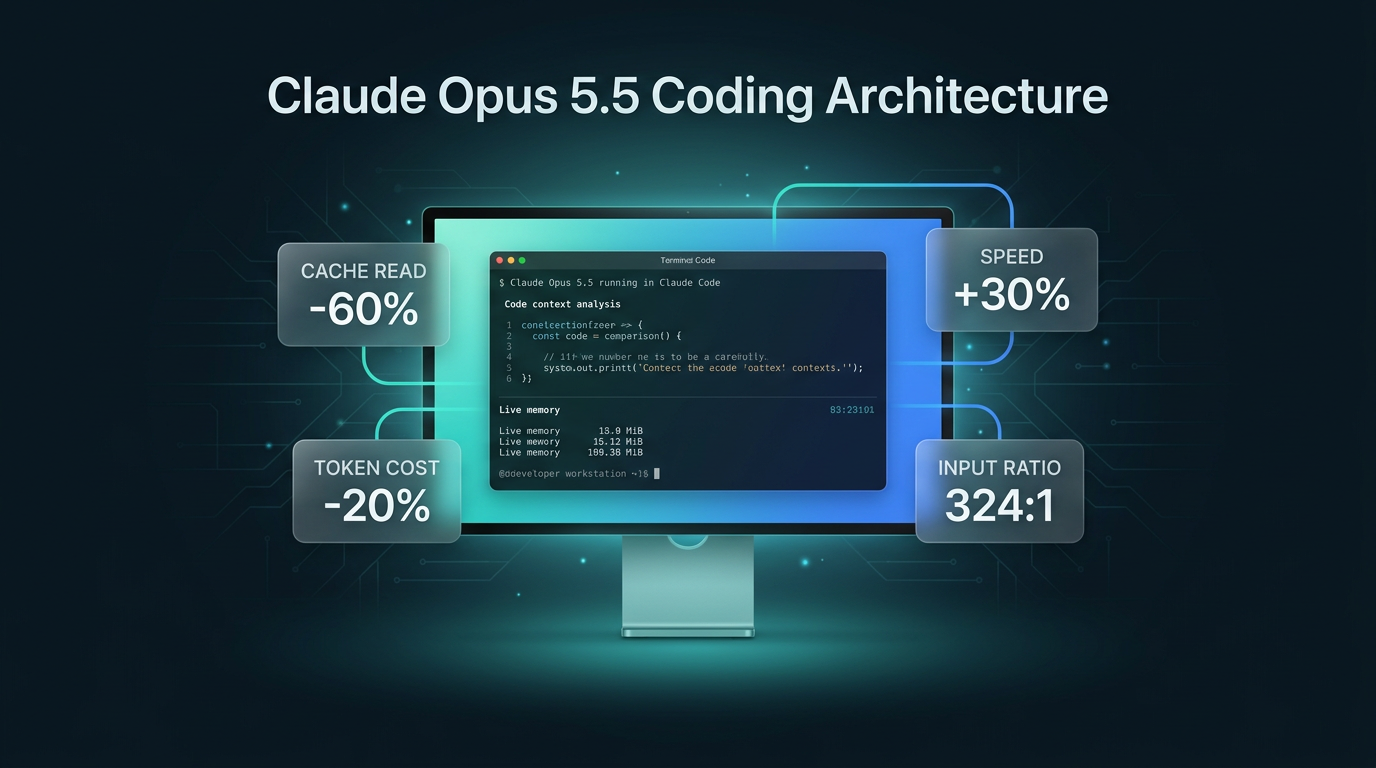
The cost savings in Claude Opus 5.5 stem from three connected adjustments: lower baseline pricing, reduced pricing on cache reads, and faster execution speeds. For usage billed by token, input and output token prices dropped by 20 percent. Even more impactful for agentic work, the cost of reading a cached token dropped by 60 percent. The company states that as of the release date, reading a cached token on this model costs one-fifth of what comparable competing models charge.
For Claude Opus 5.5, the cache change matters because coding agents repeatedly revisit the same repository instructions, files, tool definitions, and conversation history. A long session may add new information while still relying on much of the earlier context. When that information is available as a cache read, the developer does not pay the same rate as if the model had to process it as new input.
Speed also received a measurable boost. Claude Opus 5.5 produces output text more than 30 percent faster than Opus 5. While faster throughput does not change token consumption directly, it shortens wait times during unattended agent runs where the model must complete multiple reasoning passes before reporting back. This is mainly a time benefit, but it matters when a workflow includes several sequential tool calls or delegated checks.
Operational efficiency goes beyond raw pricing. The company noted that on complex tasks, the model frequently requires fewer conversation turns to solve a problem. In third-party evaluations cited from Zeta Labs, the model completed the same tasks with fewer turns and tool calls than Opus 5, cutting costs nearly in half while solving twice as many of their most difficult programming challenges. Those findings do not mean every task will produce the same result. They indicate that fewer turns can create an additional saving when the task is open-ended and the model avoids spending time on an unproductive approach.
How Developer Habits Shifted Context Requirements
Data gathered from Claude Code usage between March and September 2026 explains why context management has become the central focus of model pricing. During that six-month window, developer behavior changed across several metrics:
- Context per request expanded by 2.6 times, shifting the ratio of input tokens to output tokens from 189 to 1 up to 324 to 1.
- Claude works 3.3 times longer per prompt, executing more than 40 percent more model calls per prompt.
- Developer interruptions during prompt execution dropped by 68 percent.
- Engineers became twice as likely to connect an external tool server or skill, while direct text pasting into prompts declined by one-third.
These figures describe a shift from short question-and-answer exchanges toward longer working sessions. Developers are giving coding agents access to more structured context through tools and skills, then allowing those agents to continue across more model calls. The result is less manual interruption, but also more repeated reading of the information needed to complete the task.
Because sessions hold substantial codebases in memory across multiple tool executions, re-reading previously cached context accounts for the vast majority of the token bill. A price decrease aimed specifically at cached reads yields much higher financial savings today than it would have under earlier workflows, simply because tokens read from cache dominate total usage. In practical terms, context engineering is now part of cost management. Teams need to decide which instructions, files, and tool outputs should remain available throughout a run.
Harness Improvements and Cache Protection
Lower cache prices only help if the model harness avoids cache misses. Alongside the model update, improvements inside Claude Code reduced cache misses on input tokens by more than 50 percent. Common friction points that previously invalidated memory have been insulated, making the cache more useful over a session that includes many actions.
For instance, routine actions such as refreshing a session login no longer invalidate cached data. Larger adjustments, including updating instructions mid-conversation or mounting tools on demand, also maintain the existing cache. For models like Claude Opus 5.5 and Fable 5.1, users can change reasoning effort levels during an active session without wiping cached progress.
For external integrations using API keys or cloud providers, teams can now set a one-hour cache lifetime, matching the extended retention previously available to subscription plans. When developers spawn delegated subagents to explore secondary tasks, the child agent branches directly from the parent session cache rather than charging to parse the entire codebase from scratch. This is especially relevant when a parent session has already gathered repository details that a secondary agent needs for a focused check.
Cache protection does not remove the need for careful session design. A changing prompt, a newly loaded tool, or an unnecessary context item can still affect what the agent must read. The practical goal is to preserve useful context while avoiding needless additions. That balance helps the lower cache-read price apply to the largest possible share of a coding session.
Practical Guidelines for Managing Claude Opus 5.5 Sessions
To capture the full economic benefit of Claude Opus 5.5, developers must manage their session discipline. The company recommends running the /usage command inside Claude Code regularly to inspect what fraction of current token volume comes from cached reads. This gives a session-level view of whether the workflow is reusing context or repeatedly sending it as uncached input.
Selecting Claude Opus 5.5 at the very start of a work session prevents unnecessary cache disruption, as switching models midway can reset the cache. Similarly, engineers should compact conversation history before stepping away from the keyboard rather than waiting until they return. For teams relying on direct cloud provider endpoints, activating the one-hour cache retention setting ensures that long delays between user inputs do not trigger avoidable cache rebuilds.
Task scope dictates whether the turn-reduction advantage materializes. On small, well-defined coding jobs with limited file context, Claude Opus 5.5 and Opus 5 finish in roughly the same number of turns, meaning savings remain limited to the baseline 20 percent token discount. The larger financial and time savings appear primarily on ambiguous, large-scale problems where older models run in circles and waste tokens chasing unproductive debugging paths.
That distinction makes measurement important. A team can compare cached reads, total turns, tool calls, and completion time across representative tasks instead of applying one expected saving to every workflow. Short mechanical changes may mainly benefit from pricing. Longer tasks with open-ended investigation have more opportunity to benefit from cache reuse and fewer turns.
What This Changes for Real Automation Builds
In production development, context accumulation is often the primary bottleneck for complex workflows. Wasif designs AI automation and multi-step agent architectures where systems must parse large database schemas, dynamic payloads, and extensive tool definitions. When background workers handle heavy context, cache retention directly influences whether automated pipelines remain financially sustainable.
With Claude Opus 5.5, lower cache read fees and subagent inheritance make running autonomous checks more viable. In setups featuring agentic AI systems, specialized subagents can audit code changes, run schema validations, or draft integration tests without paying the penalty of reading the original context bundle anew. This does not eliminate compute costs, but it reduces duplicated context processing when several agents work from the same parent session.
These mechanics also affect how Wasif can structure an automation workflow. A parent agent can gather the relevant repository and task context, while delegated workers handle narrower responsibilities. Keeping those workers connected to the parent cache helps separate tasks without forcing every worker to rebuild the same background. The approach is most useful when the workflow is long-running, tool-heavy, and dependent on shared information.
Claude Opus 5.5 FAQ
Is Claude Opus 5.5 cheaper for every coding task?
No. Claude Opus 5.5 has lower token and cache-read pricing, but the total saving depends on the task and session pattern. Short, well-scoped tasks may use about the same number of turns as Opus 5, while longer and more open-ended tasks have more potential to benefit from cache reuse and fewer turns. Teams should measure representative work rather than assume a single result applies everywhere.
What is the most practical way to protect cache usage?
Developers can choose the model at the start of a session, compact before stepping away, and use the one-hour cache lifetime when working through an API key or cloud provider. Running /usage in Claude Code also shows how much usage comes from cached reads. These steps help developers see whether a long session is retaining useful context.
Does faster output reduce token usage?
No. Output that arrives more than 30 percent faster reduces waiting time, but it does not by itself reduce the number of tokens generated or improve the cache hit rate. The cost changes come from token pricing, lower cache-read pricing, cache behavior, and the number of turns needed for a task.
For teams planning longer coding sessions, Wasif can help assess where Claude Opus 5.5 fits within an automation workflow and identify practical ways to preserve context. Explore options with Wasif at Wasif Ahmed’s contact page.