Securing AI agents has become an urgent operational challenge as autonomous software moves into business workflows. Building software no longer means deploying static code that calls predictable endpoints. Teams now run dynamic tools that take open-ended actions across multiple platforms.
Lovable announced that it joined AWS, CrowdStrike, Databricks, Docker, Google Cloud, Okta, Proofpoint, Salesforce, ServiceNow, Wiz, and Zscaler as a founding member of the Blueprint Alliance. This cross-industry coalition focuses on advancing an open reference architecture for securing and governing software agents at an enterprise scale, as announced on the Lovable blog.
A reference architecture provides a shared blueprint describing how complex systems fit together safely. Most companies do not run artificial intelligence from a single vendor. Identity comes from one identity provider, data platforms run in another cloud, and telemetry arrives through separate observability pipelines. Each provider secures its own boundary, but teams have lacked a unified blueprint for securing AI agents across those distributed environments.
The Core Challenge in Securing AI Agents
Modern agentic workflows interact with critical company assets. When an autonomous system attempts to update records, schedule jobs, or call APIs, security teams need to understand the blast radius. Without shared standards, organizations often struggle to enforce basic governance.
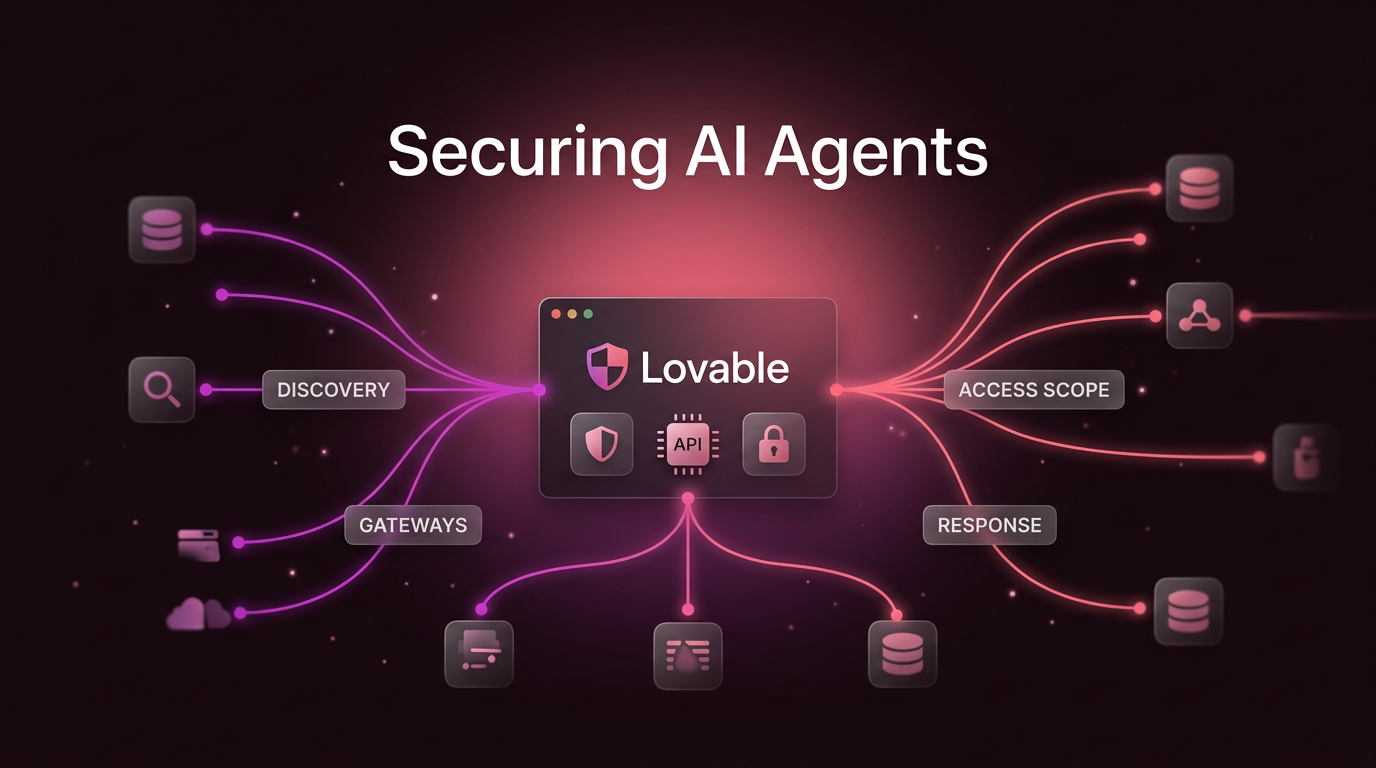
The Blueprint Alliance organizes its technical reference architecture around four fundamental questions that every enterprise IT and engineering team must answer when securing AI agents:
- Where are the agents running across the infrastructure?
- What resources and systems can those agents connect to?
- What specific operations are agents performing right now?
- How can an administrator respond when an anomaly occurs?
By establishing concrete answers to these questions, the framework provides practical structures instead of abstract policies.
Mapping the Fleet: Discovery and Registration
The first tier of the blueprint focuses on visibility. Organizations cannot protect assets they cannot see. The alliance outlines three ways software agents enter an organization:
First, what internal developers build directly. These are internal tools built on agent frameworks and connected to various foundation models selected by engineering teams.
Second, shadow tools discovered across environments. Unregistered scripts and background jobs operate across cloud infrastructure, internal networks, endpoints, and developer browsers.
Third, imported systems. These include external builder platforms, SaaS products, automation pipelines, local processes running on staff workstations, and third-party agent gateways.
To manage this sprawl, the blueprint calls for a centralized agent directory. In this directory, every system receives a distinct identity paired with a verifiable human owner. Securing AI agents begins with knowing who launched each process and who remains accountable for its actions.
Controlling Boundaries and Connection Scopes
Once an agent exists in the directory, administrators must establish identity boundaries. Traditional service accounts often carry static credentials with broad permissions, which creates significant risk for autonomous systems.
The alliance framework places access policies directly on top of the central directory. These policies range from coarse-grained rules down to fine-grained and intent-based permissions, backed by network controls and security guardrails. Rather than granting standing privileges, permissions are limited to the immediate task. When an agent creates sub-agents to complete child tasks, delegation remains strictly traceable.
Understanding blast radius requires listing every resource an agent can touch. The architecture explicitly enumerates sensitive targets:
- Model Context Protocol (MCP) servers and custom tools
- SaaS business applications and internal data stores
- Command-line interfaces and underlying operating system terminals
- Peer agents and foundation models
- Payment processors, legacy databases, and web browsers
Securing AI agents means ensuring that no automated process holds broader reach than its immediate prompt requires.
Enforcing Real-Time Execution Policies
Visibility and permissions alone do not stop runtime errors or deliberate prompt manipulation. The blueprint places dedicated gateways directly inside the execution path to evaluate requests before they run.
These enforcement checkpoints include specialized agent gateways, MCP gateways, large language model gateways, and enterprise security gateways. Inline policy evaluation intercepts traffic in real time rather than checking audit logs after data leaves the network.
Monitoring happens throughout each active session. The blueprint details continuous checks covering secure sandboxing, live data access verification, anomaly detection, output filtering, prompt injection defenses, distributed tracing, and cost controls. When high-stakes tasks arise, the system triggers human-in-the-loop validation checkpoints before execution proceeds.
Incident Response and Containment
The fourth pillar of the alliance reference architecture addresses rapid response. If a process behaves abnormally, administrators need precise containment controls rather than coarse shutdowns that disable entire production lines.
The blueprint supports graduated responses, including instant token revocation, universal session termination, dynamic network quarantine, individual process termination, and halting the parent agent platform. Security personnel can neutralize a compromised worker without breaking adjacent services, while ensuring system reinstatement remains auditable.
What This Means for Real-World Deployments
For engineering leads and software builders, Lovable joining the Blueprint Alliance signals that application generation tools are prioritizing operational security. Developers building workflows require reliable guardrails so that generated applications comply with standard enterprise requirements.
Wasif builds production automations using platforms like Make.com, custom code, and Go High Level CRM architectures. In client implementations involving Agentic AI Systems & AI Workforce solutions or tailored AI automation pipelines, securing AI agents follows these exact containment principles. Scoping access tokens, restricting API scopes, and keeping human verification steps on sensitive database writes ensures automations remain reliable.
FAQs
Why is the Blueprint Alliance needed right now?
Enterprises run tools from multiple cloud, model, and identity vendors simultaneously. The Blueprint Alliance provides a vendor-neutral reference architecture so organizations can govern autonomous software across disparate platforms under a single security framework.
How does the blueprint handle shadow AI?
The architecture includes active discovery mechanisms that scan networks, endpoints, browsers, and cloud infrastructure to detect unregistered background jobs. It then requires these tools to be registered in a directory under an accountable human owner.
What is intent-based access control for software agents?
Intent-based access control evaluates the specific objective of an agent before approving an action, rather than relying on permanent permissions. This approach ensures tools only access third-party data when completing an authorized task.
If you are planning to build reliable automated workflows or need help securing AI agents across your internal systems, reach out to discuss your project.