Anthropic has announced that Claude Mythos 5 is rolling out to cybersecurity tools, enterprise code scanners, and vetted defense organizations. The update introduces the model directly into Claude Security for Enterprise customers, launches a 35 million dollar fund for open-source maintainers, and sets a roadmap to expand access through partner platforms.
As detailed in the announcement on the Claude blog, the initiative builds on Project Glasswing, an early program started in April that provided select organizations with advance access to Claude Mythos Preview and Claude Mythos 5. The stated focus is helping defensive teams find and resolve software vulnerabilities before malicious actors can exploit them.
Key Changes Across the Claude Security Suite
Claude Mythos 5 is now integrated into Claude Security, which is currently available in public beta for Claude Enterprise subscribers. Enterprise administrators can turn on the feature directly within their admin console without paying a separate add-on fee, as scans are billed under standard token usage.
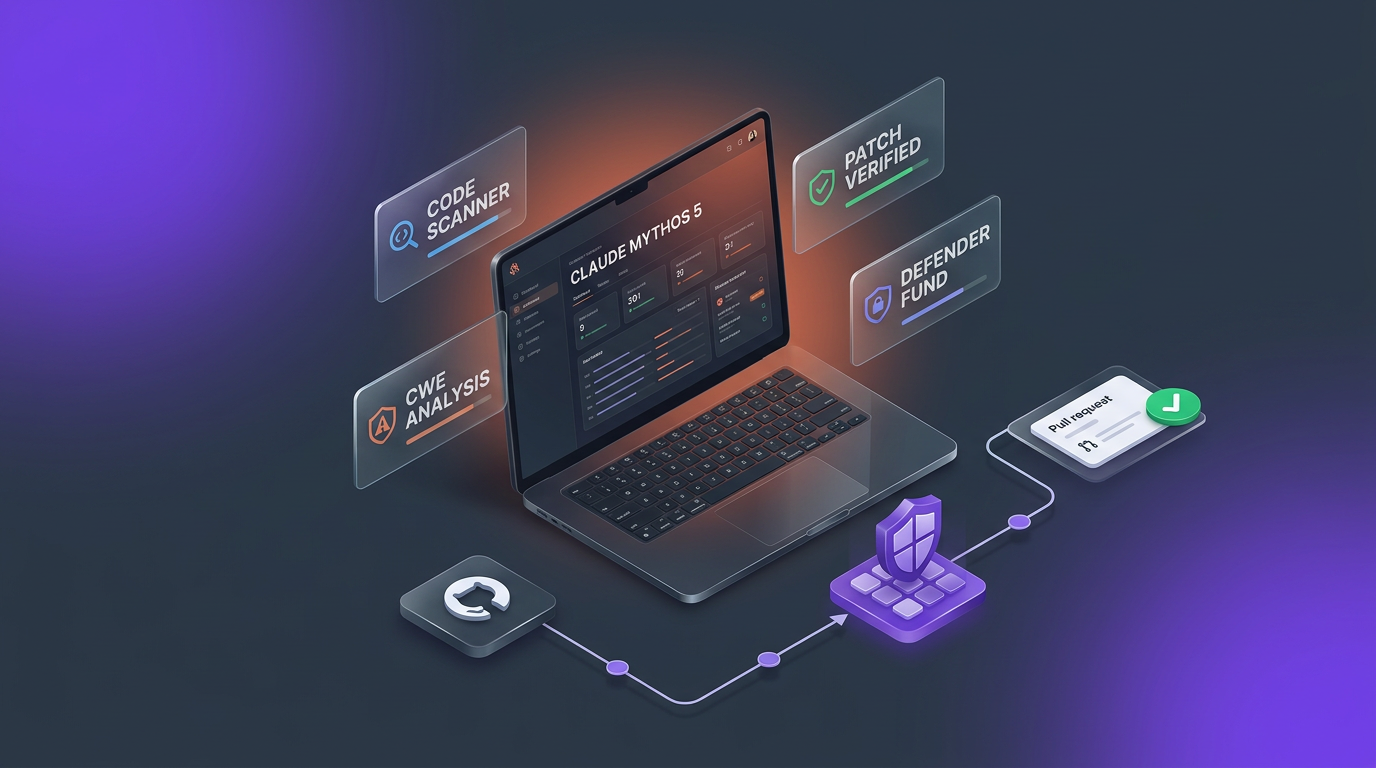
Once enabled, teams can run repository scans from claude.ai/security. The scan inspects codebases for security flaws and returns structured reports containing:
- Common Weakness Enumeration (CWE) category classifications
- Assessed confidence scores and severity levels for each finding
- Suggested code patches tailored to the detected vulnerability
- Direct handoff into Claude Code on the web for human review and interactive patch application
Anthropic states that the scan itself does not grant raw model access. Instead, it generates concrete artifacts, meaning every suggested code change remains subject to manual inspection before implementation.
Safeguarding Model Access Through Purpose-Built Tools
Direct conversational access to high-capability models presents dual-use risks, as users could attempt to steer model outputs toward offensive tasks or exploit generation. To mitigate this, Anthropic is structuring Claude Mythos 5 access around task-specific interfaces rather than open-ended chat prompts.
Technology partners building incident response, triage, and vulnerability remediation products will embed Claude Mythos 5 in the background. End users interact only with specialized controls that deliver defensive outcomes, such as automated alert summaries or verified pull requests. The model operates behind defined task boundaries designed to prevent unauthorized exploit creation.
Alongside tool integrations, Anthropic announced plans to expand its Cyber Verification Program over the coming weeks. The program grants vetted defense teams reduced guardrail restrictions on Claude Opus and Claude Sonnet models for authorized protection work, with planned expansion into Mythos-class models in subsequent phases.
The Defender Advantage Fund for Open-Source Software
To address vulnerabilities across public infrastructure, Anthropic is launching the Defender Advantage Fund (0xDAF). The program allocates 35 million dollars in Claude credits to organizations that defend and maintain open-source software projects.
The fund expands on previous Project Glasswing donations, which provided 4 million dollars to open-source security organizations and backed coordinated patching efforts like Akrites and Gold Eagle. Initial grants under the new fund will pilot three core defensive areas:
- Patching active vulnerabilities in widely adopted open-source packages
- Automating scanning and remediation workflows that maintainers can replicate
- Developing architecture improvements that protect codebases against entire classes of software attack
Anthropic stated it will distribute initial pilot grants to a small group of recipients before expanding the program more broadly.
What This Means for Automated Security Workflows
For organizations running complex software architectures, the introduction of Claude Mythos 5 into structured workflows signals a shift in how code auditing occurs. Integrating high-capability models into closed, deterministic pipelines allows teams to gain defensive intelligence without exposing raw generation prompts to abuse.
When Wasif designs custom AI automation and agentic AI systems, structured guardrails and human approval loops remain essential requirements. Anthropic’s choice to route Mythos 5 findings through Common Weakness Enumeration classifications and mandatory review in Claude Code mirrors this design principle. Automated scanners should identify risks and prepare fixes, but production code updates must always require authorized human confirmation.
If you want to build secure, structured automation workflows for your business operations, feel free to reach out to Wasif Ahmed.