A standard AI code reviewer often analyzes raw text diffs without executing the target software. When an automated system reviews code solely from a diff, it must guess at the surrounding repository context and assume whether an identified issue actually produces a runtime error. This guesswork frequently produces false positives or misses logic flaws that appear only when tests run. Moving the evaluation into an execution environment eliminates this problem by running checks before any feedback is delivered to the developer.
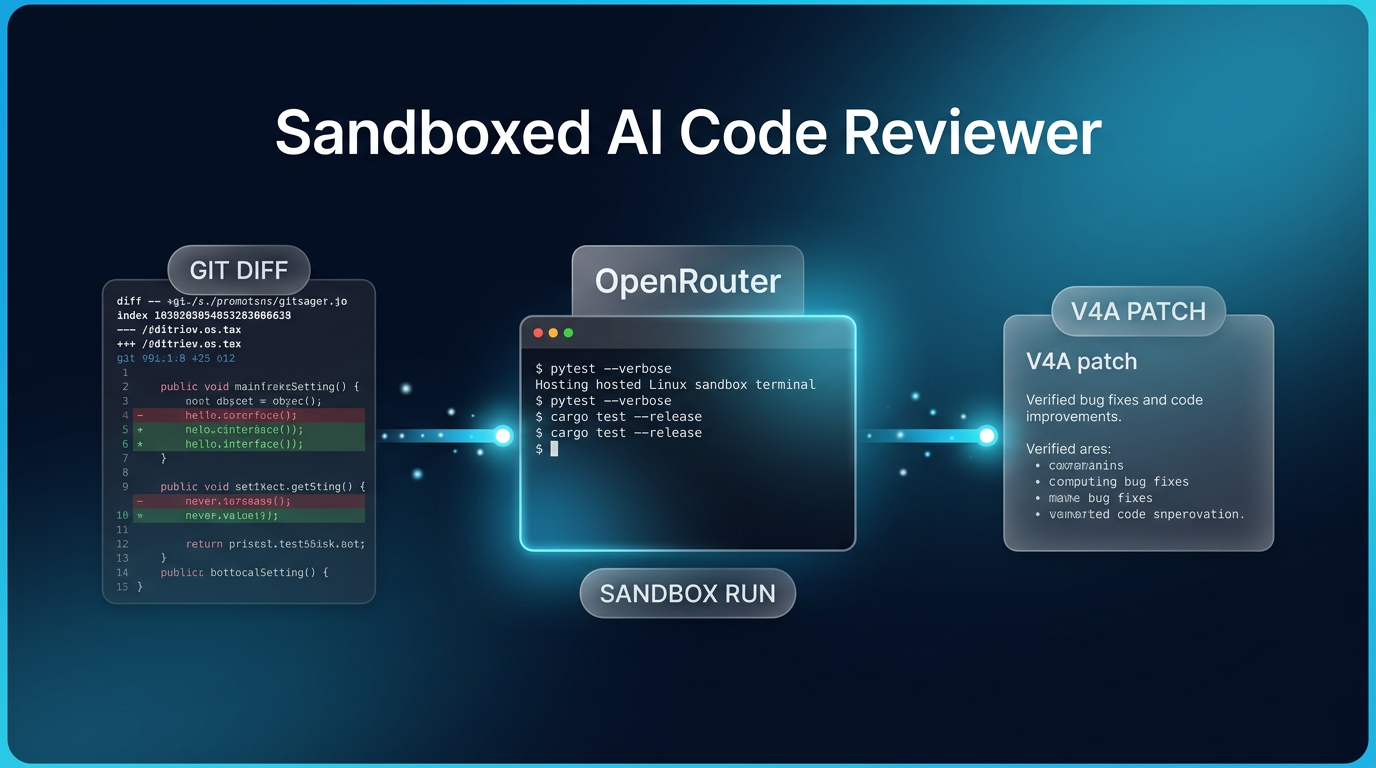
A recent tutorial published on the OpenRouter tutorial blog details how to build a lightweight script that tests modifications directly. The tutorial outlines a 233-line standard-library Python script that inspects Git changes, uploads them to an isolated Linux environment, validates bugs through direct test execution, and produces formatted fixes.
Why a Sandboxed AI Code Reviewer Prevents Hallucinations
Static inspections struggle when code depends on external libraries, project configuration, or complex object states. An AI code reviewer that only reads patch files cannot determine whether a modified variable breaks an unmentioned module elsewhere in the tree. Because of these visibility gaps, language models often hallucinate syntax errors that do not exist or invent non-existent import failures.
Sandboxing solves this limitation by providing an interactive shell alongside the model. Instead of asking the model to mentally trace code execution, the script uploads the diff along with modified files into a hosted Linux sandbox through the OpenRouter Responses API. The AI code reviewer then executes commands, runs existing test suites, and observes stdout and stderr directly. If a supposed bug does not cause a test to fail or an assertion to break, the reviewer discards the speculation before notifying the programmer.
How the 233-Line Python Architecture Operates
The entire implementation described in the tutorial relies strictly on Python standard library modules, avoiding third-party dependency overhead. Keeping the client script minimal ensures that developers can run the tool across diverse operating systems without managing complex virtual environments.
The script executes four sequential tasks during a review cycle:
- Extracting local Git diffs and changed source files from the current branch.
- Provisioning a temporary hosted Linux sandbox using the Responses API.
- Executing runtime commands to reproduce bugs and inspect real application output.
- Emitting confirmed corrections as structured V4A patches for immediate review.
By returning fixes as V4A patches, the AI code reviewer provides precise diff hunks that developers can inspect and apply directly with standard patch utilities. The workflow eliminates the need to copy and paste code blocks manually from chat interfaces into local editor windows.
Benchmarking Model Cost and Reliability
Model selection determines both the financial cost and the reliability of automated code analysis. The OpenRouter tutorial evaluated the workflow against a controlled five-bug code change across multiple runs, comparing two distinct models from Anthropic.
Claude Haiku 5.5 delivered rapid execution at an average cost of $0.0153 per review run. While Haiku offers low expenses for high-frequency testing, its success rate on complex logic errors was lower than larger alternatives.
Claude Sonnet 5.5 demonstrated complete reliability in the benchmark. Across three test runs against the five-bug change, Sonnet fixed all five bugs in every run. Sonnet completed each review run in an average of 60 seconds with an average run cost of $0.0447. For production software where bug detection outweighs raw execution speed, paying roughly four cents per commit provides a dependable validation safeguard.
Integrating the AI Code Reviewer into Daily Workflows
A functional script needs sensible triggers to protect repositories without slowing team velocity. The tutorial covers two deployment patterns: pre-push hooks and continuous integration pipelines.
Local Pre-Push Hook
Running the script as a Git pre-push hook catches mistakes before commits leave a local workstation. The hook triggers automatically when a developer runs git push. If the script detects issues and generates a patch, the push halts, allowing the engineer to review the proposed fixes locally. This approach keeps incomplete work and accidental bugs off shared remote branches.
GitHub Actions Pipeline
For engineering teams requiring central oversight, running the script inside GitHub Actions creates an automated pull request inspector. When a pull request opens, the action triggers the Python script, connects to the sandbox, validates the incoming changes, and posts confirmed findings directly to the pull request discussion thread. Centralizing this check ensures that all submitted code meets baseline quality checks before human maintainers conduct their review.
FAQs
How does a sandboxed AI code reviewer verify security issues?
The script uses the OpenRouter Responses API to provision a hosted Linux sandbox where it can run security scans, invoke compilers, and execute targeted test cases. If an identified security vulnerability produces unexpected system behavior or crashes, the runner confirms the vulnerability before generating a fix.
What is a V4A patch format?
A V4A patch is a structured format that represents code modifications cleanly. It allows developers to view exact line deletions and additions so that confirmed fixes can be applied directly to their repository files using standard Git patch commands.
Why use standard-library Python for this automation?
Using only the Python standard library removes the need for package installations, dependency pinning, or virtual environment activation. This makes the 233-line script portable across local developer laptops, lightweight container images, and continuous integration runners.
Connecting Code Review to Broader Automations
Automated verification fits naturally alongside modern development stacks. Wasif builds operational workflows, custom software integrations, and Agentic AI Systems & AI Workforce configurations that help businesses run technical processes reliably. Grounding model responses in verifiable environments is a sound architectural principle whether auditing code repositories, structuring business data, or connecting tools through AI automation.
When software teams remove speculation from automated systems, output quality rises significantly. An AI code reviewer backed by sandboxed execution turns ambiguous textual advice into actionable, tested engineering fixes that developers can verify immediately.
To discuss building custom operational software or integrating automated AI workflows into your business systems, reach out through the contact page.