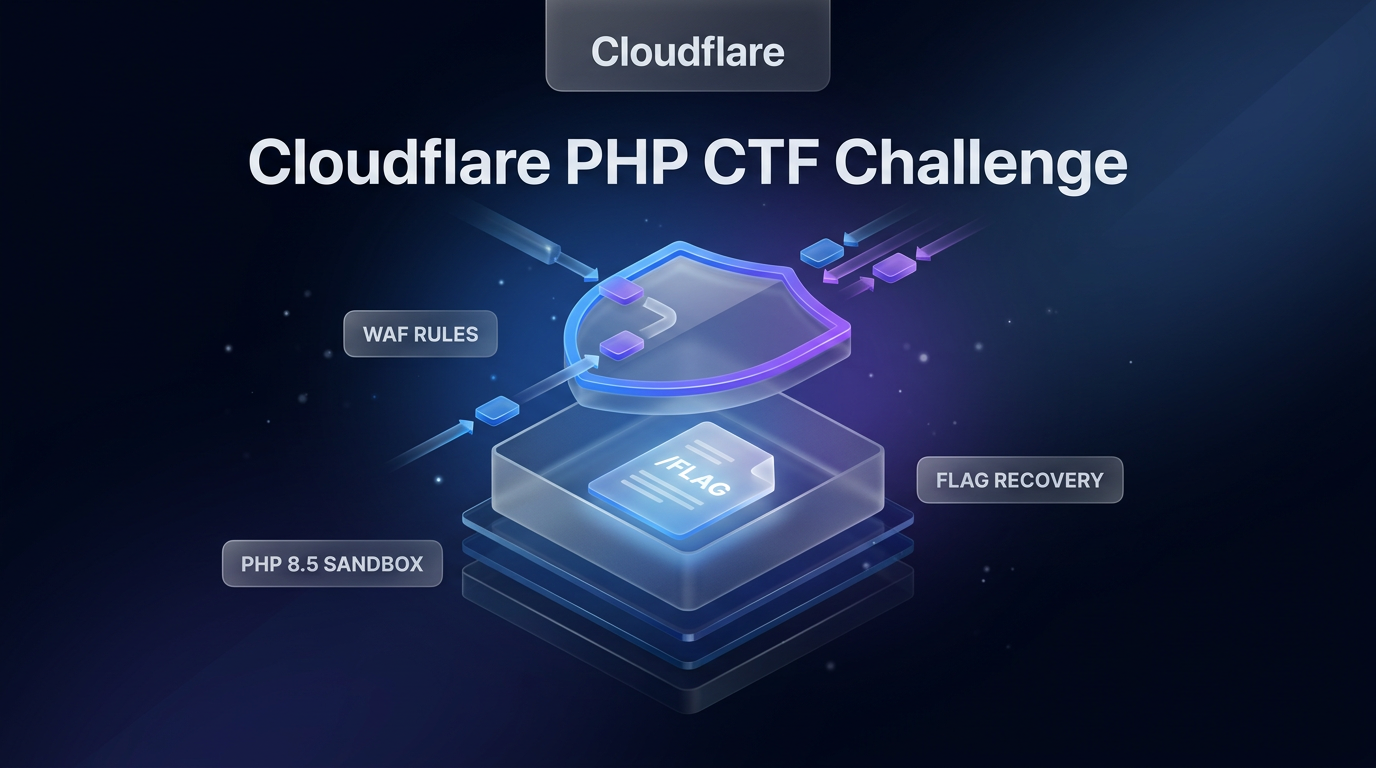
Cloudflare has announced the Cloudflare PHP CTF, an active Capture the Flag challenge hosted through its official Bug Bounty program on HackerOne. The initiative arrives directly after significant security disruptions across the web, including compromised intermediate certificates and the emergence of severe vulnerabilities in PHP known as php2shell. To test its protective layers under real conditions, Cloudflare placed a deliberately vulnerable PHP environment behind its Web Application Firewall and invited ethical hackers to attempt an exploit.
The announcement follows a challenging operational period for infrastructure teams worldwide. Security teams first dealt with eight compromised eMudhra intermediate certificates, an event that opened risks for unauthorized server impersonation. Shortly after, disclosures revealed critical remote code execution flaws in the core PHP runtime. In response, Cloudflare deployed client updates, added new WAF mitigation rules, and rolled out full transaction detection across all account tiers, including the Free plan.
The Vulnerabilities Behind the Cloudflare PHP CTF
The core objective of the Cloudflare PHP CTF revolves around two specific vulnerabilities: CVE-2026-109618 and CVE-2026-109619. These security flaws constitute the php2shell vulnerability set, exposing underlying PHP environments to potential remote code execution. Because PHP powers a large share of active websites, vulnerabilities in the runtime present immediate operational risks for businesses and platform maintainers.
Cloudflare moved to shield web origins by introducing edge mitigations as details of php2shell surfaced. The company says that widespread use of automated intelligence tools allows malicious actors to scan for entry points and construct exploits rapidly. Rather than relying solely on internal laboratory testing, Cloudflare organized this public initiative to collect field data, validate defensive assumptions, and reinforce the edge filters protecting production domains.
Details regarding the announcement and challenge structure were announced on the Cloudflare blog, establishing strict parameters for researchers participating through HackerOne.
Understanding the Cloudflare PHP CTF Architecture
The target environment for the Cloudflare PHP CTF is hosted in a Cloudflare Container and configured with standard components. It runs stock PHP version 8.5.11 accompanied by standard PHP extensions, served through Apache 2 via mod_php. The application entry point consists of an empty index.php script located behind the standard WAF rules designed to intercept php2shell exploit payloads.
Inside this sandbox environment sits a single target file titled /flag. To simulate active attack scenarios without leaving permanent exposure, the entire sandbox environment resets every few minutes, generating a new flag file on each refresh cycle. The explicit goal for security researchers is to craft a payload that slips past the WAF, achieves remote code execution in the PHP sandbox, and retrieves the dynamic value stored within the /flag file.
- Runtime: Stock PHP 8.5.11 with default extensions
- Web Server: Apache 2 running mod_php inside a Cloudflare Container
- Entry Point: An empty index.php script
- Defensive Layer: Default Cloudflare WAF protection rules enabled
- Target: Content stored in the sandbox file named /flag
Scope, Rules, and Requirements for the Cloudflare PHP CTF
Participating in the Cloudflare PHP CTF requires adherence to strict operational parameters defined in the Cloudflare HackerOne Bounty Terms. Testing is authorized exclusively against the challenge hostname on WAF-protected /php/* endpoints using HTTP POST requests. Direct interactions with Cloudflare core infrastructure, third-party services, or the upstream PHP repository remain strictly out of scope.
To qualify for a reward in the Cloudflare PHP CTF, participants must demonstrate attacker-controlled PHP code or command execution through an authorized POST request. Researchers must use this execution to read the current contents of /flag and verify the flag promptly through the CTF interface at php-rce.cloudflare.app before the sandbox resets. Once verified in the interface, researchers must submit a private HackerOne report titled with the prefix PHP CTF.
Submissions must include comprehensive proof of concept data: the exact endpoint, complete payload, request sequence, HTTP headers, encoding formats, and raw request or response logs. Cloudflare requires an explanation detailing how the WAF was bypassed and how the command execution extracted the flag. Attempt identifiers and precise UTC timestamps are mandatory. Furthermore, rewards depend on presenting a materially distinct WAF bypass technique. Duplicate bypass mechanisms, simple file disclosures without code execution, local exploits, or partial chains do not qualify for bounty awards.
Why Edge Filters Are Not a Substitute for Patching
While edge mitigations offer immediate protection during zero-day events, Cloudflare made a point to clarify that WAF filters cannot replace origin-level software maintenance. A web application firewall acts as an external shield by intercepting known malicious request signatures and blocking dangerous responses from traveling back to an attacker. However, an edge filter cannot reverse unauthorized actions that reach the origin server if an exploit bypasses inspection.
Organizations maintaining dynamic web applications must continue to follow upstream PHP security advisories and update their underlying dependencies. When businesses contract custom software development or deploy independent web servers, defense in depth remains mandatory. WAF rules serve as a vital perimeter control while operations teams schedule and apply permanent engine updates.
Frequently Asked Questions
What is the main goal of the Cloudflare PHP CTF?
The primary goal is to bypass Cloudflare WAF protection rules, execute code inside a vulnerable PHP 8.5.11 sandbox container, and extract the contents of the /flag file. Successful researchers must verify the recovered flag through the challenge web interface and file a detailed report on HackerOne.
Which vulnerabilities does the challenge focus on?
The challenge targets CVE-2026-109618 and CVE-2026-109619, collectively known as php2shell. These represent critical PHP runtime vulnerabilities capable of enabling remote command execution.
Can participants attack any Cloudflare endpoint during the test?
No. Testing is restricted strictly to the designated challenge hostname using POST requests sent to /php/* endpoints. Any attacks directed at underlying systems, general Cloudflare services, or upstream PHP assets are strictly unauthorized.
What This Changes for Client Builds
In client implementations, security controls can never rely on a single defensive layer. Wasif builds digital architectures with the understanding that edge proxies and origin environments must reinforce one another. Whether configuring complex customer portals, API bridges, or standard web designing projects, keeping host runtimes patched is just as essential as maintaining proactive firewall rules.
The findings generated by this challenge will help refine default firewall profiles across the web, ultimately reducing automated bot exploitation against production applications. Observing how modern edge layers withstand targeted probes allows builders to configure hosting environments that remain resilient against emerging threats.
Conclusion
The Cloudflare PHP CTF provides a practical, real-world testing ground for evaluating edge firewall rules against serious PHP vulnerabilities. By inviting the global security community to test these boundaries on HackerOne, Cloudflare aims to gather precise telemetry and harden defenses for millions of connected properties. For website operators and business owners, the initiative highlights the necessity of active edge monitoring alongside prompt application patching. To audit your web application architecture or build secure, resilient automation workflows, feel free to reach out to Wasif Ahmed.