Google released Gemini 4 Argon to handle demanding technical projects that involve deep logic, visual programming, and multi-step execution. According to Google’s announcement on builder projects, developers began testing the frontier model broadly across several fields, including software engineering, cybersecurity, legal analysis, finance, and science. The model is tuned to sustain context over prolonged execution chains rather than failing during intricate multi-part assignments.
Early demonstrations from software creators show the model moving beyond simple text answers into real-time rendering, live data parsing, and game logic. For teams evaluating new generative systems, these early implementations clarify what the model can accomplish right now and where its architectural strengths lie.
What Gemini 4 Argon Introduces for Technical Work
The primary shift with Gemini 4 Argon involves depth and precision across multi-step technical workflows. Many previous language models produce functioning scripts for isolated tasks but struggle when required to reconcile multiple computational systems at once. Google reports that Argon outperforms earlier frontier models on benchmark evaluations across diverse domains by retaining fidelity over complex instruction sequences.
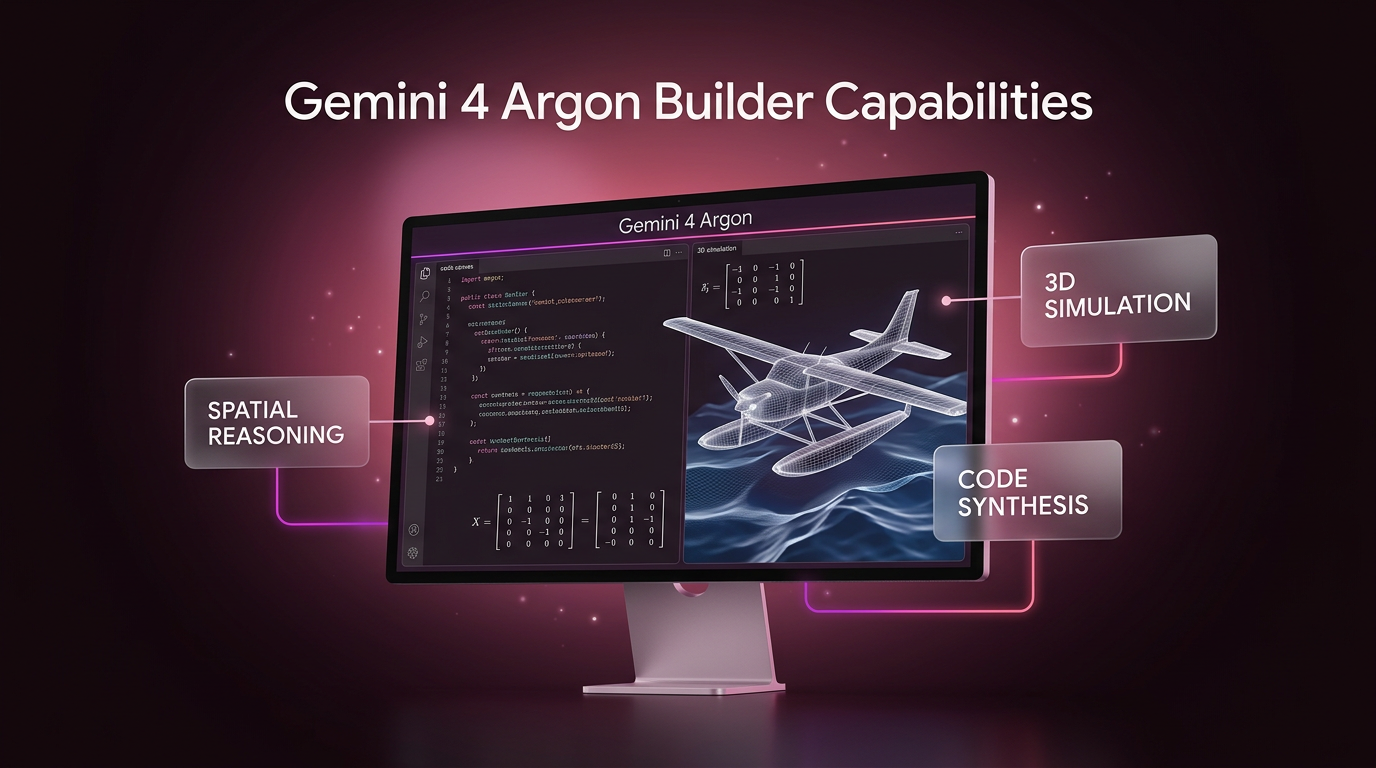
Key areas emphasized in the release include spatial reasoning, mathematical precision, and visual coding. Rather than relying entirely on external physics engines or manual parameter tuning, the model can interpret spatial relationships directly from prompts or source assets. It generates mathematical coordinates, establishes rendering parameters, and synchronizes dynamic assets without losing tracking data between steps.
- Spatial computation for complex geometry, environmental lighting, and surface interactions.
- Cross-domain data parsing, turning unstructured sensor feeds into structured visual systems.
- Multi-step code generation that coordinates separate libraries such as Three.js, Blender scripts, and browser runtimes.
- Image-to-asset reconstruction that extracts dimensional components from static 2D references.
- Low-latency state management for real-time multiplayer browser environments.
These capabilities allow engineers to compress development cycles that previously required multiple disparate specialists. By sustaining coherent logic across different libraries, Gemini 4 Argon allows a single creator to write procedural shaders, parse streaming APIs, and structure interactive game physics within one unified prompting workflow.
Five Community Builds Built on Gemini 4 Argon
Following the broader rollout, independent software creators demonstrated practical applications built with the model. These five implementations highlight how the model handles distinct technical challenges ranging from physics rendering to real-time telemetry mapping.
1. Physics and Water Interaction Simulation
A builder named Lumina (@LuminaBench on X) tested the model on complex fluid dynamics and object physics. Lumina used the model to generate a real-time 3D simulation of a seaplane floating and taxiing on moving water. Gemini 4 Argon coordinated realistic surface lighting, water movement, and hull reflections concurrently. Because the system maintained precision across multiple calculation steps, the plane responded naturally to the dynamic displacement of the water surface beneath it.
2. Global Wildfire and Tectonic Shockwave Mapping
Alex Patrascu (@maxescu on X) connected Gemini 4 Argon to live telemetry inside Google Antigravity. Patrascu ingested streaming satellite data from NASA detailing global wildfire outbreaks and combined it with live seismic feeds from the United States Geological Survey. Argon parsed the raw unstructured coordinates, cross-referenced the geographic timestamps, and rendered an interactive 3D globe. The completed build projects animated seismic shockwaves and thermal hotspot clusters directly onto the planetary model in real time.
3. Interactive Jet Engine Assembly
Ashutosh Shrivastava (@ai_for_success on X) paired Gemini 4 Argon with Blender and Three.js to construct an interactive digital twin of a high-bypass turbofan jet engine. Shrivastava tasked the model with structuring accurate individual parts, mechanical specifications, and live diagnostic readouts. The model sustained the extended instructions needed to configure individual turbine blades, internal housings, and airflow conduits, before assembling them into an interactive, explorable 3D assembly.
4. Interactive 3D Model from a Static Image
The Bugged Dev (@thebuggeddev on X) evaluated the model’s spatial extraction capabilities using a single flat image. The creator provided Gemini 4 Argon with an individual photograph of a Gothic Victorian carriage. The model interpreted the perspective, reconstructed the concealed geometry, and exported a functional 3D rendering. The final experience featured opening doors, operational window frames, dynamic flickering oil lamps, and a reactive undercarriage suspension that moved over road obstacles.
5. Real-Time Multiplayer Browser Game
Creator Chong-U (@chongdashu on X) relied on Gemini 4 Argon to develop Backyard Rascals, a browser-based capture-the-flag game. The build features cartoon animal characters running across an obstacle course to steal an opponent’s flag. The model wrote the multiplayer state management, collision detection routines, and character actions, enabling simultaneous users to run, bump, whack opponents, and cheer during live matches.
Deployment Channels and Platform Availability
Google has made the new model accessible across enterprise and consumer tiers. Developers can connect directly to Gemini 4 Argon through the official API available in Google AI Studio and the Gemini developer platform. This route provides direct access for teams seeking to integrate the model’s spatial reasoning and code generation into custom production pipelines.
For direct interface usage, subscribers with Google AI Ultra and paid Pro tiers can access Argon inside Google Antigravity. It is also available to Ultra and Pro members within the primary Gemini web application and through AI Mode in Google Search. This multi-surface release gives builders several entry points, whether they need raw API endpoints for custom software or workspace interfaces for rapid prototyping.
Frequently Asked Questions
How can developers access Gemini 4 Argon?
Developers can access Gemini 4 Argon through the Google AI Studio API and the broader Gemini developer platform. Paid Pro and Google AI Ultra subscribers can also interact with the model directly within Google Antigravity, the consumer Gemini web app, and AI Mode in Search.
Does Gemini 4 Argon support real-time data inputs?
Yes, Gemini 4 Argon can process live data feeds when integrated with external application programming interfaces. For example, community builder Alex Patrascu connected the model to live NASA wildfire feeds and USGS seismic streams to render dynamic telemetry on an interactive globe.
What programming libraries work best with the model for 3D builds?
Demonstrations from the developer community show high compatibility with WebGL frameworks like Three.js, alongside modeling software such as Blender. The model generates both the mathematical coordinates and the procedural JavaScript required to manipulate assets in real-time environments.
Putting These Capabilities to Work in Client Builds
In client automation systems, raw model power matters less than reliability during multi-step execution. When building AI automation workflows, systems often break down when moving data between external APIs, analytical parsers, and customer databases. A model that reliably retains instructions across multiple sub-tasks reduces pipeline errors in complex operations.
Wasif builds custom automation workflows, CRM integrations, and web applications for businesses that want practical operational improvements. For organisations evaluating advanced logic for backend workflows or bespoke interfaces, integrating models like Gemini 4 Argon offers concrete advantages in data processing and structured code execution. Wasif reviews these updates to determine which toolsets provide tangible speed and stability gains for production client environments.
If you want to review how modern AI models can streamline your business workflows, connect through the Wasif Ahmed contact page to discuss your project requirements.