Claude on Google Cloud is now generally available through an Anthropic managed deployment model. This release gives teams the complete set of Claude Platform features while keeping billing and security controls inside their existing Google Cloud environments. According to the update announced on the Anthropic blog, organizations can now use Claude with Google Cloud IAM credentials, draw down committed cloud spend, and receive new capabilities on day zero.
Previously, Google Cloud customers could only access Claude via a Google managed setup where Google served as the legal data processor. While that option remains available for enterprises with strict regional compliance mandates, this new Anthropic managed option removes the feature delays that often occur with third-party cloud marketplace integrations. Teams can now run current models like Claude Opus 5.5, Sonnet 5.5, Haiku 5.5, and Fable 5.1 with immediate access to beta tools as soon as they launch.
Key Architecture Updates for Claude on Google Cloud
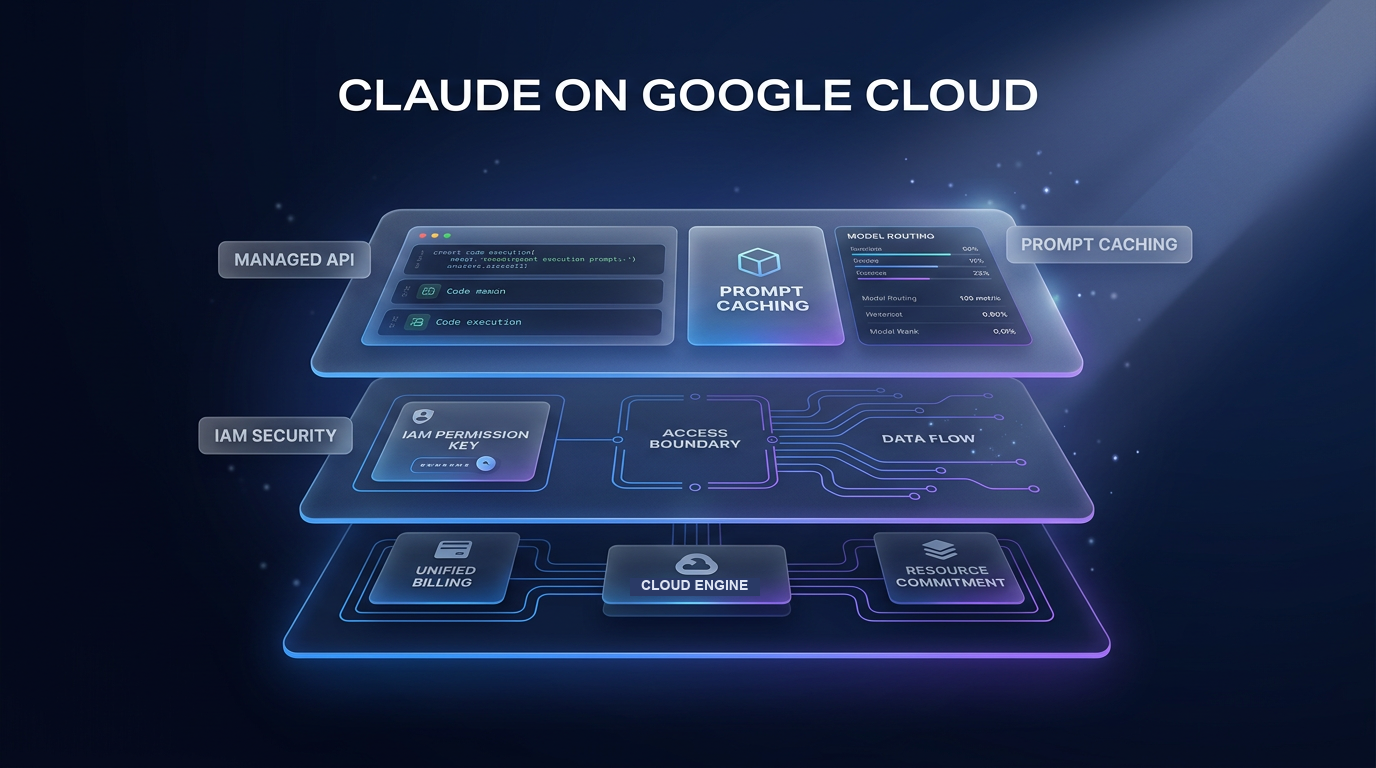
The Anthropic managed release changes how engineering teams authenticate and pay for their model usage. Rather than maintaining separate billing accounts and custom API keys across independent platforms, developers can route traffic using their existing Google Cloud IAM credentials. This setup allows engineering leads to enforce project boundaries, service account roles, and existing permission policies without rewriting access control layers.
Billing flows directly into a single Google Cloud invoice. For companies with multi-year spend agreements, model usage directly retires their Google Cloud financial commitments. Claude Models on Google Cloud under the Anthropic managed offering is currently operational across US and Global endpoints, giving technical teams flexibility in where their inference workloads run.
Alongside authentication updates, users gain direct access to the Claude Console. This development environment lets teams build prompts, run evaluations, configure agent behaviors, monitor token consumption, and manage workspace security across distinct projects. For engineering teams evaluating agentic AI systems, having a dedicated console alongside unified cloud billing simplifies operational oversight and debugging.
Complete Feature Parity and Agentic Capabilities
The primary advantage of this deployment path is immediate feature availability. In past cloud marketplace arrangements, secondary platform features lagged behind primary releases. Under the Anthropic managed configuration, new tools and public betas launch on Google Cloud on the exact day they release on the native Anthropic platform.
Teams using Claude on Google Cloud now have access to a broad set of agent building blocks:
- Claude Managed Agents in public beta for running persistent, long-duration workflows without managing server infrastructure.
- Code execution endpoints that allow Claude to run Python scripts, analyze datasets, and create visualizations directly inside an API exchange.
- Computer use capabilities that let models navigate web interfaces and desktop software to handle multi-step tasks.
- Agent skills to standardize repeatable workflows, along with the advisor strategy beta for multi-agent oversight.
- Knowledge grounding tools including the Files API, document citations, web search, web fetch, and the beta Model Context Protocol connector.
- Cost controls including prompt caching and asynchronous batch processing to control inference budgets.
The release also brings Fast Mode on Claude Opus 5.5 into general availability for customers using the Anthropic managed service. Fast Mode targets speed-sensitive workloads by accelerating output token generation by up to 2.5 times compared to standard generation speeds. Pricing for Fast Mode on Opus 5.5 is set at $8 per million input tokens and $40 per million output tokens, giving developers a direct path to reduce interactive latency in customer-facing assistants and live debugging workflows.
Early enterprise adopters have highlighted the operational value of native feature parity. Engineering teams building enterprise AI assistants require rapid access to new platform capabilities without rewriting identity boundaries. Similarly, platforms relying on high-volume prompt caching can maintain their cost efficiency while consolidating billing directly through their existing cloud commitment.
Choosing Between the Two Claude on Google Cloud Options
Google Cloud customers now have two distinct paths for deploying Claude, each serving different technical and organizational requirements. Understanding how the data governance and service layers differ is critical when planning infrastructure for production systems.
The Anthropic managed offering is built for teams that require instant access to the newest platform features, unified Google Cloud IAM credentials, and direct parity with Anthropic API releases. In this operational model, Anthropic operates the service and acts as the legal data processor. This route suits teams building autonomous agents and conversational products that rely heavily on betas like the Model Context Protocol connector, Claude Managed Agents, or advisor strategies.
By contrast, the Google managed path remains the intended choice for organizations where Google must act as the legal data processor. Companies bound by strict geographical data residency or internal regulatory constraints often choose this route. The Google managed tier also supports native platform protections, including Google Cloud Model Armor and Agent Engine, which integrate into specific enterprise security frameworks.
Practical Setup Steps and Financial Planning
Teams planning to transition to the new managed service should review their current contract structures before sending production traffic. Existing negotiated discounts between Anthropic or Google Cloud require account coordination before activation. Anthropic specifies that custom enterprise discounts cannot be applied retroactively to previously executed API calls.
For companies relying on structured pipelines, incorporating Claude on Google Cloud allows technical leads to modernize internal automation. Many businesses combine foundational model calls with structured workflow runners or custom backend scripts. Establishing reliable prompt caching early in the development cycle is especially valuable, as repeated system prompts and document contexts can otherwise inflate token spend across high-frequency pipelines.
Security teams should also review service account delegation. Because the integration connects with native Google Cloud IAM, administrators can restrict endpoint access by VPC perimeter or specific service roles, preventing credential leakage while keeping monitoring within their Google Cloud dashboard.
Where This Fits in Production System Architecture
When Wasif designs enterprise automation workflows and backend data pipelines, unified security and predictable billing are constant priorities. Teams deploying internal assistants or CRM automations often struggle when critical intelligence models reside entirely outside their core cloud security perimeter. Connecting Claude on Google Cloud into existing infrastructure makes enterprise governance and compliance much easier to maintain.
Wasif builds custom workflows that pair high-capacity reasoning models with platforms like Go High Level and automated data pipelines. Having native access to prompt caching and tool-use endpoints within a managed cloud boundary ensures that complex operational tasks execute with low latency and tight data control. For organizations already committed to Google Cloud infrastructure, this update provides a straightforward way to scale autonomous systems without sacrificing security oversight.
Frequently Asked Questions About Claude on Google Cloud
What is the primary difference between the Anthropic managed and Google managed offerings?
The difference comes down to feature access and data processing roles. Under the Anthropic managed deployment of Claude on Google Cloud, Anthropic operates the service and acts as the data processor, giving users same-day access to new features, betas, and the Claude Console. In the Google managed option, Google serves as the legal data processor and offers native integrations like Model Armor and Agent Engine, which benefits organizations with strict regional residency policies.
How does billing work under the Anthropic managed model?
Usage is consolidated into a single Google Cloud invoice. Consumption draws down an organization’s existing Google Cloud financial spend commitments, eliminating the need to maintain a separate billing relationship or external credit card for Anthropic API usage.
Which Claude models can teams access through this deployment?
Teams can deploy Claude Fable 5.1, Opus 5.5, Sonnet 5.5, and Haiku 5.5. New models and public beta capabilities ship on the Anthropic managed offering as soon as they launch on the native Claude Platform.
Deploying Claude on Google Cloud provides an effective bridge between modern autonomous capabilities and enterprise infrastructure governance, allowing organizations to scale production systems without friction.
If you are planning to modernize your operations or deploy automated intelligence workflows, explore how Wasif can help your team by visiting the contact page.