The ChatGPT Work rollout is officially underway at Uber, marking the ride-hailing company’s first company-wide deployment of an agentic system designed for knowledge work. As announced on the OpenAI blog on October 22, 2026, the initiative expands access to ChatGPT Work across more than 30,000 global staff members inside ChatGPT Enterprise. The expansion moves beyond an initial pilot involving 1,000 employees to bring active task automation directly into daily corporate operations.
Enterprise adoption of autonomous systems has historically moved in cautious phases. The ChatGPT Work rollout signals an operational pivot where autonomous software agents shift from isolated test benches into standard office environments. Teams at Uber can now hand off multi-step research, document preparation, and cross-application duties directly to digital agents.
The Key Changes in the ChatGPT Work Rollout
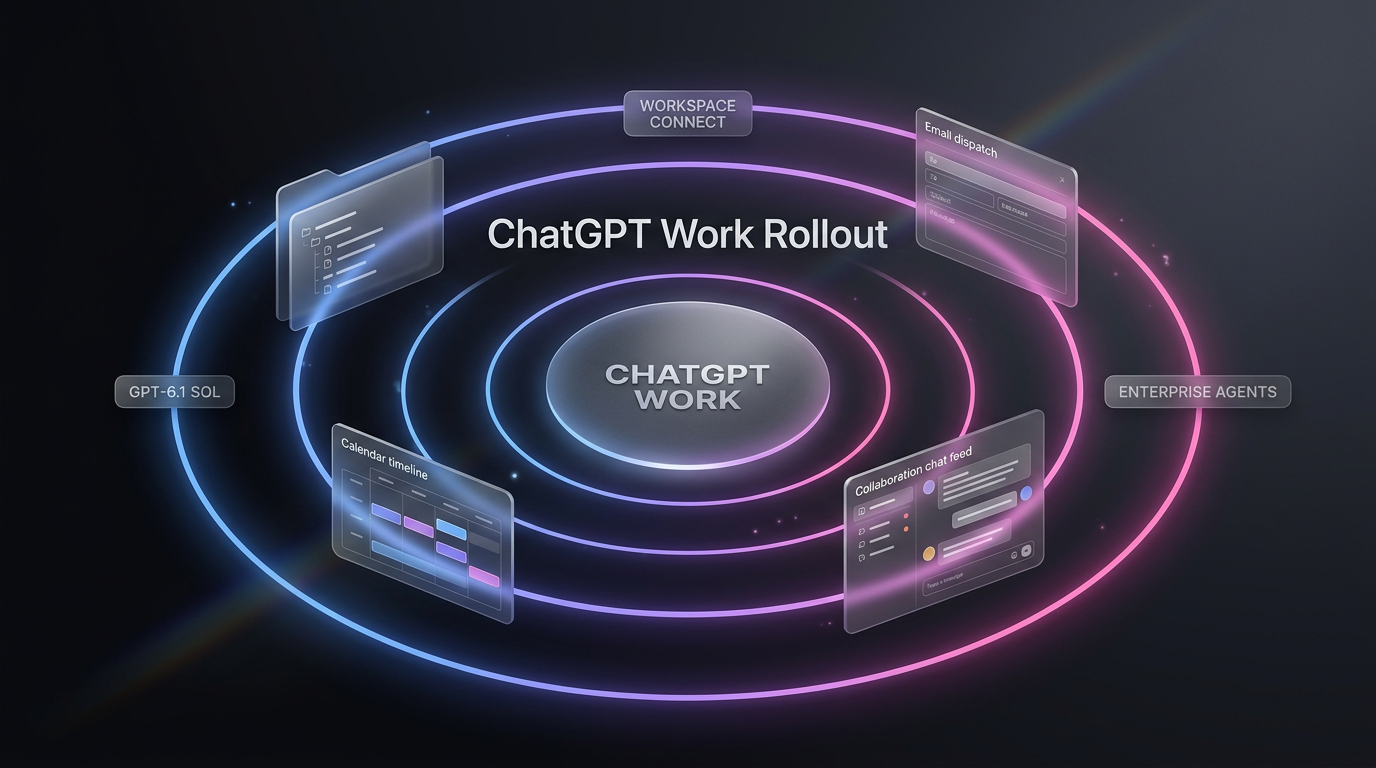
The core update centres on turning ChatGPT Enterprise into an execution-oriented workspace rather than a conversational prompt box. Through the ChatGPT Work rollout, staff can connect agentic workflows directly to core software applications they touch every day. These integrations cover Google Drive, Gmail, Google Calendar, and Slack.
Instead of copying text between browser tabs, employees use agents to synthesize research, create meeting briefs, compile presentations, and analyze data across connected storage. Uber is deploying OpenAI models like GPT-6.1 Sol as the default capability inside ChatGPT Work. The organization selected GPT-6.1 Sol to balance frontier performance with cost efficiency during heavy daily usage across thousands of concurrent sessions.
Multimodal capabilities also accompany the deployment. Workers across operations, marketing, product, and finance can use image generation and voice tools depending on the specific project. Software engineers at Uber will concurrently maintain their use of Codex to generate code and manage development pipelines alongside the broader agent rollouts.
Why the ChatGPT Work Rollout Matters to Operations
Many organizations run automated scripts, but autonomous task execution across different departmental tools presents distinct operational challenges. The ChatGPT Work rollout addresses standard knowledge bottlenecks by combining permissions, shared skills, and third-party tools under unified administrative control. Uber is supporting staff through an internal AI skills library, approved software connectors, and dedicated training programs.
CTO Praveen Neppalli Naga noted that Uber aims to equip staff across every discipline to solve problems directly as builders. When corporate teams gain direct access to autonomous agents, routine admin overhead decreases. For example, a project manager preparing a weekly sync can instruct the agent to inspect a shared folder in Google Drive, identify recent file updates, cross-reference calendar notes, and post an organized summary into a dedicated Slack channel.
President and co-founder of OpenAI Greg Brockman stated that bringing ChatGPT Work to tens of thousands of staff members allows teams across Uber to draw on frontier models and agents to manage complex duties. This structural approach mirrors broader shifts toward structured Agentic AI Systems & AI Workforce design, where agents act across systems rather than waiting passively for static prompts.
Core Features Powering the Enterprise Rollout
The scale of this implementation relies on specific technical foundations designed to maintain consistency across tens of thousands of global workers. Key elements include:
- Central model distribution: GPT-6.1 Sol acts as the primary default engine, providing high-speed reasoning while controlling operational computational overhead.
- Integrated workspace tools: Direct access to Google Calendar, Gmail, Google Drive, and Slack ensures that tasks do not stall at application boundaries.
- Multimodal execution: Integrated voice interfaces and image generation support non-technical departments such as marketing and operations.
- Governance structures: An internal AI skills library and verified permission frameworks keep integrations compliant with internal corporate guidelines.
- Developer continuity: Dedicated engineering teams maintain separate, specialized pipelines using Codex to build and test software.
Practical Implications for Enterprise Teams
Deploying agent software to 30,000 team members provides real insight into how large companies handle governance. Without structured oversight, broad employee access to generative tools often results in inconsistent outputs and unmonitored tool sprawl. By grounding the ChatGPT Work rollout inside a vetted skills repository, Uber establishes guardrails around which tools agents can access.
The shift also changes daily expectations for routine administrative work. Knowledge workers spend significant weekly hours gathering status updates, summarizing threads, and organizing documents. When an agent securely completes those steps, knowledge workers spend more time evaluating conclusions rather than compiling raw data. This represents a tangible step toward applied AI automation where autonomous tools handle routine cross-platform handoffs.
Organizations observing this transition will need to monitor how team training and skills libraries develop over time. A common barrier in large software rollouts is lack of employee adoption. Uber is actively deploying dedicated employee training alongside the software update to ensure staff know how to instruct agents effectively and verify their outputs.
Grounded Outlook for Agentic Knowledge Work
The initial pilot of 1,000 employees demonstrated that agent systems could take on multi-step instructions reliably enough to warrant widespread deployment. Uber and OpenAI have indicated that they intend to share further findings regarding user adoption rates, specific department use cases, and measurable business outcomes as the project expands.
For modern businesses, the lesson from this deployment is that agentic systems require structured data access and clear permissions to succeed. Giving an agent access to Slack or Google Workspace requires clear authorization layers so confidential files remain protected. As more companies evaluate agent software, centralized skills libraries and role-based access rules will become standard deployment requirements.
How Real Teams Can Structure Agent Deployments
In client implementations, Wasif focuses on establishing clear boundaries before introducing autonomous actions into production systems. While enterprise companies deploy proprietary software platforms, mid-market businesses often achieve similar results by combining reliable automation frameworks with focused tool permissions.
Wasif builds custom workflows that link communications channels, cloud documents, and customer records so actions occur reliably without constant human intervention. Whether connecting Make.com scenarios to generative models or setting up managed CRM workflows, the core requirement remains identical: establishing clear validation steps so automated agents deliver accurate work every time.
If you want to evaluate how practical agent workflows and structured automation can support your business operations, reach out to Wasif Ahmed to discuss your architecture.