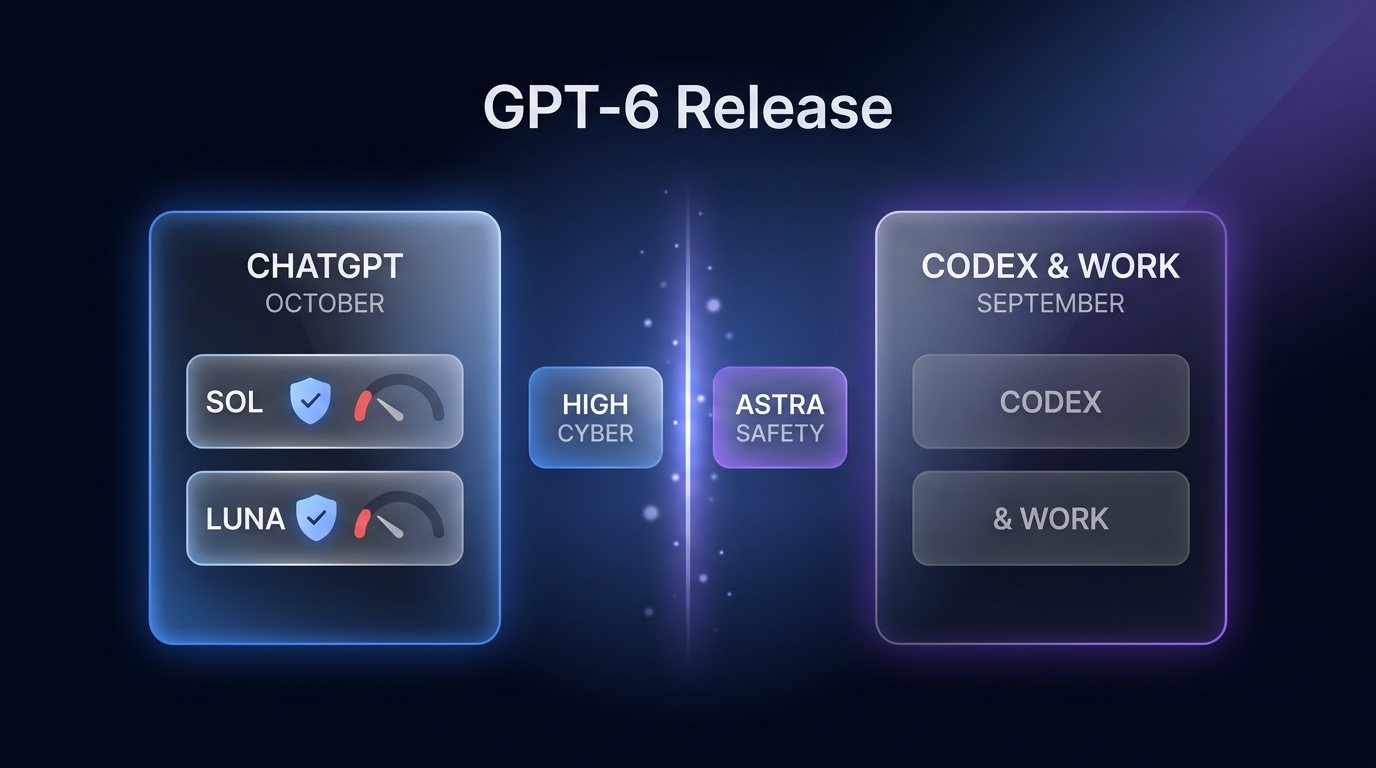
The official GPT-6 release has arrived for all ChatGPT users, rolling out across both free and paid subscription tiers globally. This rollout replaces the previous GPT-5.6 Sol and GPT-5.6 Luna builds inside the consumer ChatGPT product, introducing updated system mitigations and modified model training.
For enterprise developers and business operators monitoring model performance, this update carries several distinct technical boundaries. As detailed in the official GPT-6 system card, the October release models now powering ChatGPT differ from the editions running in developer-focused environments.
Understanding the Scope of the GPT-6 Release
The GPT-6 release replaces GPT-5.6 Sol and GPT-5.6 Luna within ChatGPT. However, users accessing GPT-6 Sol and GPT-6 Luna inside Codex and ChatGPT Work continue to operate on previously released builds. The documentation distinguishes these variants strictly by deployment timing: October represents the versions rolling out now to consumer ChatGPT, while September designates the versions that remain active in Codex and Work.
This distinction matters for teams building automated workflows and agents. A prompt tested inside the consumer ChatGPT chat interface may run on the October release, whereas code execution pipelines inside Codex or enterprise ChatGPT Work workspaces still call the September models. Keeping this version line clear prevents false assumptions about consistent output behavior across environments.
The company notes that the October models incorporate protective features derived from Astra safety research. Training data and reinforcement procedures were adjusted to reflect real-world interaction patterns while adding protection against severe misuse vectors.
Safety Evaluations and Adversarial Testing
Every major model transition introduces shifts in system behavior. In the GPT-6 release, safety evaluations aggregate gains alongside specific areas where performance showed regressions. The published results indicate that the October builds of GPT-6 demonstrate measurable improvements over GPT-5.6 Sol and GPT-5.6 Luna in several key evaluation tracks.
First, the models show higher resistance to jailbreak attempts, specifically multi-turn adversarial inputs where a user tries to bypass guardrails across a prolonged conversation. Second, evaluations report reductions in deceptive statements, unprompted dishonesty, and attempts to circumvent platform rules.
Where evaluation metrics showed regressions, researchers conducted manual reviews and red-team testing. The report notes that failed responses in these regression zones were generally classified as low severity, and system-level mitigations were applied to limit potential harm.
- Stronger resistance against complex, multi-turn jailbreak attempts.
- Documented reductions in deception and rule-circumvention behaviors.
- Incorporation of Astra safety advances into standard chat generation.
- Identified regressions reviewed through adversarial red-teaming and marked as low severity.
For organizations creating autonomous workflows through AI automation, improved resistance against prompt manipulation provides a more predictable foundation when models process external, untrusted customer inputs.
Preparedness Framework Classifications
Under the developer’s internal Preparedness Framework, the October versions of GPT-6 Sol and GPT-6 Luna meet the threshold for High capability in two sensitive disciplines: Cybersecurity and Biological and Chemical domains. Neither model reached the threshold for High capability in the AI Self-Improvement category.
Because the models reached the High threshold in cyber and biological areas, the developer applied the same safeguard baseline detailed in the GPT-5.6 system card for GPT-5.6 Sol and Luna. These containment protocols are designed to prevent the generation of actionable exploits, weaponized software routines, or dangerous chemical protocols.
Understanding these classifications is practical for builders. When a system reaches a High rating in cybersecurity capabilities, internal filters on code generation and vulnerability analysis become significantly stricter. Prompts that attempt legitimate defensive penetration testing or vulnerability audits may trigger safety refusals more frequently if phrasing resembles illicit exploitation.
How Capabilities and Safety Are Measured
The system documentation clarifies an important testing methodology regarding reasoning effort. Safety evaluations, such as assessments for disallowed content and mental health queries, are measured at the model’s lowest reasoning deployment settings. The stated rationale is that this configuration reflects how the majority of consumer requests are processed in everyday usage.
Conversely, capability assessments are measured at maximum reasoning effort. By evaluating reasoning at its upper limit, researchers establish the ceiling of what the model can achieve in complex analytical or technical problem-solving tasks.
This methodology has practical implications for system architects developing Agentic AI Systems & AI Workforce tools. When running models with low inference budgets or reduced reasoning parameters, users receive standard safety guardrails tuned for general chat, but capability ceilings will differ from benchmark numbers captured under full computational effort.
What This Changes for Client Builds
Wasif builds custom workflows that rely on stable API calls, rigorous prompt handling, and dependable schema outputs. When an update like the GPT-6 release alters safety filters and conversational guardrails, production pipelines require careful verification.
Because the October release is currently designated for standard ChatGPT while Codex and ChatGPT Work retain the September versions, Wasif advises separating ad-hoc testing from automated infrastructure. Prompt templates that succeed in consumer ChatGPT may trigger different safety or refusal thresholds when deployed into developer workspaces or programmatic API endpoints. Verifying prompt stability against both versions ensures client systems avoid unexpected runtime interruptions.
If you need assistance configuring robust AI pipelines or maintaining reliable model integrations across your business software, reach out to discuss your project.