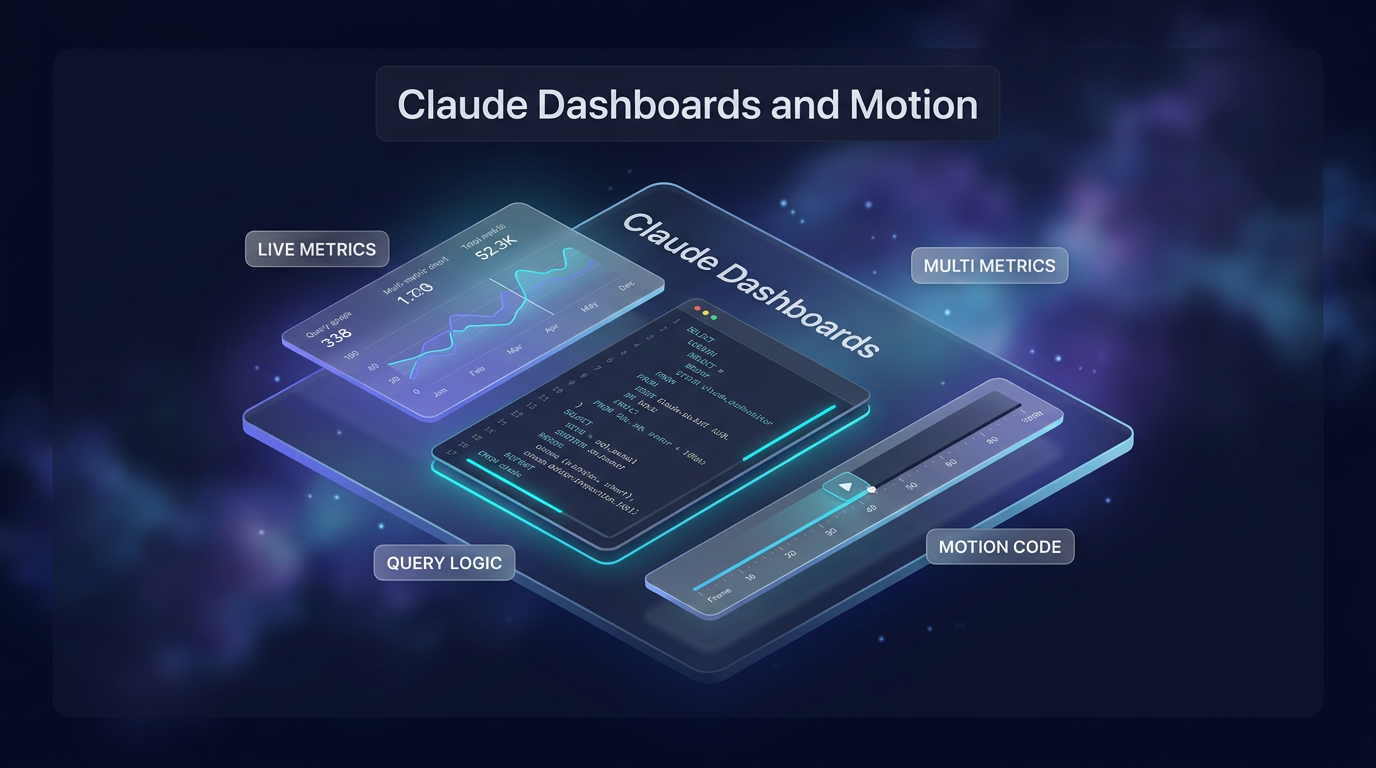
Claude Dashboards is now available in beta on paid accounts, introducing direct connections between conversational workspaces and production databases. Anthropic announced the rollout in an official update covering Dashboards and Motion, expanding how teams inspect live metrics and communicate visual ideas. Alongside Dashboards, the company released Claude Motion in beta for Team and Enterprise tiers, while graduating Docs, Slides, and Design out of beta across all subscription levels.
For operators who monitor performance indicators, accessing numbers usually involves submitting tickets to engineering teams or writing manual SQL queries. Claude Dashboards addresses that lag by letting team members ask questions in plain language and receive real-time charts linked directly to warehouse records. Because each chart reveals the underlying query, business users can verify the calculation before making operational decisions.
What Changed with Claude Dashboards and Motion
The primary change centers on direct data platform connectivity. Claude Dashboards connects directly to cloud data warehouses including Amazon Redshift, Google BigQuery, ClickHouse, Databricks, and Snowflake. It also supports CRM connectors such as Salesforce. Rather than generating hypothetical illustrations or static tables, the system reads real database schemas and populates charts from actual business records.
Every chart created inside Claude Dashboards indicates when the underlying data was last refreshed. Users can click on specific numbers to inspect the raw query, ensuring data governance teams can audit logic for revenue, user signups, or conversion rates. Claude Dashboards works alongside dedicated business intelligence platforms. When an operational question requires deeper statistical modeling, users can transfer the work into tools like Amplitude, Grafana, Hex, Mixpanel, Omni, Perplexity, PostHog, or Sigma, with integrations for Databricks Genie, Looker, monday.com, and Tableau planned for later releases.
Visual Storytelling with Claude Motion
Claude Motion handles presentation assets by turning written prompts, documents, and data into short animated visual explainers. Operating on Team and Enterprise plans, the tool writes explicit animation code rather than relying on generative video diffusion models. This architectural choice means the output contains no synthetic humans or simulated video clips.
Because Claude Motion builds animations programmatically through code, teams can edit text, labels, geometry, and timing directly in the editor. Once refined, users can download the final asset as an MP4 file. The tool also supports export workflows into specialized software including Adobe, Descript, HeyGen, Higgsfield, invideo, Luma AI, and Runway, with Canva and Captions integrations announced as coming soon.
Docs, Slides, and Design Graduate from Beta
Beyond the beta releases, Anthropic removed the beta designation from Docs, Slides, and Design across all tiers, including the Free plan. The company reported that users have generated more than 45 million documents, slide decks, and design layouts since artifacts were first added to chat conversations.
The general release includes structural upgrades designed for business teams and security compliance:
- Support for Customer-Managed Encryption Keys (CMEK) across saved artifacts.
- Administrative governance enabling organizations to select approved artifact templates.
- Real-time collaborative editing between team members and Claude on the same document or slide deck.
- External sharing controls for links outside the organization when permitted by team administrators.
- Direct file exports to PDF, PowerPoint, and editable Google Slides presentations without formatting loss.
- Mobile editing capabilities within the Claude mobile application.
Migration Path for Claude Design
Alongside these additions, Anthropic confirmed that the standalone design workspace at claude.ai/design is being folded directly into standard chat conversations. Starting September 16, design tooling began running within the main conversation view, using active project context, uploaded files, and connectors. The standalone web destination will remain active until December 14, giving teams time to transition assets.
Administrators can trigger a single migration button labeled “Migrate team design systems” on the Artifacts page to transfer organizational brand assets. Existing projects continue to function on the standalone site until it shuts down in December, though standalone chats, comments, and public preview links will expire once the separate site closes.
Practical Implications for Workflow Builders
Connecting analytical databases directly to language models alters how business operators run recurring reporting. Rather than building separate custom query scripts for exploratory questions, operators can review pipeline figures or regional revenue using plain language commands. Because Claude Dashboards exposes the query behind every card, it prevents silent hallucination errors that often occur when language models estimate metrics without direct database verification.
For teams building automated pipelines, combining structured data queries with visual reporting bridges a common operational bottleneck. In larger operational environments, connecting platforms like Salesforce or BigQuery into AI automation pipelines gives staff access to reliable summaries without burdening technical leads. Teams building agentic AI systems can similarly leverage verifiable data queries to validate multi-step project decisions.
Administrative Settings and Availability
Availability varies by feature and subscription level. Claude Dashboards is currently accessible in beta for paid accounts, including Pro, Team, and Enterprise plans. Claude Motion remains restricted in beta to Team and Enterprise workspaces. General artifact features, including Docs, Slides, and Design, are accessible immediately across all plans, including Free.
For Enterprise administrators, Dashboards and Motion are switched off by default. Admins can enable both features inside Organization settings under Artifacts. Docs, Slides, and Design are scheduled to turn on by default on October 15, though administrative teams can enable them earlier if desired.
Putting These Updates to Work
When Wasif designs operations workflows for businesses, data clarity and auditability remain the primary criteria for selecting software. Unverifiable AI summaries introduce operational friction, but the approach in Claude Dashboards provides clear visibility by displaying exact database queries and timestamps alongside charts. Combining verified database metrics with editable code-based animations creates a practical foundation for internal stakeholder reviews.
To explore how automated data workflows and connected business systems can support your operational goals, visit Wasif Ahmed’s contact page to discuss your setup.