The Atlassian OpenAI partnership expanded on October 6, 2026, introducing frontier models into enterprise project tracking and documentation tools. This agreement brings advanced artificial intelligence systems directly into Atlassian products, giving software and product teams more direct ways to turn organizational data into everyday execution.
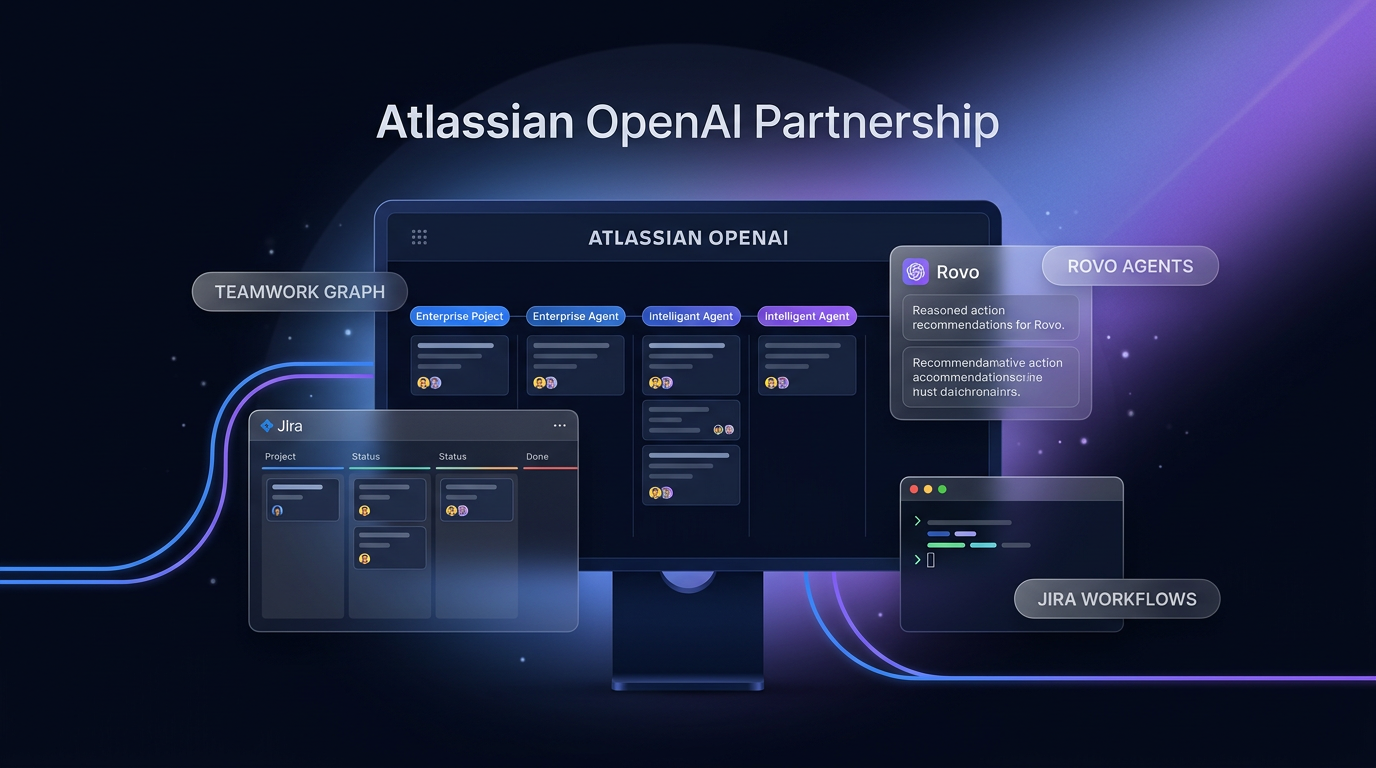
As part of this announcement, Atlassian stated that OpenAI frontier models in the GPT-6 family, including GPT-6 Astra and the GPT-5.6 series, will run across its cloud infrastructure. The collaboration integrates these language models with Atlassian Rovo and the Teamwork Graph context layer, connecting tickets, documents, and project goals across teams.
The expanded agreement builds on a relationship that initially started in 2023. Over the past three years, both companies have tested how generative models and natural language interfaces function inside software engineering pipelines. This renewed commitment deepens that technical integration across core Atlassian cloud systems.
How the Atlassian OpenAI partnership Powers Teamwork Graph
At the center of this integration sits the Teamwork Graph, an enterprise context architecture developed by Atlassian to map the relationships between people, projects, decisions, and documentation. The Atlassian OpenAI partnership uses this structural data to give AI models direct grounding in an organization’s actual operating history.
Without structured context, language models struggle to answer operational questions accurately. They often generate plausible statements that lack alignment with real sprint schedules or technical specifications. By combining OpenAI reasoning capabilities with the Teamwork Graph, Rovo can inspect interconnected work records and deliver grounded answers.
For example, a product manager preparing for an upcoming product launch can query Rovo about schedule health. Drawing directly on the Teamwork Graph, Rovo connects Jira tickets, Confluence documents, and active team discussions. The system identifies unresolved engineering blockers, flags missed milestones, and surfaces critical technical decisions that need attention. OpenAI models process this raw project data into a clear assessment of launch readiness, allowing teams to act quickly on operational bottlenecks.
The agreement also expands internal technical usage between both organizations. According to the announcement, more than 3,000 Atlassian developers actively employ Codex across their development terminals, integrated development environments, and code review routines. Codex users access relevant work items and technical documentation directly through Atlassian plugins powered by the Teamwork Graph. Concurrently, OpenAI relies on Jira to manage operational workflows and engineering tracking across its own teams.
Expanding Developer Workflows Across ChatGPT and Codex
The collaboration extends outside native Atlassian interfaces through dedicated plugins and command-line interfaces. Through the Atlassian and Teamwork Graph CLI plugins for ChatGPT and Codex, technical staff can query project documentation and pull request statuses directly inside their active prompt terminals, subject to role-based system permissions.
Atlassian also introduced an extension bringing work items from Jira and Confluence directly into ChatGPT and Codex prompts. A pinned Atlassian Home view displays assigned tasks, Bitbucket pull requests, projects, and recent Looms, allowing technical staff to inspect tasks without context switching between browser tabs.
Through the Atlassian OpenAI partnership, engineers can generate code suggestions in their IDE while referencing the exact acceptance criteria defined in Jira. Because the plugin queries the Teamwork Graph, the model receives the required context without forcing developers to manually copy and paste background specifications.
These features connect cleanly with broader Agentic AI Systems & AI Workforce patterns, where specialized agents access existing business tools rather than operating in isolation. When agents are granted secure access to issue trackers and code repositories, they shift from isolated conversational interfaces to functional workflow assistants.
Practical Capabilities for Jira and Confluence Teams
Teams running their core planning inside the Atlassian stack gain several distinct capabilities from these integrated models:
- Automatic synthesis of launch status by correlating linked Jira epics, unresolved tasks, and Confluence release documentation.
- Direct extraction of technical background during IDE coding sessions through Codex plugins linked to the Teamwork Graph.
- Quick retrieval of team ownership and project decisions within ChatGPT without manually searching multiple documentation spaces.
- Unified visibility over assigned tickets, recent pull requests, and project updates within a single terminal or dashboard view.
- Automated identification of stalled dependencies across multiple software teams before those delays disrupt planned delivery milestones.
For organizations evaluating AI automation across development pipelines, having models execute tasks inside existing access controls reduces administrative friction. Security and compliance configurations established in Atlassian administration consoles remain active when models query project records.
Measuring Engineering Velocity with Atlassian DX
A key focus of the ongoing collaboration is keeping humans in direct oversight while delegating operational tracking to automated agents. Under the Atlassian OpenAI partnership, the companies noted they are exploring deeper Jira features to assign tasks directly to AI agents, record automated outcomes, capture team decisions, and monitor task status.
To evaluate whether automated agents genuinely save engineering hours, Atlassian pairs these features with DX, its platform for measuring engineering productivity and cycle time. Engineering managers can track delivery speed, cycle intervals, and developer sentiment, providing quantitative metrics on whether agentic workflows actually reduce delivery bottlenecks.
Measuring engineering impact prevents teams from deploying automated tools that generate low-value code or unnecessary administrative noise. By linking model activity directly to cycle time metrics in Atlassian DX, leadership teams can see whether AI-assisted triage and development translate into measurable throughput improvements.
As detailed in the official announcement published on the OpenAI blog, the agreement prioritizes efficiency and practical execution across joint enterprise customers.
Where This Fits in Real Projects
Wasif builds connected operational systems for businesses, integrating project trackers, customer records, and automated agents. In practical implementation work, raw intelligence is rarely the bottleneck; organizational context is what makes an AI agent reliable. When enterprise platforms anchor frontier models into existing relationship graphs like Jira and Confluence, businesses spend less time writing complex prompt boilerplate and more time automating substantive workflows.
From Wasif’s experience evaluating enterprise tooling, the Atlassian OpenAI partnership demonstrates that AI utility depends heavily on structured data hygiene. When an organization maintains well-organized Jira boards, detailed pull request descriptions, and clear Confluence architecture notes, frontier models can extract signal quickly. Conversely, fragmented documentation produces lower quality agentic responses regardless of how advanced the underlying model may be.
Frequently Asked Questions About the Atlassian OpenAI partnership
What models are included in this expanded agreement?
The collaboration gives Atlassian expanded access to OpenAI frontier models in the GPT-6 family, including GPT-6 Astra, alongside models in the GPT-5.6 series. These models power Rovo and related agentic capabilities across Atlassian Cloud products.
How does Teamwork Graph assist language models?
The Teamwork Graph acts as a context layer that maps connections between staff, open tickets, technical specifications, and project decisions. It provides the relational grounding necessary for models to answer questions accurately without hallucinating organizational facts.
How does this collaboration protect enterprise data permissions?
The Atlassian OpenAI partnership applies existing role-based access controls to all AI queries. When users query Rovo or use Atlassian CLI plugins within ChatGPT and Codex, the system respects workspace permissions, ensuring staff only see project data and documents they are authorized to access.
Can developers interact with Jira outside the web browser?
Yes. Through CLI plugins and extensions for ChatGPT and Codex, developers can view assigned work items, Bitbucket pull requests, and project documentation directly within their terminal or code editor.
Conclusion: Takeaways for Jira, Confluence, and Rovo Teams
The expanded Atlassian OpenAI partnership marks a clear shift toward embedding frontier models directly inside structured operational databases. For teams already committed to Jira, Confluence, and Rovo, this development means AI assistance moves from passive document summarization to active status analysis and task resolution grounded in company data.
Organizations using these platforms should audit their current workspace hygiene. Because Rovo and OpenAI models rely on the Teamwork Graph to infer progress and dependencies, consistent ticket tagging, clear milestone definitions, and up-to-date documentation will directly determine the quality of automated insights your team receives.
Engineering leaders should establish baseline productivity metrics within Atlassian DX before deploying new agentic capabilities broadly. Tracking code review speed, task completion rates, and sprint predictability ensures that automation genuinely benefits developers rather than introducing additional review overhead.
Careful implementation is essential to maximize the value of the Atlassian OpenAI partnership. If you are planning to connect custom AI agents or automated pipelines to your company’s existing workflows, reach out through Wasif’s contact page to discuss your architecture.