Understanding your Opus 5.5 task cost comes down to measuring completed work rather than simply tracking raw token counts. When developers deploy autonomous coding tools, they do not set out to buy millions of tokens; they aim to solve an issue, refactor an endpoint, or run a test suite. The actual Opus 5.5 task cost is determined by how many attempts the model takes to solve that specific problem.
A recent breakdown published on the Claude blog by Addy Osmani explains how token pricing and agent execution loops interact. In tools like Claude Code, two models with identical token prices can generate wildly different session bills. One model might read code once and patch it, while another reads, fails, checks logs, and tries again. Because every step sends context back to the model, efficiency depends heavily on session structure.
How Model Pricing and Turns Dictate Opus 5.5 Task Cost
In autonomous tools, a task functions as a continuous loop. The model inspects conversation history, triggers a terminal or file tool, processes the output, and repeats until the objective succeeds. Each pass through this loop represents a turn, and each turn resends the entire conversation accumulated up to that stage.
Because previous context is resent repeatedly, turns compound token consumption rapidly. If a task starts with 20,000 tokens of context and grows to 120,000 tokens over 40 turns, the average turn might process around 70,000 tokens. That single task processes roughly 2.8 million input tokens even though the active conversation window never exceeded 120,000 tokens. When evaluating the Opus 5.5 task cost, the cheapest turn is always the turn your workflow avoids.
Completing the exact same task in 25 turns drops input processing down to about 1.75 million tokens. Providing automated testing scripts, build commands, or verification endpoints helps the model spot errors earlier. When an agent can verify its own syntax and runtime output immediately, it avoids wandering down invalid paths that inflate the Opus 5.5 task cost.
Four Variables That Control Session Expenses
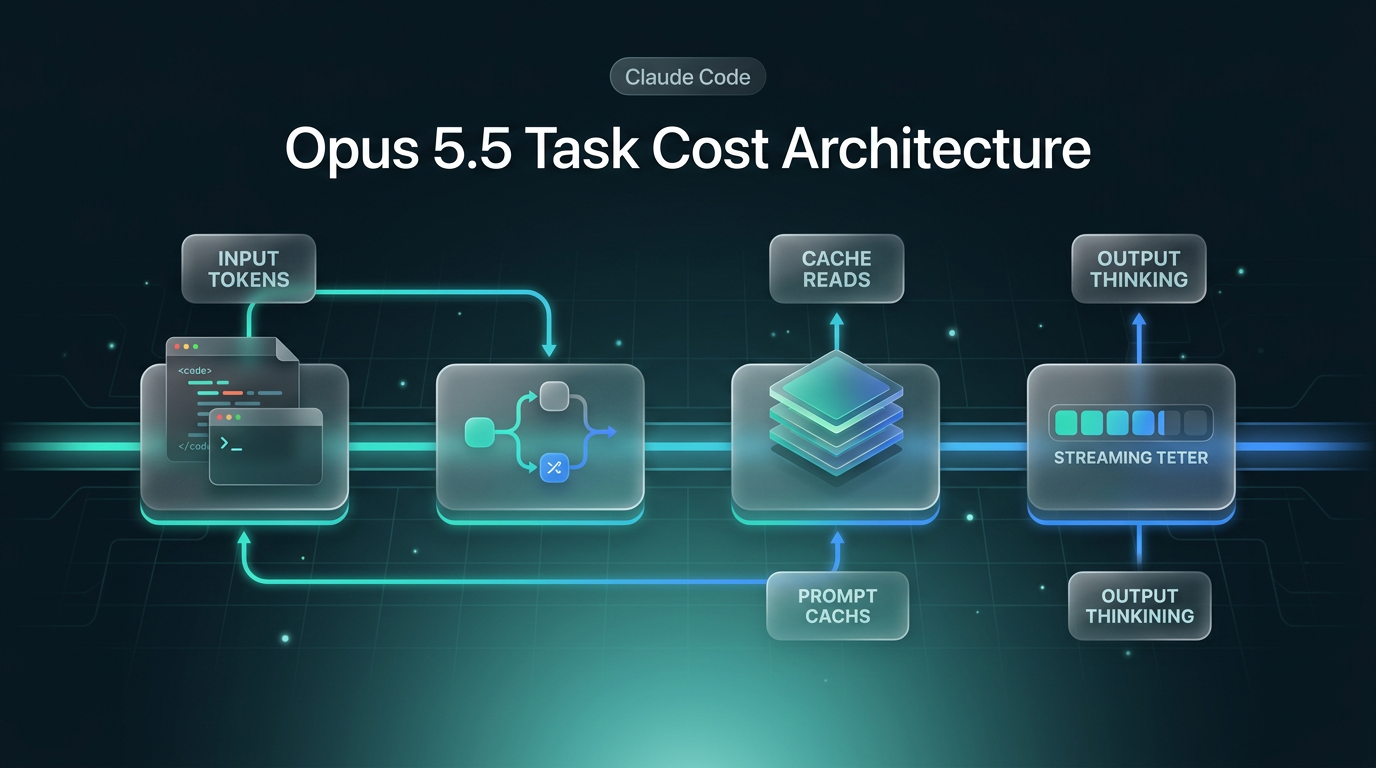
To evaluate what a run will cost on an API key, developers must monitor four distinct components of the execution loop:
- Total Turns: The count of tool calls and replies. Every additional turn resends the entire history accumulated up to that point.
- Cache Reads: Repeated context sent from earlier turns. The API bills prompt cache reads at a small fraction of fresh input prices.
- Output Token Volume: Generated code, text, and internal thinking tokens. Output tokens remain the priciest tier across model tiers.
- Base Model Tier: The baseline API list rates for standard input, cached input, and generated output.
Output tokens carry the highest financial weight. Under list pricing for Opus 5.5, output tokens cost $20 per million, which is five times the fresh input rate of $4 per million tokens. Furthermore, output tokens cost 100 times more than cache reads, which are priced at $0.20 per million. Because internal thinking tokens are billed at the full output rate, deep reasoning loops increase the Opus 5.5 task cost noticeably if left unguided.
Evaluating Opus 5.5 Task Cost Across Development Sessions
The transition from Opus 5 to Opus 5.5 introduced two primary adjustments: updated list pricing and changes in task efficiency. API rates for standard input and output decreased by 20 percent compared to Opus 5. More significantly, prompt cache reads dropped by 60 percent, declining from one-tenth of the input rate to one-twentieth.
For developers running extended agentic sessions, this cache discount provides substantial relief. A task processing 2.8 million input tokens with a zero percent cache hit rate would cost $11.20 in input alone. With a 90 percent cache hit rate, that same input volume costs approximately $1.62. If the cache hit rate rises to 96 percent, input expenses drop to roughly $0.99. Prompt caching is the single most effective lever for moderating the Opus 5.5 task cost during long builds.
On standard subscriber plans such as Pro, Max, or Team tiers, these updated economics extend usage limits by about 25 percent. On direct API usage, savings fluctuate based on task structure. Open-ended debugging tasks that rely heavily on cached context can see input savings of up to 60 percent. Conversely, short tasks dominated by extensive reasoning outputs see savings closer to the baseline 20 percent reduction.
Managing Session Efficiency and Token Budgets
Lower base prices reduce the cost per token, but developer habits determine how many tokens an agent consumes. One key mechanism inside Claude Code is the effort setting. Effort dictates how many tokens the model spends on reasoning, conversational responses, and intermediate tool executions.
While reducing effort lowers token usage per turn, it can also cause the model to miss subtle bugs, triggering an unintended retry. In agentic engineering, an extra retry almost always costs more than the tokens saved by lowering model effort. Raising effort or providing structured guidelines keeps the agent focused on finding the right solution during its initial pass.
Developers can inspect these metrics directly by running the /usage command at the conclusion of a Claude Code session. The generated summary displays fresh input tokens, cache reads, and output tokens. Reviewing these figures helps engineers pinpoint whether an elevated Opus 5.5 task cost stems from cache misses, runaway tool loops, or excessive reasoning output.
FAQs
How can I check my current Opus 5.5 task cost in Claude Code?
You can check your session numbers by running the /usage command in your active terminal session. The output provides a structured summary detailing fresh input tokens, cache reads, and total output tokens consumed. Multiplying those values by current API list rates shows your exact Opus 5.5 task cost for that run.
Why do cache reads have such a strong impact on session pricing?
Because autonomous sessions resend previous conversation history on every turn, the vast majority of input data consists of repeated text. On Opus 5.5, cache reads cost $0.20 per million tokens compared to $4.00 per million for fresh input. Maintaining high cache retention prevents repetitive file reading from ballooning your overall bill.
Does extended thinking time increase the total task expense?
Yes, thinking tokens are categorized and billed as standard output tokens. Because output tokens cost $20 per million on Opus 5.5, extensive reasoning loops represent the most expensive part of a session. Balancing effort settings ensures the model thinks deeply enough to avoid retries without generating unnecessary output.
What this changes for client builds
When Wasif designs custom AI automation workflows and deploys agentic AI systems, token economics play a direct role in operational reliability. Lower cache pricing makes multi-step execution loops significantly more predictable for client environments. By structuring system prompts, batching tool calls, and establishing clear verification scripts upfront, Wasif ensures that each autonomous agent operates within strict token budgets while completing tasks on the first pass.
Managing your Opus 5.5 task cost requires the right balance of prompt caching, verification tests, and agent constraints. If you want to build efficient automated workflows for your business, reach out to Wasif Ahmed to discuss your system architecture.