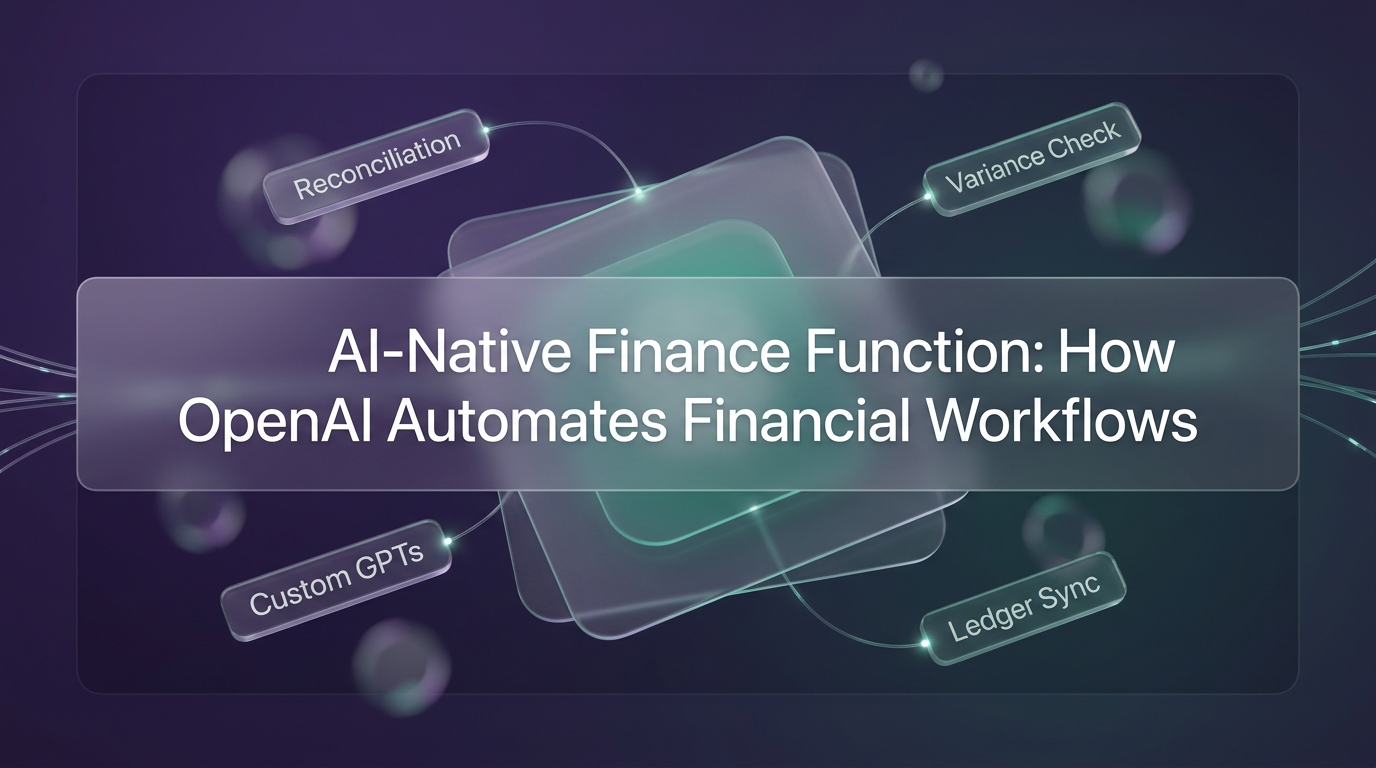
Finance teams spend significant time reconciling data across systems, reviewing complex vendor contracts, and drafting monthly variance reports. Transitioning to an AI-native finance function allows organizations to shift from repetitive manual entries to automated analysis and real-time operational support. As detailed on the OpenAI blog, OpenAI shared how their internal finance operations use ChatGPT, custom GPTs, and API integrations to handle core financial workflows.
Building an AI-native finance function is not about replacing human accountants or financial analysts with fully autonomous models. Instead, it focuses on embedding language models directly into daily tools to accelerate data retrieval, run custom Python scripts for variance checking, and summarize lengthy documentation. Understanding how this structure works helps finance leaders evaluate where automation fits within their existing systems.
Core Components of an AI-Native Finance Function
An effective financial framework combines structured data pipelines with AI capabilities. Finance personnel interact with custom tools that interface with general ledger software, enterprise database systems, and document repositories.
Financial Analysis and Variance Tracking
Traditional budget variance tracking requires pulling balance sheets, comparing period-over-period expenses, and manually identifying anomalies. In an AI-native setup, teams use models equipped with data analysis tools to run Python code against exported accounting tables. The model calculates percentages, highlights unusual fluctuations, and drafts descriptive summaries explaining revenue or expense shifts.
Contract Analysis and Vendor Audits
Reviewing vendor agreements and customer contracts often slows down accounting operations. Custom GPTs trained on internal accounting guidelines process uploaded PDFs to pull key terms, billing schedules, auto-renewal clauses, and payment obligations. This gives finance team members rapid access to structured contract data without reading through lengthy legal text.
Automated Data Workflows
Connecting AI models to internal databases enables direct querying through natural language. Instead of waiting for custom database queries from engineering teams, finance analysts can request specific metrics, such as monthly recurring revenue by geography or historical churn rates. The system executes the underlying query and returns clean data tables alongside brief explanatory summaries.
Key Implementation Principles for Finance Teams
Modernizing finance operations requires clear boundaries around accuracy, governance, and model interaction. OpenAI outlined several core operational guidelines that teams should establish when deploying AI across accounting processes.
- Start with low-risk internal workflows like drafting commentary, categorizing support documentation, or summarizing meeting transcripts.
- Maintain human oversight for all reporting outputs, ensuring experienced analysts verify model calculations against source accounting ledgers.
- Use structured prompts and standard operating procedure templates so different team members receive consistent analysis structures.
- Enforce strict data privacy rules to protect sensitive balance sheet metrics, customer identities, and proprietary pricing structures.
Adopting these practices ensures that models serve as assistants while human operators remain responsible for audit readiness and accurate financial reporting.
Practical Considerations and Limitations
While artificial intelligence accelerates processing times, language models are not statistical engines by default. Raw language generation can make calculation errors if asked to perform direct arithmetic in text format. Effective systems rely on code execution environments, such as Python interpreters, to perform mathematical operations while using the language model to write code and interpret results.
Organization size and infrastructure readiness also determine how quickly a company can adopt an AI-native model. Businesses with fragmented accounting tools, unstandardized chart of accounts, or poor document storage will face friction. Cleaning underlying data structures and setting up clear API connections remain essential prerequisites for any automation initiative.
FAQs
What is an AI-native finance function?
An AI-native finance function is an accounting and financial planning architecture where artificial intelligence tools are embedded into core daily operations. Rather than treating AI as an external add-on, teams use language models and automated code execution to handle contract reviews, data queries, and variance analysis directly within their workflows.
How do finance teams prevent AI model calculation errors?
Finance teams avoid arithmetic errors by using models connected to programmatic code interpreters. Instead of calculating numbers directly through text generation, the model writes and executes code scripts that pull verified data and compute precise math, while human analysts review all final outputs against source records.
Which financial tasks are best suited for AI automation first?
Tasks that involve parsing unstructured text or combining structured reports make ideal starting points. Common initial applications include summarizing long commercial contracts, drafting monthly variance commentary, extracting metadata from receipts, and querying internal database documentation.
Where This Fits in Custom System Builds
Implementing an AI-native structure requires connecting disconnected software platforms into reliable pipelines. Wasif builds custom workflows using platforms like Make.com, connecting databases, CRM software, and document storage systems to eliminate routine manual tasks. Business teams looking to refine operational workflows can explore tailored solutions for AI automation and structured knowledge management with Notion systems.
Building sustainable systems requires matching the right tools to specific business problems while ensuring data security and audit compliance. To discuss building custom automations for your business operations, feel free to reach out directly.